
Catching up with past NDSA Innovation Awards Winners: AIMS Project

The AIMS Project (An Inter-Institutional Model for Stewardship) won a 2012 Innovation Award in the Project category. AIMS participants were recognized for their work developing a framework for stewarding born-digital content and filling the gap between applying standards such as OAIS and the necessary workflows and tools for implementation. The responses to this Q&A were provided by AIMS Project participants from Stanford University, University of Hull, and University of Virginia.

What have you/project teams been doing since receiving an NDSA Innovation Award?

Stanford: Made the digital archivist position continuing (aka “real”), 2+ years ago we added another full-time digital archivist. DLSS & Special Collections collaborated to build our capacity and procedures for acquiring and processing and delivering b-d materials. Received 3 grants to develop our open-source email processing/delivery platform (ePADD project, discovery online). This last has morphed into a new grant application by Harvard & the Univ. of Manchester (w/ us as consultants) to further develop ePADD with more preservation elements.

  • Total born-digital collections acquired since 2012: ~140 accessions and ~250 TB. Born-digital processing projects (processed and in progress) include: Amos Gitai, Dorothy Fadiman, Helen & Newton Harrison, Ted Nelson, New Dimensions, Silicon Genesis, Ruth Asawa, Lourdes Portillo. Other collection acquisition highlights (unprocessed) include: Rebecca Solnit, Lynn Hershman-Leeson, Marlon Riggs, Bob Stein, David Bohrman.
  • Through the born-digital program, Stanford and Virginia are members of the Software Preservation Network and both nodes for the Emulation as a Service Infrastructure (EaaSI) project
  • Stanford DLSS and Special Collections has also worked together with a number of other institutions, including University of Michigan, Duke University, Indiana University, and Princeton University to develop ArcLight, an open source discovery and delivery environment for archives.
  • After Yale, Mark Matienzo served as the Director of Technology for the Digital Public Library of America, and joined Stanford in 2016.

Virginia: We have also made digital preservation and management a priority by making the AIMS position permanent.  We have been fortunate to have both digital archivists and a digital preservation librarian as full time positions.

Hull: Simon Wilson retained responsibility for born-digital archives when he returned to his substantive role as Senior Archivist. Hull retained a high profile across the UK with lots of advocacy for encouraging organisations to take practical steps with digital preservation and proposed that digital archives could be undertaken as a shared-service between multiple archive services.

  • The project gave us a huge boost of confidence with increased advocacy within the institution and lead to the inclusion of born-digital archives as key activity for the library service
  • Colleagues from Hull collaborated with the University of York in a project funded by JISC to look at the suitability of Archivematica to support research data management activity – an opportunity to review and identify similarities and differences between research data and born-digital archives
  • Advocated and secured funding from a range of sources including The National Archives to create an archive for Hull UK City of Culture 2017

What did receiving the NDSA Innovation award in 2012 for AIMS mean to you and/or the project team?

Recognition of work that was critical to the basic operations within archives then and now. This was an international group that came together, identified significant challenges, and developed strategies to address them.

The Award also helped introduce and integrate our work into the larger preservation community. Since 2012, Virginia, for example, has been very active in the NDSA with two staff being elected as Coordinating Committee Chairs and several others being chairs of Interest and Working Groups.

The encouragement of working with others for mutual benefit – a legacy that has remained central to our philosophy. Simon Wilson served on the Digital Preservation Coalition’s Partnership and Sustainability Sub-committee (2016-2019) and contributed to the international curatorial team reviewing NDSA Levels of Digital Preservation

What efforts, advances, or ideas over the last 5-8 years have caught your attention or interest in the area of digital stewardship?

There are too many to note but the rise of Distributed Digital Preservation Services has made significant advances to help many organizations understand and implement digital preservation in a cost effective manner. Software preservation and emulation have also risen to the fore based on much of the scholarly foundations of folks like those at MITH. With the rise of cloud services, emulated environments are now much more standardized than they were in the AIMS years.

The AIMS project was a significant collaborative and technical endeavor. What components of the project do you think have sustained or grown in the digital stewardship community over time? What ideas or work from the project had you hoped would gain traction in the community, but did not quite catch on?

We still live in hope of an integrated hierarchical collections discovery platform and UI. Entities like the DPLA, though one of the largest digital portals in the world, still lack the means to represent hierarchical collections. Much of our archival materials (including born digital) are difficult to discover and access.

What are some priorities or challenges you see for digital stewardship?

Better integration of new technologies such as augmented reality (which includes artificial intelligence and machine learning). There is too much data being produced for humans to manage themselves.

Metadata is still largely siloed by organization and efforts to integrate and iterate metadata is still a major challenge for the library and archives professions.

Digital preservation is still a major challenge for any organization that manages digital content. Much of the funding still comes from collections budgets and a shift to consider preservation akin to infrastructure (like electricity) is the only way we will be able to scale to meet the challenge of preserving the cultural record.

Hull’s experience has been very dependent on project funding and this has seen phases of activity / in-activity which has demonstrated the need for dedicated resource to transition into a service which can be maintained though for the long term it should be considered part of business as usual with all members of the team contributing to this strand of activity.
Catching up with past NDSA Innovation Awards Winners: Mid-Michigan Digital Practitioners

The Mid-Michigan Digital Practitioners (MMDP) won a 2016 Innovation Award in the Organization category. MMDP was recognized for taking an innovative approach to providing support and guidance to the digital preservation community. The responses to this Q&A were provided by Rick Adler, Ed Busch, and Bryan Whitledge.

What have you/the project team been doing since receiving an NDSA Innovation Award?

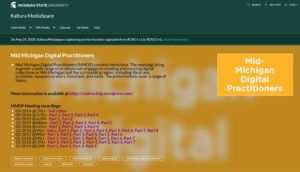
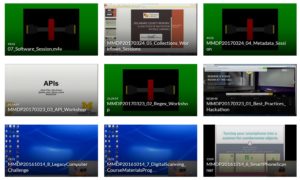
Since receiving the award, we have continued to do what we do best – connecting archivists, librarians, curators, historians, digital humanities experts, and other kindred professionals and students across Michigan. Cultural heritage workers have Screen shot of past Mid-Michigan Digital Practitioners meeting recordings on the MSU Kaltura websitea disposition to share knowledge with others. MMDP is all about sharing knowledge and our constituency is other cultural heritage workers. We connect via our semi-annual meetings (which, thanks to support from the Library of Michigan, and other institutions, have remained free for attendees) and through our listserv list.
In light of the public health emergency, we didn’t hold a spring meeting, but we did hold some virtual check-ins to connect with the MMDP community and share experiences about working from home, dealing with job cuts at our institutions, or returning to the physical workspace. We are looking forward to a fully virtual fall meeting – we think that the Mid-Michigan Digital Practitioners should be able to pull off a great virtual meeting!

One effort we undertook a few years ago was to create a directory of experts. Conferences and meetings are great, and so is a listserv list, but sometimes it is nice for one person to connect with another to speak in-depth about a specific topic. The directory is a list of MMDP members who are willing to share their expertise in different skills and tools with other MMDP members on a one-on-one basis. If someone is looking for someone with policy-writing skills, we’ve got that. If another person needs some help with StoryMapJS, we’ve got that, too. And if another MMDP member needs some help cataloging Cherokee-language materials, there is an expert who can help with that!

We also have an MMDP member who led a pilot grant in Michigan to explore the creation of a statewide digital preservation network. While the MMDP wasn’t part of the grant, we definitely contributed to getting the word out across the state. MMDP members have been at the table every step of the way. The project is now moving to the next phase in creating a digital preservation network and the MMDP is one venue for sharing information about the project with the people most likely to work with it.

What did receiving the NDSA Innovation award in 2016 for MMDP mean to you and/or the project team?

Back when we started, we were an experiment… and it worked. So, the recognition was very meaningful. The award definitely raised our profile outside of Michigan. Hopefully, we have inspired other digital practitioners from around the country to form similar groups. For us, in terms of our Michigan constituency, it reinforced our conviction that what we are doing is valuable and needs to be sustained. Many of our more recent members might not know about the NDSA Innovation award, but the commitment, effort, and spirit that led NDSA to bestow the award upon us are still present in everything we strive to do for our community.

What efforts, advances, or ideas over the last 5-8 years have caught your attention or interest in the area of digital stewardship?

Lowering the barriers to entry—across the board—for digital culture. The barriers are numerous and they aren’t solely financial. The network we mentioned a moment ago is an example of that. Here in Michigan, we have some world-class institutions and they can create homegrown digital preservation environments that are second-to-none. But we also have many small historical societies with historical collections that are just as important, yet they don’t have the tools, the staff, or the finances to allow them to join a major digital-preservation endeavor. MMDP members can help to make digital preservation accessible to institutions of all stripes in Michigan. Our members have varying levels of knowhow about a wide range of digital stewardship topics (advocacy, governance, technical infrastructure skills, developing training materials, etc.), and encouraging them to share what they know expands the potential of cultural heritage professionals around Michigan. Also, we can lean on the Screen shot of past Mid-Michigan Digital Practitioners meeting recordings on the MSU Kaltura websitetechnological tools and skills at those institutions that support the network to make the essential technology of digital preservation accessible to all at a relatively low cost. Hopefully, through a project like this, every library, archives, museum, and historical society in the state can jump in and join the digital preservation effort. And we can get all of those historic photos off of old flash drives!

Another set of barriers that we hope to do away with are the limits to access that surround much of our digital cultural content. We are inspired by all of the various digital efforts across the state and the country. But there are so many fantastic resources that are buried behind paywalls and even more fantastic resources that don’t see the light of day because of the costs associated with making them available. One of our members works with cultural institutions all across the state to help them share their collection metadata through the Digital Public Library of America and a new state portal called Michigan Memories. But that isn’t enough. We also need to find resources for institutions with fantastic content but no means to host it, and help them preserve it or make it accessible with low-cost or free tools. It includes developing K-12 lesson plans and curricula supported by the freely available primary sources—we know how great this content is, but we also have to be aware that many of our target audiences are swamped with information and they might not have time to wade through hundreds of primary sources across several different platforms to develop a the perfect lesson. If we can help with that, students across the state benefit.

The MMDP project provides a great example of a regional collective that represents a wide range of libraries, archives, and museums. What successes or challenges have emerged over the now 7 years of this project?

As with any endeavor, especially one operated solely by volunteers, it can be difficult to sustain. But we have been fortunate to keep this going with new volunteers who rotate on and off our planning team as they have time. Our leadership and governance is truly 100% flexible. This means that our planning team varies in size and composition all the time. We have had planning team members tell us that their other responsibilities in life have picked up, so they have to take a break from MMDP. One year later, they are back on the planning team conference calls and recruiting speakers for our next workshop.

Overall, one of the major successes has been the low-risk opportunity for leadership afforded to our members. Becoming a member of the planning team is as simple as saying, “I would like to help.” From there, the responsibilities are divvied up as needed. When we say “low-risk,” it doesn’t necessarily mean easy or not important. Putting together a conference for 80+ attendees is no simple feat. But we have such a great group and the low-pressure nature of the MMDP really allows a new leader to learn the ins and outs without fear of failure. And, of course, the veteran MMDP members are always available as a safety net to help out as needed. Dozens of cultural heritage workers in Michigan can include a stint with MMDP’s planning team as part of their leadership experience.

We have had another success in that our efforts have been recognized by the Library of Michigan and a few of the professional organizations in Michigan for librarians, archivists, and museum professionals. We have been offered space in the Library of Michigan’s facilities to host our conferences, and we have been able to partner with other professional organizations to host a one-day workshop or a panel on digital stewardship in their conferences. It is great that other organizations and institutions in Michigan recognize that we are a special group and they support us—it allows us to keep serving anyone in Michigan looking for more information about anything and everything related to digital stewardship. 

What are some priorities or challenges you see for digital stewardship?

2020 has definitely brought about many challenges in all aspects of life. Because of the current public health emergency, the resulting budget cuts, and calls for meaningful change in policies related to equity and inclusion, the priorities for digital stewardship will have to change, too. Digital cultural heritage seemed to many people like a nice “extra” thing in their lives. With remote learning, we saw how digital cultural heritage immediately became a necessity for students. And it became a comfort for people looking for a moment of peace—they could explore a museum’s holdings through a public-facing DAM or do some genealogy using digital newspapers. We also need to take stock of the work we are doing and how it can best serve all of our communities, which may mean reorienting some of the priorities we defined before March of 2020.

In light of the seismic upheavals on many fronts, MMDP foresees tough times in trying to execute our priority of continuing to facilitate the sharing of digital stewardship information among our members. With tightening budgets on the horizon and more demands for digital cultural heritage, our members need to be able to get the most out of the limited time and funds that we have. There are so many new tools, new initiatives, and new skills—every one of us could spend a lifetime learning about them (and spend a ton of money in the process). By sharing some information and offering advice like “try this, and avoid that,” we hopefully can save people a lot of time, effort, and money to accomplish their digital stewardship goals.

Another priority will be to continue to lower the barriers to entry to digital stewardship. Michigan is a big state with a wide variety of needs in that realm. MMDP is one helpful piece in a larger puzzle of knowledge-sharing and collaboration that will be needed to ensure that Michigan’s cultural heritage is preserved and made accessible to the people who could use it.

DLF and NDSA Among Finalists for Digital Preservation Awards 2020

We’re thrilled by today’s announcement that projects from both DLF’s Born-Digital Access Working Group (BDAWG) and NDSA are among the finalists for the Digital Preservation Coalition’s (DPC’s) prestigious Digital Preservation Awards 2020.  

One of three finalists for the Software Sustainability Institute Award for Research and Innovation, BDAWG is being recognized for its white paper, Levels of Born-Digital Access (LBDA), a set of benchmarks and practical guidelines supporting access to born-digital materials. LBDA lays out recommendations for accessibility, description, researcher support and discovery, security, and tools that institutions can consider implementing according to their needs, resources, and abilities. Read more about the project.

NDSA’s Levels of Digital Preservation Revision Project (LoDP) is among three finalists for the International Council on Archives (ICA) Award for Collaboration and Cooperation. First released in 2013 as a tiered set of recommendations for how organizations should begin to build or enhance their digital preservation activities, LoDP was updated in 2019 with broad community input. Read more about the project.

Learn more about other finalists and award categories at https://www.dpconline.org/events/digital-preservation-awards/the-finalists, and tune in to the #WeMissiPRES program showcasing “The Best of Digital Preservation in 2020” on Wednesday, Sept. 23.

We congratulate all of the finalists! DPC member voting opens Sept. 16 and goes through Oct. 2. Winners will be announced on World Preservation Day, Nov. 5, as part of an online celebration.

Meet the NDSA Coordinating Committee Candidates for the 2020 Election

This year we have four people who have thrown their hats into the ring to run for the NDSA’s Coordinating Committee (CC), of which we will elect three. The CC is dedicated to ensuring a strategic direction for NDSA, to the advancement of NDSA activities to achieve community goals, and to further communication among digital preservation professionals and NDSA member organizations. The CC is responsible for reviewing and approving NDSA membership applications and publications; updating eligibility standards for membership in the alliance, and other strategic documents; engaging with stakeholders in the community; and working to enroll new members committed to our core mission. The successful candidates will each serve a three year term. 

Each member organization will receive an email invitation to the ballot in the coming weeks. But right now let’s meet the candidates!


  • Elizabeth England, Digital Preservation Specialist, U.S. National Archives and Records Administration 

Elizabeth England is a Digital Preservation Specialist at the U.S. National Archives and Records Administration, where she participates in strategic and operational initiatives and services for the preservation of born-digital and digitized records. She previously was the Digital Archivist and a National Digital Stewardship Resident at Johns Hopkins University. Elizabeth currently serves on the NDSA Communications and Publications group and the DigiPres 2020 Planning Committee. As a past recipient of the NDSA Future Steward award, Elizabeth is interested in advancing NDSA as a resource and community for students and early-career digital stewards, and strengthening the Alliance by increasing representation and inclusion of smaller institutions and colleagues from groups marginalized in the field. Elizabeth is interested in joining the Coordinating Committee to help further realize this work as well as priorities identified in the 2020 Agenda, particularly around the value of digital preservation labor and exploring sustainability models for digital stewardship educational and training programs.


  • Jessica C. Neal, College Archivist, Hampshire College 

Jessica is a Black, queer, millennial archivist and memory worker from Mobile, AL. In addition to her work in academia, Jessica has centered her career on building frameworks around the ethics of documentation that focus on Black-led social movements, art, literature, and struggle throughout the diaspora. Specifically, she is committed to partnering with communities of color to recover, document, and maintain autonomy over the processes in which their narratives and narrative art are preserved and accessed, particularly through the oral history tradition and digital environments. Jessica also has experience working in academic libraries and archives, historical societies, federal government, and private sector organizations. She is currently the College Archivist at Hampshire College, a workshop facilitator with DocNow and a member of NDSA’s DigiPres 2020 Planning Committee.


  • Linda Tadic, Founder/CEO, Digital Bedrock   

Linda has served on the Coordinating Committee for the past two years. During this time, she has promoted the Levels of Digital Preservation to broader communities, in particular to media and entertainment organizations and non-academic institutions. She was a co-presenter on the Levels at the 2019 conference of the Association of Moving Image Archivists (AMIA), of which she is a founding member and former President . As an educator, she incorporates NDSA reports and projects into her courses in the UCLA Information Studies department, and has previously served as an adjunct in NYU’s Moving Image Archiving and Preservation program. Linda brings to the CC her diverse experience working in non-profit and educational archives, managing digital asset management systems, and founding Digital Bedrock, a managed digital preservation service provider. She has over 30 years of experience in leading preservation, metadata, and digital production operations at organizations such as ARTstor, HBO, the Media Archives and Peabody Awards Collection at the University of Georgia, and the Getty Research Institute. If re-elected, Linda will continue promoting NDSA, its activities, and digital preservation concepts to new potential constituencies. Linda participates in the Infrastructure Working Group.


  • Frederick Zarndt, Consultant, Digital Divide Data / Recollect CMS

Frederick has worked with historic and contemporary newspaper, journal, magazine, book, and records digitization since computer speeds, software, technology, storage, and costs first made it practical. He has experience in every aspect of digitization projects including project requirements development, project management, conversion operations (both in-house and outsourced), acceptance testing, software development for production and delivery of digital data, and digital preservation. Frederick has been a member of the IFLA Governing Board, as well as, Chair of its Division II and former secretary and chair of the IFLA News Media Section. For 8 years, he was the administrative chair of the ALTO XML Editorial Board. Frederick has more than 25 years’ experience in software development and is a member of ACM and IEEE and a Certified Software Development Professional (CSDP). He is a member of ALA and IFLA. Frederick has Master’s Degrees in Computer Science and Physics.


Catching up with past NDSA Innovation Awards Winners: Martin Gengenbach


Nominations are now being accepted for the NDSA 2020 Innovation Awards.

Martin Gengenbach won a 2013 Innovation Award in the Future Steward category. Martin was recognized for his work documenting digital forensics tools and workflows, especially his paper, “The Way We Do it Here: Mapping Digital Forensics Workflows in Collecting Institutions” and his work cataloging the DFXML schema. He is currently the Lead, Preservation at Gates Archive.

What have you been doing since receiving an NDSA Innovation Award?

When I received the 2013 NDSA Innovation Award for Future Steward, I had just accepted a position at Gates Archive in Seattle, WA, and I am still there! Gates Archive is the trusted custodian for the personal and philanthropic collections of the Gates Family. In my current role as Lead, Preservation, I oversee physical and digital preservation activities at the archive. I also teach courses in Digital Forensics for the SAA Digital Archives Specialist Certification. The DAS courses (both Fundamentals and Advanced) have been an important way for me to continue to grow in my understanding about digital forensics for archives and special collections and engage with practitioners across the country. 

On a more personal note, my most recent activity has been to take some family leave time to care for my 6-month old son, Henry.

What did receiving the NDSA Award mean to you?

I felt so honored to receive the NDSA Innovation Award! As a newbie archivist and recipient of the “Future Steward” award, this recognition provided a major boost to my professional confidence, and helped me to manage the imposter syndrome that we all feel, particularly as a new member of the profession. Also, by attending the Digital Preservation conference I met so many other scholars and practitioners in the field who I have stayed in touch with, both as colleagues and as friends. Many of the people and projects that I first encountered through the Digital Preservation conference are still important resources in my everyday professional life.

What efforts, advances, or ideas over the last few years have you been impressed with or admired in the area of digital stewardship?

One finding I noted in my research on digital forensics workflows in 2012 was the limited examples of documentation for processing or providing access to born digital content. Thankfully this is no longer the case, and I’m really impressed by the proliferation of born-digital arrangement and description guidelines that are now available online. I’m particularly excited about the recently released version 4 of the Guidelines for Efficient Archival Processing in the University of California Libraries, as previous versions were really helpful in developing my views on digital processing as part of a broader processing program. I’ve also been following the DLF Born Digital Access Group, and the work they have been doing to push digital stewards to think more critically about policies and practices around access to digital holdings. These resources are great for the digital stewardship community, as they provide examples for organizations that may have mature processes for acquiring and preserving digital content but are still working on developing ways to process that content, and what those processing decisions mean when it comes to providing access to users.

Digital and analog preservation are often kept very separate organizationally; there is “preservation” and then there is “digital preservation.” Has your current position changed your thinking about (digital) preservation?

Most organizations have had to incorporate digital preservation into existing systems and workflows as they began to receive digital content over time. Gates Archive is a relatively new archive and we have had the opportunity to build an organization from day one with the assumption that collecting and delivering digital content will be central to our business; we have the benefit of not having to “fit digital into” any existing structures. In practice, the result is that all archive staff are comfortable and capable working with physical or digital materials, and digital expertise is distributed. It makes all of our work better to be able to have additional inputs into a developing process or policy, and there is no “that’s not my job.” We are all invested in developing a successful digital preservation program.

For me, this integrated model has been further highlighted by research I presented at the Digital Preservation conference in 2014. In a follow-up to the work for which I was recognized, I went back to each of the institutions and discovered many digital forensics workflows that were operational in 2012 had paused or halted work due to employee turnover. This reinforced the need for a comprehensive approach to cultural heritage stewardship that integrates digital and physical workflows to ensure that stewardship is not limited by individual technical skills and expertise. I’ve got the recent article, “What’s Wrong With Digital Stewardship: Evaluating the Organization of Digital Preservation Programs from Practitioners’ Perspectives” at the top of my to-read list, and I’m excited to see what that group of authors has to say.

Skip to content