The NDSA is pleased to announce the release of the 2023 Storage Infrastructure Survey Report, available at https://doi.org/10.17605/OSF.IO/9QP4W
From October 24 to November 22, 2023, the 2023 NDSA Storage Infrastructure Survey Working Group conducted a 51-question survey designed to gather information on the technologies and practices used in preservation storage infrastructure.
This effort builds upon three previous surveys, conducted in 2011, 2013, and 2019. The survey encouraged responses from NDSA and non-DSA members to gain a broader understanding of storage practices within the digital preservation community. The survey received 138 complete responses, with most coming from the United States, but it did have a global reach. The 2023 survey also incorporated two new questions on storage and environmental impact.
Some major takeaways from the report include:
The amount of preservation storage required for all managed copies appeared to stabilize relative to previous surveys. Fewer organizations reported higher allocations of storage, but the anticipated need for storage over the next three years remains elevated.
Only 28% of respondents currently participate in a cooperative system – down from 45% in 2019 – and 63% indicate they are not considering a distributed storage cooperative. The use of commercial cloud storage providers rose from 46% in 2019 to 55% in 2023.
Heavy use of an onsite storage element was reported by academic institutions (91%), archives (88%), and government agencies (71%). It also shows that use of onsite storage is most often combined with use of either independently managed offsite storage or commercial cloud storage managed by the organization.
The leading offsite storage provider used by 56% of the responding academic institutions is Amazon Web Services. For responding archives, Amazon Web Services (36%) and Preservica (21%) are the most prevalent. Non-profits, museums, historical societies and public libraries use Amazon Web Services 45% of the time.
52% of respondents said their organization is considering their environmental impact during storage planning.
The proposed schedule for the Storage Infrastructure Survey to be conducted is every three years, allowing for ongoing tracking and analysis of approaches to preservation storage over time. The next planned Storage Infrastructure goup is scheduled to kick off in 2026. Interested in participating in the next Storage Infrastructure Working group? A call for group members will go out in late 2025 or early 2026.
~ NDSA 2023 Storage Infrastructure Survey Working Group
TheNational Digital Stewardship Alliance (NDSA) is an organization with a diverse international membership sharing a commitment to digital stewardship and preservation. Its Excellence Awards Working Group (EAWG) is just as diverse and just as committed. Since 2012 this team has come together to select awardees who have offered their significant engagement with the theory and practice of long-term digital preservation stewardship at a level of national or international importance. EAWG members understand the importance of innovation and risk-taking in the developing successful digital preservation tools and activities. This means that excellent digital stewardship can take many forms; therefore, eligibility for these awards has been left purposely broad.
I started as a member of the EAWG in 2019 and took part in discussions that led to the group’s move to presenting awards biennially in the odd-numbered years, to interleave them with the Digital Preservation Coalition’s Digital Preservation Awards. I have been co-chairing the group since January 2023, and, although the timing for awards may have changed, our standards have not. Any person, any institution, or any project meeting the criteria for any of the Excellence Awards’ six categories can be nominated. Neither nominators nor nominees need to be NDSA members or to be affiliated with member institutions. Self-nomination is accepted and encouraged, as are submissions reflecting responses to the needs or accomplishments of historically marginalized and underrepresented communities. It is truly inspiring to receive the nominations each year and learn about exciting work that is happening in the field of digital stewardship and preservation that we may never have known about otherwise.
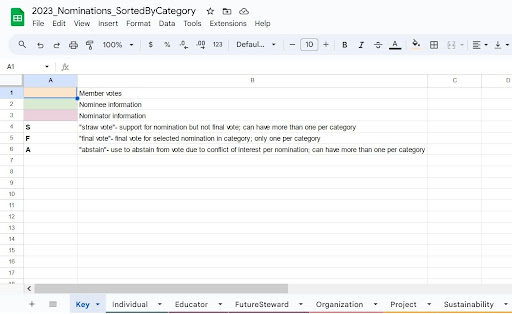
Basic spreadsheet shared by Excellence Awards Working Group members to review, discuss, and select awardees.
Award categories are: Individual, Educator, Future Steward, Organization, Project, and Sustainability. The criteria for each category specified on the EAWG webpage will help nominators select the “big bucket” their nominations will best fit, and every nomination must support the specific contributions named with evidence of their significance. Yet individual nominations focus on individual efforts. So, what can a nominator include to encourage EAWG members to recognize the importance of the nominee’s contributions? Let’s look at a few things that can help a nomination stand out.
Firsts
Efforts producing—or even on their way to producing—something absolutely fresh for the field of digital stewardship are worth nominating. This could be work to produce new tools, connections, workflows, methods, strategies, and more. Nominations for the new developments could offer information showing such aspects as: how this output is new; why it is notably original; what its impact or expected impact will be; and what potential it will have for widespread use. Past nominations have included phrases such as “facilitate the creation of a field that is easier, kinder, smarter, and faster,” “establish tangible solutions to put into practice,” “drawing on the collective experience of those in the field,” and “open resources that have been created and shared.”
A New Angle on the Known
Another perspective on fresh outputs is that of rethinking the known. This work could offer updated preservation formats, updated tools, or even an enhancement for providing access or enhancing discoverability. Nominations for such work could offer information evidencing: how this update is an improvement; why it is important to the field; what benefit it will provide; and how wide a range of digital stewards can implement it. Nominations for this type of work have included phrases like: “re-thinking this for the next generation,” “ensuring the outputs were shared with the greater community and not created within an academic silo,” “advance future generations of digital stewards,” and “enhancing tools and standards our field has used for decades.”
Hot Topics
Significant work being done in areas of high interest to the digital stewardship and preservation communities is certainly worth nominating. Recently, such areas of interest have included DEI initiatives, study on the environmental impact of digital stewardship, and the use of artificial intelligence. Nominations reflecting efforts in such areas have incorporated aspects including: multidisciplinary connections, research and training methodologies, the promotion of integrating diverse perspectives, and strategies to increase awareness of a specific digital preservation challenge. Such efforts have been described as “uplifting while educating,” “improving experience for new digital preservationists through work on documentation, information-sharing, and tools development,” and “actively seeks out venues to spread the message.”
Widespread Impact
Another type of work worthy of nominating is that which will bring a positive impact to a significant portion of the field of digital stewardship. This impact will often include the characteristics of recognized reusability or adaptability and could be seen via open access to code, guides to a topic or practice, or policies that were developed. It could possibly be achieved through outreach activities or collaborations. Nominations describing such work have noted details such as: “demystifying often-challenging material required for working in digital preservation,” “bolsters others offering leadership and growth opportunities,” “informs digital preservation best practices,” “shaped the design and implementation of open-source software,” and “engaged with the preservation community as speakers, writers, and collaborators.”
These are just a few suggestions on nominating your colleagues and their work. There are certainly more areas, perspectives, and outputs that could be recognized. For more ideas, links to announcements for past winners can be found at the bottom of the Excellence Awards Working Group webpage. Remember, there is no perfect nomination expected by the EAWG. All submissions are received, reviewed, and discussed by all group members equally. Working group members realize that this is an opportunity to celebrate the achievements of our colleagues, and the selection has never been easy. Yet during my time with the group, we have ensured that no final selection has been solidified without the unanimous support of the members.
The EAWG will be seeking nominations again next year. Until then, we will be offering other blogs and video clips to help digital stewards and preservationists better understand our work. We also hope this information will encourage them to nominate their colleagues or themselves. We look forward to your submissions!
Written by Kari May, Excellence Awards Working Group, Co-Chair