
2021 DLF Forum, DigiPres, and Learn@DLF Calls for Proposals

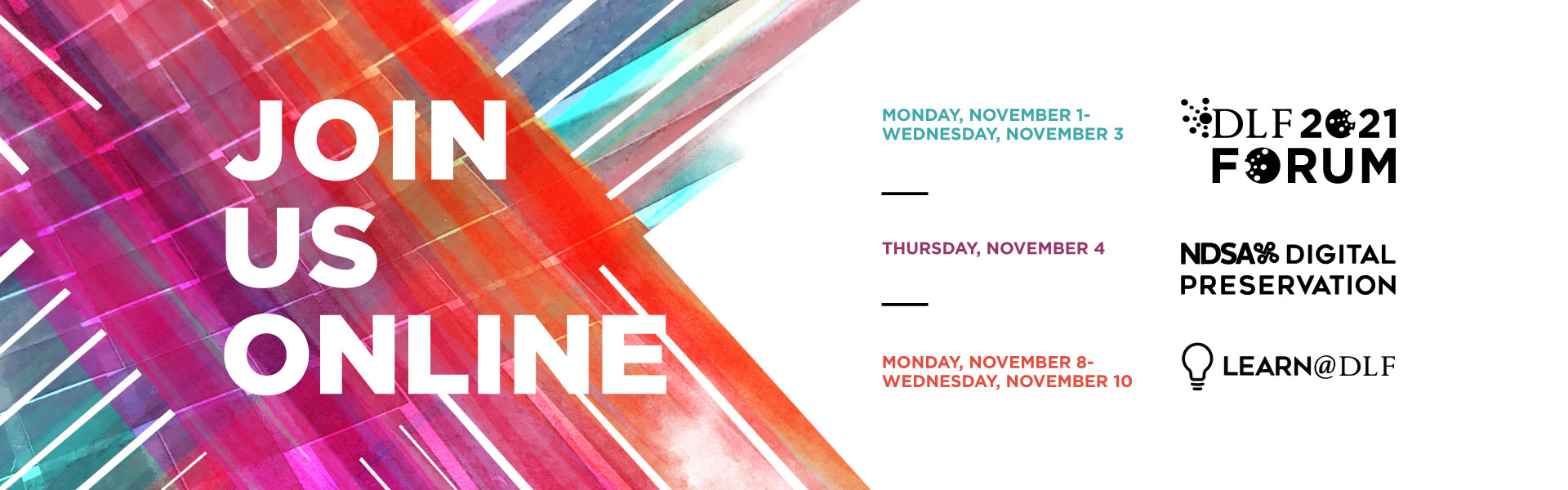
Join us online

We’re delighted to share that it’s CFP season for CLIR’s annual events.

Based on community feedback, we’ve made the decision to take our events online again in 2021. We look forward to new and better ways to come together—as always, with community at the center.

Our events will take place on the following dates:

For all events, we encourage proposals from members and non-members; regulars and newcomers; digital library practitioners and those in adjacent fields such as institutional research and educational technology; and students, early-career professionals and senior staff alike. Proposals to more than one event are permitted, though please submit different proposals for each. 

The DLF Forum and Learn@DLF CFP is here: https://forum2021.diglib.org/call-for-proposals/ 

NDSA’s Digital Preservation 2021: Embracing Digitality CFP is here: https://ndsa.org/conference/digital-preservation-2021/cfp/

Session options range from 5-minute lighting talks at the Forum to half-day workshops at Learn@DLF, with many options in between.

The deadline for all opportunities is Monday, May 17, at 11:59pm Eastern Time.

If you have any questions, please write to us at forum@diglib.org, and be sure to subscribe to our Forum newsletter to stay up on all Forum-related news. We’re looking forward to seeing you this fall.

-Team DLF
Digital Library Federation to Host National Digital Stewardship Alliance


NDSA DLFrev1BL_notag_200

Washington, DC, October 19, 2015—The National Digital Stewardship Alliance (NDSA) today announced that it has selected the Digital Library Federation (DLF), a program of the Council on Library and Information Resources (CLIR), to serve as NDSA’s institutional home starting in January 2016. The selection and announcement follows a nationwide search and evaluation of cultural heritage, membership, and technical service organizations, in consultation with NDSA working groups, their members, and external advisors.

Launched in 2010 by the Library of Congress as a part of the National Digital Information Infrastructure and Preservation Program with over 50 founding members, the NDSA works to establish, maintain, and advance the capacity to preserve our nation’s digital resources for the benefit of present and future generations. For an inaugural four-year term, the Library of Congress provided secretariat and membership management support to the NDSA, contributing working group leadership, expertise, and administrative support. Today, the NDSA has 165 members, including universities, government and nonprofit organizations, commercial businesses, and professional associations.

CLIR and DLF have, respectively, a 60- and 20-year track record of dedication to preservation and digital stewardship, with access to diverse communities of researchers, administrators, developers, funders, and practitioners in higher education, government, science, commerce, and the cultural heritage sector.

“We are delighted at this opportunity to support the important work of the NDSA and collaborate more closely with its leadership and vibrant community,” said DLF Director Bethany Nowviskie. “DLF shares in NDSA’s core values of stewardship, collaboration, inclusiveness, and open exchange. We’re grateful for the strong foundation laid for the organization by the Library of Congress, and look forward to helping NDSA enter a new period of imagination, engagement, and growth.”  

CLIR President Chuck Henry added, “The partnership between NDSA and DLF should prove of significant mutual benefit and national import: both organizations provide exemplary leadership by promoting the highest standards of preservation of and access to our digital cultural heritage. Together they will guide us wisely and astutely further into the 21st century.”

The mission and structure of the NDSA will remain largely unchanged and it will be a distinct organization within CLIR and DLF, with all organizations benefiting from the pursuit of common goals while leveraging shared resources. “The Library of Congress fully supports the selection of DLF as the next NDSA host and looks forward to working with NDSA in the future,” said Acting Librarian of Congress David Mao. “The talent and commitment from NDSA members coupled with DLF’s deep experience in supporting collaborative work and piloting innovative digital programs will ensure that NDSA continues its excellent leadership in the digital stewardship community.”

“The Library of Congress showed great vision and public spirit in launching the NDSA. And with the Library’s support and guidance, NDSA has grown to embrace a broad community of information stewards,” said Micah Altman, chair of the NDSA Coordinating Committee.  “And with the support and leadership of CLIR and DLF we aspire to broaden and catalyze the information stewardship community to safeguard permanent access to the world’s scientific evidence base, cultural heritage, and public record.”

CLIR is an independent, nonprofit organization that forges strategies to enhance research, teaching, and learning environments in collaboration with libraries, cultural institutions, and communities of higher learning. It aims to promote forward-looking collaborative solutions that transcend disciplinary, institutional, professional, and geographic boundaries in support of the public good. CLIR’s 186 sponsoring institutions include colleges, universities, public libraries, and businesses.

The Digital Library Federation, founded in 1995, is a robust and diverse community of practice, advancing research, learning, and the public good through digital library technologies. DLF connects its parent organization, CLIR, to an active practitioner network, consisting of 139 member institutions, including colleges, universities, public libraries, museums, labs, agencies, and consortia. Among DLF’s NDSA-related initiatives are the eResearch Network, focused on data stewardship across disciplines, and the CLIR/DLF Postdoctoral Fellows program, with postdocs in data curation for medieval, early modern, visual studies, scientific, and social science data, and in software curation.

Skip to content