2023 NDSA Storage Survey Report Published

The NDSA is pleased to announce the release of the 2023 Storage Infrastructure Survey Report, available at https://doi.org/10.17605/OSF.IO/9QP4W 

From October 24 to November 22, 2023, the 2023 NDSA Storage Infrastructure Survey Working Group conducted a 51-question survey designed to gather information on the technologies and practices used in preservation storage infrastructure. 

This effort builds upon three previous surveys, conducted in 2011, 2013, and 2019. The survey encouraged responses from NDSA and non-DSA members to gain a broader understanding of storage practices within the digital preservation community. The survey received 138 complete responses, with most coming from the United States, but it did have a global reach. The 2023 survey also incorporated two new questions on storage and environmental impact. 

Some major takeaways from the report include:

  • The amount of preservation storage required for all managed copies appeared to stabilize relative to previous surveys. Fewer organizations reported higher allocations of storage, but the anticipated need for storage over the next three years remains elevated. 
  • Only 28% of respondents currently participate in a cooperative system – down from 45% in 2019 – and 63% indicate they are not considering a distributed storage cooperative. The use of commercial cloud storage providers rose from 46% in 2019 to 55% in 2023. 
  • Heavy use of an onsite storage element was reported by academic institutions (91%), archives (88%), and government agencies (71%). It also shows that use of onsite storage is most often combined with use of either independently managed offsite storage or commercial cloud storage managed by the organization. 
  • The leading offsite storage provider used by 56% of the responding academic institutions is Amazon Web Services. For responding archives, Amazon Web Services (36%) and Preservica (21%) are the most prevalent. Non-profits, museums, historical societies and public libraries use Amazon Web Services 45% of the time.
  • 52% of respondents said their organization is considering their environmental impact during storage planning. 

The proposed schedule for the Storage Infrastructure Survey to be conducted is every three years, allowing for ongoing tracking and analysis of approaches to preservation storage over time.  The next planned Storage Infrastructure goup is scheduled to kick off in 2026. Interested in participating in the next Storage Infrastructure Working group? A call for group members will go out in late 2025 or early 2026.  

~ NDSA 2023 Storage Infrastructure Survey Working Group

Submitting a Notable Nomination: Suggestions from the Excellence Award Working Group

The National Digital Stewardship Alliance (NDSA) is an organization with a diverse international membership sharing a commitment to digital stewardship and preservation. Its Excellence Awards Working Group (EAWG) is just as diverse and just as committed. Since 2012 this team has come together to select awardees who have offered their significant engagement with the theory and practice of long-term digital preservation stewardship at a level of national or international importance. EAWG members understand the importance of innovation and risk-taking in the developing successful digital preservation tools and activities. This means that excellent digital stewardship can take many forms; therefore, eligibility for these awards has been left purposely broad. 

I started as a member of the EAWG in 2019 and took part in discussions that led to the group’s move to presenting awards biennially in the odd-numbered years, to interleave them with the Digital Preservation Coalition’s Digital Preservation Awards. I have been co-chairing the group since January 2023, and, although the timing for awards may have changed, our standards have not. Any person, any institution, or any project meeting the criteria for any of the Excellence Awards’ six categories can be nominated. Neither nominators nor nominees need to be NDSA members or to be affiliated with member institutions. Self-nomination is accepted and encouraged, as are submissions reflecting responses to the needs or accomplishments of historically marginalized and underrepresented communities. It is truly inspiring to receive the nominations each year and learn about exciting work that is happening in the field of digital stewardship and preservation that we may never have known about otherwise.

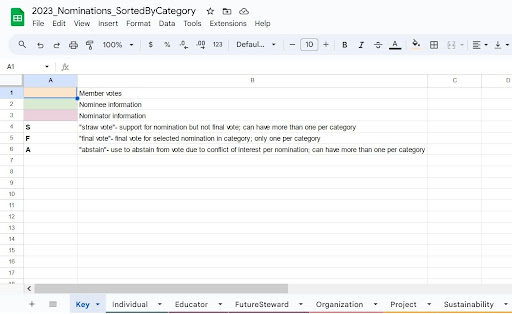
Screenshot of spreadsheet for reviewing nominations.
Basic spreadsheet shared by Excellence Awards Working Group members to review, discuss, and select awardees.

Award categories are: Individual, Educator, Future Steward, Organization, Project, and Sustainability. The criteria for each category specified on the EAWG webpage will help nominators select the “big bucket” their nominations will best fit, and every nomination must support the specific contributions named with evidence of their significance. Yet individual nominations focus on individual efforts. So, what can a nominator include to encourage EAWG members to recognize the importance of the nominee’s contributions? Let’s look at a few things that can help a nomination stand out.


  • Firsts
    • Efforts producing—or even on their way to producing—something absolutely fresh for the field of digital stewardship are worth nominating. This could be work to produce new tools, connections, workflows, methods, strategies, and more. Nominations for the new developments could offer information showing such aspects as: how this output is new; why it is notably original; what its impact or expected impact will be; and what potential it will have for widespread use. Past nominations have included phrases such as “facilitate the creation of a field that is easier, kinder, smarter, and faster,” “establish tangible solutions to put into practice,” “drawing on the collective experience of those in the field,” and “open resources that have been created and shared.”
  • A New Angle on the Known
    • Another perspective on fresh outputs is that of rethinking the known. This work could offer updated preservation formats, updated tools, or even an enhancement  for providing access or enhancing discoverability. Nominations for such work could offer information evidencing: how this update is an improvement; why it is important to the field; what benefit it will provide; and how wide a range of digital stewards can implement it. Nominations for this type of work have included phrases like: “re-thinking this for the next generation,” “ensuring the outputs were shared with the greater community and not created within an academic silo,” “advance future generations of digital stewards,” and “enhancing tools and standards our field has used for decades.”
  • Hot Topics
    • Significant work being done in areas of high interest to the digital stewardship and preservation communities is certainly worth nominating. Recently, such areas of interest have included DEI initiatives, study on the environmental impact of digital stewardship, and the use of artificial intelligence. Nominations reflecting efforts in such areas have incorporated aspects including: multidisciplinary connections, research and training methodologies, the promotion of integrating diverse perspectives, and strategies to increase awareness of a specific digital preservation challenge. Such efforts have been described as “uplifting while educating,” “improving experience for new digital preservationists through work on documentation, information-sharing, and tools development,” and “actively seeks out venues to spread the message.”
  • Widespread Impact
    • Another type of work worthy of nominating is that which will bring a positive impact to a significant portion of the field of digital stewardship. This impact will often include the characteristics of recognized reusability or adaptability and could be seen via open access to code, guides to a topic or practice, or policies that were developed. It could possibly be achieved through outreach activities or collaborations. Nominations describing such work have noted details such as: “demystifying often-challenging material required for working in digital preservation,” “bolsters others offering leadership and growth opportunities,” “informs digital preservation best practices,” “shaped the design and implementation of open-source software,” and “engaged with the preservation community as speakers, writers, and collaborators.”

These are just a few suggestions on nominating your colleagues and their work. There are certainly more areas, perspectives, and outputs that could be recognized. For more ideas, links to announcements for past winners can be found at the bottom of the Excellence Awards Working Group webpage. Remember, there is no perfect nomination expected by the EAWG. All submissions are received, reviewed, and discussed by all group members equally. Working group members realize that this is an opportunity to celebrate the achievements of our colleagues, and the selection has never been easy. Yet during my time with the group, we have ensured that no final selection has been solidified without the unanimous support of the members.

The EAWG will be seeking nominations again next year. Until then, we will be offering other blogs and video clips to help digital stewards and preservationists better understand our work. We also hope this information will encourage them to nominate their colleagues or themselves. We look forward to your submissions! 

Written by Kari May, Excellence Awards Working Group, Co-Chair


NDSA Welcomes One New Member in Quarter 3 of 2024

As of September 2024, the NDSA Leadership unanimously voted to welcome one new applicant into the membership. Please join me in welcoming our new member! To review our list of members, you can see them here.

The Archive and Heritage Digital Curation Group

In their application, The Archive and Heritage Digital Curation Group noted that they are “a specialised consulting services that ensure that your archival processes meet regulatory compliance and standards.” They continued to note that, “We provide comprehensive support in archiving, records management, metadata management, disaster preparedness, and environment scanning to safeguard your valuable collections. Both from a IT systems and Archives and Records Management perspective. We also do digitisation from equipment to physical digitisation, collection building and storage.” 


NDSA Announces 2024 Slate of Candidates for Coordinating Committee

NDSA is happy to announce the 2024 slate of Coordinating Committee (CC) candidates. Elections will soon be held for three (3) CC members. The CC is dedicated to ensuring a strategic direction for NDSA, to the advancement of NDSA activities to achieve community goals, and to further communication among digital preservation professionals and NDSA member organizations. The CC is responsible for reviewing and approving NDSA membership applications and publications; updating eligibility standards for membership in the alliance, and other strategic documents; engaging with stakeholders in the community; and working to enroll new members committed to our core mission. The successful candidates will each serve a three-year term. Ballots will be sent to membership organization contacts shortly.

Kari May

Kari is a full-time digital preservationist for the University of Pittsburgh Library System. She became one of the university’s NDSA representatives and a member of the Excellence (Innovation) Awards Working Group (EAWG) in 2019. In 2023, Kari became a Co-Chair for the EAWG and has sought to increase transparency and ensure equity and inclusion in all aspects of EAWG processes by initiating new activities and encouraging more standardization in completing and documenting the awards cycle. Kari has also been a member of the NDSA DigiPres Planning Committee (PC) for 2022 and the 2023 Storage Survey Working Group and is currently a member of the Events Strategy Working Group. Her work with other professional organizations includes Co-Chair of the 2025 BPE Program Committee, member of DLF PC 2020-2024, member of LD4 PC 2022, Digital Preservation Coalition Digital Preservation Awards guest Judge 2022, and member of SAA Collection Management Steering Committee 2023-2025.

Kari feels that digital stewardship challenges continue to expand and require professionals to provide creative solutions supported by limited resources. Working with the Coordinating Committee would offer an opportunity to encourage valuable connections throughout the field of digital stewardship and offer strategies to foster collaboration to maximize benefits for all.

Matt McEniry

Matt McEniry is the Director of the Digital Scholarship Lab at Texas Tech University Libraries. The Lab provides digital preservation, digitization, and data management services for TTU and Lubbock organizations. His areas of expertise include project management, digital preservation, digitization, metadata description, data management, and copyright curation. Matt is currently working on a publication describing the complex working relationships between archives, collection owners, and digitization labs. He has previously presented on his work with community partners and their digital collections at DigiPres 2023 and DigiPres 2024 Redux. 

Matt first became involved in the NDSA in 2013 with the Infrastructure Working Group and helped with the Innovation awards until 2015. In 2023 he served on the DigiPres 2023 Planning Committee and is the current co-chair of the Excellence Awards Working Group. He along with his co-chair, Kari May, helped to successfully plan and present the awards at DigiPres 2023. Having worked with the Strategy Team to help update NDSA’s Foundational Strategy, Matt wants to be able to help see these goals and strategies through as part of the Coordinating Committee. He wants to learn from the committee and engage with NDSA on a broader level, especially during this time of transition.

Margo Padilla

Margo Padilla is the Digital Preservation Librarian at New York University where she unifies strategies and processes across the Division of Libraries to facilitate the preservation of digital resources. Prior to NYU, she was the Digital Archivist at the New-York Historical Society where she led the development of infrastructure for collecting, preserving, and providing access to born-digital collections. Margo recently served as a member of the National Best Practices for Archival Accessioning Working Group born-digital accessioning and digital preservation subgroup, and previously participated in Collective Responsibility: National Forum on Labor Practices for Grant-Funded Digital Positions. 

Margo received her MLIS with a concentration in Management, Digitization, and Preservation of Cultural Heritage and Records from San José State University and her undergraduate degree from the University of California, Berkeley. Margo is interested in furthering the conversation on reliance on contingent labor in cultural heritage organizations, as well as advancing digital preservation best practices that can be realistically implemented by differently resourced institutions. She brings active engagement to committee work and believes the value of NDSA membership is derived from the collective dedication of the digital preservation community, as exemplified by the Interest and Working Groups.

Max Prud’homme

Patrice-Andre (Max) Prud’homme, PhD, is the Director of Digital Curation at Oklahoma State University. He provides leadership and management in the areas of digital curation, preservation, and discovery of digital resources, developing and applying digital and computational methods to augment the value of digital archival materials. He recently served on the 2023 NDSA Storage Survey Working Group. He served on the NDSA Membership Working Group, collaborating on writing membership engagement proposals, and on the 2021 NDSA Fixity Survey Working Group. He has also served as a Project Lead, instructor, and advisor in Digital POWRR since its inception in 2011, and helped bring one of the Digital POWRR Institutes to the Oklahoma State University campus in June 2024. He also serves as Digital Archivist for a five-year grant program funded by the Senate Historical Office. He is the former Head of Digital Collections at Illinois State University. Max looks forward to advancing the NDSA mission by advocating for greater collaboration and participation with other communities (including engaging students and new professionals). His goal is to augment sustainable knowledge-sharing in the area of digital stewardship to benefit the greater digital preservation community. 

Tuelo Ntlotlang

Tuelo Ntlotlang is a Subject Librarian at Botswana International University of Science and Technology (BIUST) Library, who is actively engaged in open science and digital scholarship initiatives. She is enthusiastic about open access and digital preservation activities in BIUST. Tuelo has sold the open science movement to BIUST research community, and then established an institutional repository (BIUSTRE) that focuses on ensuring that BIUST intellectual output remains accessible to the global community. She is also actively involved in advocating for adoption of open science and open access at a national level, working closely with Botswana Open Data Policy Working Group as a secretariat and Botswana Library Consortium Board Members as a treasurer. Furthermore, Tuelo is a standing committee member of IFLA Academic and Research Libraries (ARL) Section serving in the webinar team, where webinars are organized to address the new trends in academic and research libraries globally, including open science and digital preservation. 

She is pleased to report that she contributed to IFLA ARL, receiving the Dynamic Unit and Impact Award at the IFLA Conference in 2021. Therefore, Tuelo believes that her strong academic and intellectual abilities coupled with her experiences and skills acquired position her in good stead to perform well on the NDSA Coordinating Committee (CC). Tuelo holds a Master’s degree in library and information studies from University of Botswana. She vows to bring experience and welcomes the opportunity to engage in an environment that she will work with diverse community of peers and colleagues in NDSA Coordinating Committee (CC). Tuelo understands that time and effort will be required to understand, support and represent the interests of the group, therefore she is willing to make that effort.

Kathryn Slover 

Kathryn Slover has been the Digital Archivist at the University of Texas at Arlington (UTA) Libraries since August 2020. In this position she leads the exploration, evaluation, and implementation of methods, tools, and systems related to the preservation of born-digital and digitized content. She manages the web archiving program at UTA as well as works with donors and record creators to transfer digital materials to the archives. In addition to her digital preservation work, she also leads the departments collecting efforts related to LGBTQ+ materials in Tarrant County. 

Kathryn earned a Bachelor of Arts in History from the University of Redlands in 2014 and obtained a Master of Arts in Public History from Middle Tennessee State University in 2016. Prior to her current role at UTA, she previously served as the Electronic Processing Archivist at the South Carolina Department of Archives and History (from 2018-2020) and as the Archives Assistant at the Rutherford County Archives (from 2016-2018). She has been a Certified Archivist since 2020 and recently served on the NDSA Storage Survey Working Group from 2023-2024.

Sylvia Umana

Sylvia is a dedicated Digital Collections Librarian at the Namibia University of Science and Technology Library with a deep passion for her role in preserving and managing digital assets. She holds a Master’s degree in Library and Information Science from the University of Namibia in 2020, where her area of research focused on the digital preservation of institutional repositories. In her role as the digital collections’ librarian, Sylvia worked on various digitization projects including collaborations with the National Archives of Namibia and Desert Research Foundation of Namibia. She is committed to advancing her knowledge on active digital preservation, and thus continues to explore as she aims to actively implement these in her organization.

With a strong commitment to safeguarding digital collections for future generations, she is eager to expand her expertise and contribute to the evolving field of digital preservation and information management especially in developing countries such as Namibia. Her enthusiasm for learning and her attention to detail drive her mission to ensure the longevity and accessibility of valuable digital resources

 

Member Fee Survey: Feedback Requested

NDSA has been an active membership organization since its founding in 2010. It advocates for the digital stewardship needs of its member organizations, convenes a community of practice, and provides professional development opportunities for its members. Today, NDSA is completely run by volunteers from its member organizations, with administrative assistance subsidized by CLIR.

NDSA membership has always been free for any organization committed to long-term digital stewardship. While NDSA has thrived thanks to an active network of volunteers, this model has also presented many challenges to NDSA’s sustainability and independence as the organization has grown and matured. While NDSA was fortunate to have been funded through the Library of Congress’ National Digital Information Infrastructure and Preservation Program in our early years, and has received financial support from CLIR since 2016, we now find ourselves unable to fulfill our mission and goals without a sustainable funding model.

NDSA funding would enable us to hire a community manager, who would onboard and support NDSA members, coordinate communications and outreach, and assist with NDSA in-person and virtual events. These are all unmet needs that have been identified as high priority through member surveys, interviews, and discussions within NDSA Leadership.

Over the past few years, NDSA engaged in many activities to uncover these unmet needs. The Task Force on Membership Engagement and Recruitment began in 2021. The group conducted a survey of NDSA’s member base to measure the current value of benefit offerings and understand how to attract and recruit broader partnerships. Survey results led to the creation of the Membership Working Group, charged with discussing the findings on membership types and fees, criteria for evaluating new members, improving the new member onboarding, and more. In 2023, the Membership Working Group held group listening forums and individual interviews to gain more information on member preferences and opportunities for NDSA to engage with and grow our membership. The group recently completed its recommendations on improvements and expansion of NDSA’s member engagement, and submitted a report for review by the NDSA Leadership.

Concurrently in 2022, NDSA Leadership began efforts to explore the optimal organizational alignment to meet member needs and help NDSA fulfill its mission and to serve as a national leader in the field of digital preservation. Through this evaluation, NDSA refreshed its Mission, Vision, and Values and developed a summary of its current host relationship with CLIR, its operational support requirements, and its financial impact.

In late 2022, the Long-Term Conference Planning Working Group was charged with examining NDSA’s annual conference practices and making strategic recommendations on the future of NDSA conferencing and events. The group recommended that NDSA lengthen the interval between its national in-person conferences, incorporate more virtual options, and create a clear mission statement for those in-person gatherings. They also recommended that NDSA explore the implementation of smaller “Designated Community” events that would be accessible to more of its members. Through these recommendations, NDSA will develop a more holistic strategy for its programming and events. A new working group focused on implementing these improvements to NDSA events began its work in May 2024.

When thinking about how to financially support these growing needs, NDSA Leadership has discussed a sliding scale membership fee model, organizational vs. individual memberships, vendor sponsorships, and revenue from events such as the DigiPres conference. Your feedback is critical to help us determine a membership fee schedule that would be both sustainable and affordable. If a fee-for-membership model is not feasible for a majority of member organizations, NDSA will evaluate its other funding options. However, without sustainable funding, meeting the most basic needs of NDSA’s members will be at risk and NDSA’s strategic goals will not be met.

In order to evaluate these funding options, we have created a brief survey which should take about 10 minutes to complete. The survey will be sent out via email to NDSA’s member representatives – please keep an eye on your inbox! In exchange for completing the survey, you may choose to be entered into a raffle for one free registration to the next DigiPres conference. (Your contact information will only be used for the raffle and will not be included in the dataset for analysis.) We request that you complete the survey by September 10, 2024.

If you have any questions or comments, please contact Bethany Scott, NDSA Coordinating Committee Chair, at ndsa[dot]digipres [at] gmail [dot] com. Thank you for your feedback and support!

Call for Nominations to the NDSA Coordinating Committee

NDSA will be electing three members to its Coordinating Committee (CC) this year, with terms starting in January 2025. CC members serve a three year term and participate in a monthly call to help guide and sustain the organization’s strategy and direction. The Coordinating Committee provides strategic leadership to the organization in coordination with group co-chairs. NDSA is a diverse community with a critical mission, and we seek candidates to join the CC that bring a variety of cultures and orientations, skills, perspectives and experiences, to bear on leadership initiatives. Working on the CC is an opportunity to contribute your leadership for the community as a whole, while collaborating with a wonderful group of dynamic and motivated professionals. 

If you are interested in joining the NDSA Coordinating Committee (CC) or want to nominate another member, please complete the nomination form by 11:59pm EDT Friday, August 30, 2024, which asks for the name, e-mail address, brief bio/candidate statement (nominee-approved), and NDSA-affiliated institution of the nominee. We particularly encourage and welcome nominations of people from underrepresented groups and sectors. 

As members of the NDSA, we join together to form a consortium of more than 270 partnering organizations, including businesses, government agencies, nonprofit organizations, professional associations and universities, all engaged in the long-term preservation of digital information. Committed to preserving access to our national digital heritage, we each offer our diverse skills, perspectives, experiences, cultures and orientations to achieve what we could not do alone. 

The CC is dedicated to ensuring a strategic direction for NDSA, to the advancement of NDSA activities to achieve community goals, and to further communication among digital preservation professionals and NDSA member organizations. The CC is responsible for reviewing and approving NDSA membership applications and publications; updating eligibility standards for membership in the alliance, and other strategic documents; engaging with stakeholders in the community; and working to enroll new members committed to our core mission. More information about the duties and responsibilities of CC members can be found at the NDSA’s Leadership Page.

We hope you will give this opportunity serious consideration and we value your continued contributions and leadership in our community.

Any questions can be directed to ndsa [dot] digipres [at] gmail [dot] com

NDSA Excellence Awards: A history of growth and celebration

For almost a dozen years the National Digital Stewardship Alliance (NDSA) has been home to the Excellence Awards. From simple beginnings these awards have evolved in response to changes in the field of digital preservation and stewardship, and they will continue to evolve as the field grows and embraces new possibilities. This post offers key points in the history and current practices of the awards. 

In August of 2011, a guest post from Trevor Owens on the Library of Congress blog The Signal asked the question: “What kinds of awards would help recognize and encourage work with important collections, tools, services, organizations, and student projects related to digital stewardship and preservation?” This question led to the NDSA Innovation Working Group assembling an action team to complete the first awards cycle in 2012.

In 2016, the awards became more formalized with the adoption of an Innovation Working Group Charter. This document was made available via a wiki and noted that success would be signified by the completion of an awards cycle and increasing awareness of innovations in the field of digital preservation. It also recognized that the merit of the awards was their ability to “communicate the value of digital preservation work within the community and externally to stakeholders at member organizations and the larger world.”

The awards began by accepting nominations in four categories: individual, future steward, project, and organization. In 2017, the Charter was updated, and the Educator category was added, and these five categories were maintained through 2020. In 2021, the working group felt that the long-term impact of innovation should be recognized. To promote this broader perspective, the sixth category, Sustainability, was adopted.

Other important changes were to follow in 2021. First, the working group wanted to provide greater opportunities for NDSA to “highlight and commend all forms of creative and meaningful contributions in the field of digital preservation.” Many felt that the current name of the awards did not support this expanded and purposely broad view; therefore, the name of the awards was changed from the Innovation Awards to the Excellence Awards. A relationship was also growing between the NDSA and the Digital Preservation Coalition (DPC). It was recognized that the biennial DPC Digital Preservation Awards overlapped with the NDSA Excellence Awards, possibly causing confusion and stress on the part of individuals wondering which awards would be the better choice for their submission. Negotiations between the two were completed in 2022, and now the NDSA and DPC interleave their awards ceremonies, giving each cycle the opportunity to receive primary focus.

This agreement also includes cooperative efforts. During each awards cycle, a member will be invited for representative participation of the other on their juries. This agreement reflects the merit sought in the 2016 Charter by promoting greater consistency in criteria and evaluation of nominations, enhancing organizational continuity between the affiliates, and amplifying the award-related communications of each.

In 2023, the working group was facing a complete turnover of its members. Additionally, the DigiPres 2023 Conference Planning Committee had established a liaison position to help coordinate the awards presentation during the conference in November. New members were needed to facilitate the objectives of the group; a call for members returned six respondents, including representatives from the DPC and the Open Preservation Foundation. The roles of the 2023-2025 co-chairs were filled by Kari May and Matthew McEniry.

The group immediately started work on the newest award nominations, reviewing 51 submissions for 24 individual nominees by August 2023. This was done using updated evaluation criteria determined by the working group.The group also utilized new outreach channels offered by new members to garner more submissions from organizations and individuals outside of the U.S.

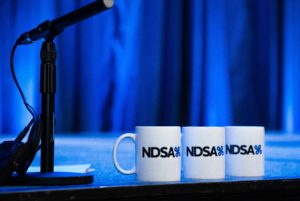
A microphone and three NDSA mugs in a row on a stageAfter the awardees had been selected and accepted, the group put together blogs to highlight past winners, showcase previous projects, and build up to the current cohort of award winners. The co-chairs meticulously put together an awards presentation that held to the time limitations of the conference (just 15 minutes) and successfully fulfilled the obligations of the group for the year. 

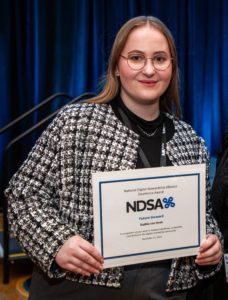
Photo of Sophia von Hoek holding the NDSA award certificate

January 2024 was the month of the DigiPres Redux virtual conference. Four of the awardees participated in the conference to highlight their work: Stephen Abrams (Individual), Sophia van Hoek (Future Steward), Ashley Blewer (Educator), Michelle Donoghue (Project). 

Working Group members facilitated this session and helped to promote a positive and educational environment for all participants. With the rest of 2024 being an interim year with no awards, the group is assembling a number of blogs and video clips to offer a peek into the  work and its importance to the field digital stewardship. The first video clip, presenting information on the Individual Category, is now live on the NDSA YouTube channel. 

The co-chairs have also spent time reshaping the group’s charter and guidelines to align with current procedures and standards. As 2025 creeps closer, they will soon begin working on the next iteration of the Excellence Awards. Look for more clips to come and remember, if you know some organization or individual you may want to nominate for an award, we’d love to take a look at how they are impacting and supporting digital stewardship.

~ Excellence Awards co-chairs Kari May and Matt McEniry


NDSA Updates Strategic Activities

As part of the NDSA’s broader organizational alignment activities taking place over the last year, the NDSA Coordinating Committee recently charged a small group of Leadership members to review and update its foundational strategy, which had previously been published in 2019.

The updated NDSA Strategy retains the NDSA’s mission, vision, and values. The three top-level goals of the organization remain the same, too:

  1. Convening and sustaining an engaged community to advance digital stewardship theory and practice.
  2. Identifying, communicating, and advocating for the common needs, concerns, standards, and good practices of the community.
  3. Providing outreach, resources, training, and professional development opportunities to bolster the effectiveness, productivity, and continuity of the community.

To provide a meaningful, actionable roadmap towards achieving each of these goals, the NDSA Leadership has outlined specific activities and initiatives to be completed in the next three to five years. Some of these activities include strengthening and stabilizing the NDSA’s shared governance, enhancing membership services with improved outreach and new groups, and increasing transparency through new communication methods and channels.

Please check out the “Goals and Strategies” section of the NDSA 2024 Strategy for the full list of activities and initiatives that you can look forward to in the coming years!

One of the first activities that the NDSA Leadership will begin working towards is investigating avenues to develop a sustainable funding model, including but not limited to restructuring membership options, hosting events, and seeking sponsorships. Towards that end, in the coming weeks we will be sending out a brief survey about funding the NDSA work. Keep an eye out and respond to the survey to make your voice heard! And as always, feel free to reach out to the NDSA Leadership with your thoughts and feedback at ndsa.digipres@gmail.com.

– Bethany Scott, 2024 Coordinating Committee Chair

NDSA Welcomes 1 New Member in Quarter 2 of 2024

As of June 2024, the NDSA Coordinating Committee voted to welcome one new applicant into the membership. This member brings a host of skills and experience to our group. Keep an eye out for them on your working and interest group calls and be sure to give them a shout out. Please join me in welcoming our new members! To review our list of members, you can see them here.

The Gates Preserve

On their website, The Gates Preserve, “believes that archiving is a statement of value. Taking the time to gather, contextualize, catalog, and articulate the moments of an individual, a culture, or a subculture is critical to its legacy persisting into the future. We believe in thoughtful, carefully constructed legacies that are presented and shared in a way that honors its subjects. This is what we’ve attempted to do here.”  In their application, The Gates Preserve states that they would “like to be in alignment with associations that are doing work in alignment with the services they offer their clients” and the activities and commitments in digital preservation. 


The 2021 NDSA Staffing Survey is a 2024 Digital Preservation Award Finalist

The Digital Preservation Coalition (DPC) has recently announced the finalists for the 2024 Digital Preservation Awards. We are very pleased to announce that the Working Group team behind the revision and reimagining of the 2021 NDSA Staffing Survey are finalists for the International Council on Archives Award for Collaboration & Cooperation. You can read our full award application summary here.

The redesign of the 2021 NDSA Staffing Survey was a significant international effort to build and refine one of the only longitudinal open datasets of its kind by reconfiguring the survey from an organizational focus (as seen in the 2012 and 2017 versions), to allow for individual participation. This shift allowed for a more detailed picture of the current state of digital preservation staffing to emerge from the data, and was the product of intensive collaboration between the members of the Working Group, as well as the digital preservation community.

DPC members will be selecting their first and second choices for each category as well as providing feedback on the finalists to the judges before winners are selected. Voting opens on this Friday, June 14 and closes on Friday, July 12, 2024. (If you are a DPC member, we would really appreciate your vote!)

Winners will be announced at iPres 2024 in Ghent, Belgium on Monday, September 16.

Skip to content