
NDSA Excellence Awards: A history of growth and celebration

For almost a dozen years the National Digital Stewardship Alliance (NDSA) has been home to the Excellence Awards. From simple beginnings these awards have evolved in response to changes in the field of digital preservation and stewardship, and they will continue to evolve as the field grows and embraces new possibilities. This post offers key points in the history and current practices of the awards. 

In August of 2011, a guest post from Trevor Owens on the Library of Congress blog The Signal asked the question: “What kinds of awards would help recognize and encourage work with important collections, tools, services, organizations, and student projects related to digital stewardship and preservation?” This question led to the NDSA Innovation Working Group assembling an action team to complete the first awards cycle in 2012.

In 2016, the awards became more formalized with the adoption of an Innovation Working Group Charter. This document was made available via a wiki and noted that success would be signified by the completion of an awards cycle and increasing awareness of innovations in the field of digital preservation. It also recognized that the merit of the awards was their ability to “communicate the value of digital preservation work within the community and externally to stakeholders at member organizations and the larger world.”

The awards began by accepting nominations in four categories: individual, future steward, project, and organization. In 2017, the Charter was updated, and the Educator category was added, and these five categories were maintained through 2020. In 2021, the working group felt that the long-term impact of innovation should be recognized. To promote this broader perspective, the sixth category, Sustainability, was adopted.

Other important changes were to follow in 2021. First, the working group wanted to provide greater opportunities for NDSA to “highlight and commend all forms of creative and meaningful contributions in the field of digital preservation.” Many felt that the current name of the awards did not support this expanded and purposely broad view; therefore, the name of the awards was changed from the Innovation Awards to the Excellence Awards. A relationship was also growing between the NDSA and the Digital Preservation Coalition (DPC). It was recognized that the biennial DPC Digital Preservation Awards overlapped with the NDSA Excellence Awards, possibly causing confusion and stress on the part of individuals wondering which awards would be the better choice for their submission. Negotiations between the two were completed in 2022, and now the NDSA and DPC interleave their awards ceremonies, giving each cycle the opportunity to receive primary focus.

This agreement also includes cooperative efforts. During each awards cycle, a member will be invited for representative participation of the other on their juries. This agreement reflects the merit sought in the 2016 Charter by promoting greater consistency in criteria and evaluation of nominations, enhancing organizational continuity between the affiliates, and amplifying the award-related communications of each.

In 2023, the working group was facing a complete turnover of its members. Additionally, the DigiPres 2023 Conference Planning Committee had established a liaison position to help coordinate the awards presentation during the conference in November. New members were needed to facilitate the objectives of the group; a call for members returned six respondents, including representatives from the DPC and the Open Preservation Foundation. The roles of the 2023-2025 co-chairs were filled by Kari May and Matthew McEniry.

The group immediately started work on the newest award nominations, reviewing 51 submissions for 24 individual nominees by August 2023. This was done using updated evaluation criteria determined by the working group.The group also utilized new outreach channels offered by new members to garner more submissions from organizations and individuals outside of the U.S.
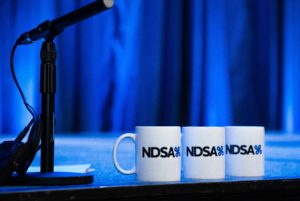
A microphone and three NDSA mugs in a row on a stageAfter the awardees had been selected and accepted, the group put together blogs to highlight past winners, showcase previous projects, and build up to the current cohort of award winners. The co-chairs meticulously put together an awards presentation that held to the time limitations of the conference (just 15 minutes) and successfully fulfilled the obligations of the group for the year. 
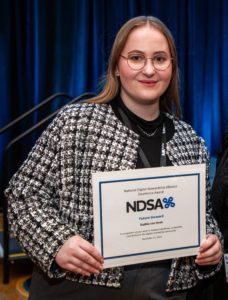
Photo of Sophia von Hoek holding the NDSA award certificate

January 2024 was the month of the DigiPres Redux virtual conference. Four of the awardees participated in the conference to highlight their work: Stephen Abrams (Individual), Sophia van Hoek (Future Steward), Ashley Blewer (Educator), Michelle Donoghue (Project). 

Working Group members facilitated this session and helped to promote a positive and educational environment for all participants. With the rest of 2024 being an interim year with no awards, the group is assembling a number of blogs and video clips to offer a peek into the  work and its importance to the field digital stewardship. The first video clip, presenting information on the Individual Category, is now live on the NDSA YouTube channel. 

The co-chairs have also spent time reshaping the group’s charter and guidelines to align with current procedures and standards. As 2025 creeps closer, they will soon begin working on the next iteration of the Excellence Awards. Look for more clips to come and remember, if you know some organization or individual you may want to nominate for an award, we’d love to take a look at how they are impacting and supporting digital stewardship.

~ Excellence Awards co-chairs Kari May and Matt McEniry

 

Catching up with past NDSA Excellence Awards Winners: Project Electron

In 2020, Project Electron received the NDSA Innovation Award in the Project category. It impressed the awards panel with its comprehensive adaptation and extension of traditional archival principles and workflows to digital materials. A multi-year initiative at the Rockefeller Archive Center, it sought to implement sustainable, user-centered, and standards-compliant infrastructure to support the ongoing acquisition, management, and preservation of archival digital records. The panel also appreciated the positioning of this initiative as an open-source and standards-based effort. This would allow maximum opportunities for its transferability to other programmatic contexts in a time when many archival institutions face significant challenges in supporting digitized and born-digital records and special collections. Headshot for Hillel Arnold

We contacted Hillel Arnold and found out how Project Electron has evolved and learned how it has impacted other work.

1) What have you been doing since receiving an NDSA Excellence Award?

We operationalized Project Electron in August 2019. Since then, we’ve continued to build on the infrastructure, methodologies, and expertise we built during the project.

One of the next big pieces of work we undertook was a complete rebuild of our discovery environment, locally branded as DIMES. The knowledge about building event-driven pipelines we picked up from Project Electron shaped this project, and also allowed us to complete it relatively quickly under challenging circumstances during the COVID-19 pandemic. You can read more about this project in the blog post announcing its launch.

Once we’d done all of that, the number of applications we needed to maintain had grown significantly, so we’ve also spent a fair amount of time improving our maintenance chops. As many folks know, I feel strongly that maintenance practices are both a core part of technology work as well as an enabler of strategic initiatives. We refined our continuous integration and continuous deployment pipelines, and instituted regular, efficient processes for dependency management. This continues to be an important area of focus for us, as we look for ways to implement DevOps methodologies and tools which help to expand our pool of developers among our colleagues. 

Finally, we’ve continued to invest in building a User Experience and Accessibility program to support ongoing evaluation and improvement of these systems. 

2) What did receiving the NDSA award mean to you?

For us, the Innovation Award was important because it provided external validation not only of what we were doing, but how we were going about it. It felt really good to know that other people saw value in what we were doing, even if they weren’t going to use our code, or if a completely different approach made sense for them. It also verified that our project values had been instrumental in directing us towards solutions that were reproducible and based in archival standards and practice. Most of all though, the award reaffirmed our participation in a community of digital preservation practitioners, which is incredibly important to the project team as well as the Rockefeller Archive Center as an institution. We have a lot to learn from each other!

3) How has Project Electron evolved since you won the Excellence Award?

As I mentioned above, Project Electron was an important platform for us in a number of ways. On the systems side, the approach we took has allowed us to extend the existing infrastructure to support additional workflows. So far we’ve built additional services to support a data pipeline for archival description, creation of image derivatives and IIIF manifests, and we’re in the process of building out services to support the ingest of digitized AV content. We’ve also spent some time improving the infrastructure’s scalability so we can process large files and large packages of files. 

Going into the project, we always knew we would have to build more than just software applications. So, we’ve also spent a significant amount of time building a user community around the tools and working to support adoption across our donor organizations. In many cases this has involved implementing other tools such as DART to support the creation of BagIt bags by organizations. 

We’re also trying to find ways to support records management processes in our donor organizations, since having an empowered records management function is key to successfully onboarding organizations because they are an effective way of mitigating concerns many of our donor organizations have about risk management. We’ve taken some broader approaches in this area too, such as spinning up a Records and Information Management Program to support these efforts, as well as establishing the Advancing Foundation Archives conference and community. 

4) What do you currently see as some of the biggest challenges in digital preservation?  

Climate change. In order for the work of digital preservation to be useful, there needs to be a future in which the records we’re preserving will be used. Thankfully, there is a growing conversation around issues of climate change and sustainability, and the ways that digital preservation is impacted by and can impact them. The things that make us skilled digital preservation practitioners (thinking about systems, data flows and disaster recovery) are also key ingredients in supporting sustainability, so we have a lot to offer. At the same time, significant changes in this area are going to require us to both work collectively across the entire archival sector, and also to develop partnerships outside of it.

~

Learn more about the other winners from the 2020 NDSA Innovation Awards!

NDSA Welcomes Four New Members

As of 8 March 2022, the NDSA Leadership unanimously voted to welcome its four most recent applicants into the membership. Each new member brings a host of skills and experience to our group. Keep an eye out for them on your calls and be sure to give them a shout out. Please join me in welcoming our new members.


Quantum Corp

Quantum Corp’s goal is to be the leading provider of management and storage services for unstructured data. They mainly focus on designing solutions to address the problems associated with managing and the storage of large data repositories and archives.


University of Cape Town Libraries

University of Cape Town Libraries is particularly interested in growing broad-based general awareness, basic understanding, and active participation in their digital preservation systems & services for the university as a whole. Their burgeoning network of Data Stewards & Champions, an interdisciplinary community of practice working to develop and maintain a vibrant, sustainable data culture, is an important vehicle for this.


Vanderbilt University Library

Vanderbilt University Library is interested in learning from others’ digital stewardship experiences as well as sharing theirs with the NDSA community. The Library currently holds digital archives with audiovisual, textual, and image-based content. They are using several different systems to archive them, including Glacier, ArchivesSpace, Archivematica, Fedora, and Portico. The Library preserves a number of collections, including the TVNews archive and Vanderbilt yearbooks.


WiLS (Wisconsin Library Services, Inc.)

WiLS is a non-profit membership organization that facilitates collaboration and innovation in order to advance library service in the state of Wisconsin and beyond. Since 2005, WiLS has provided consortium management and leadership for the Recollection Wisconsin statewide digital collections program. Notable and recent WiLS digital stewardship projects and initiatives include Recollection Wisconsin’s Curating Community Digital Collections program (IMLS), the Digital Readiness Community of Practice implementation project (NHPRC), mentorship of two national cohorts of tribal libraries engaged in community memory projects (through the IMLS’s Accelerating Promising Practices initiative), and their work with the Ho-Chunk Nation and other Wisconsin tribal communities to increase their capacity in digital collections development and management.


~ Hannah Wang, Vice Chair of the NDSA Coordinating Committee


NDSA’s Evolutionary Leadership

Echoing the sentiments of other colleagues, digital preservation is not a state that is achieved; rather it is a comprehensive set of managed activities that are necessary to provide continued access to digital objects, beyond the limits of media failure or technological change. Similarly, leadership within an organization, especially one that is 100% volunteer driven, is not a state that is achieved, but one that is, or should, be constantly evolving. The continuous evolution of leadership can be attained through sound organizational governance.

To avoid getting caught in the traps of “cult of personality” leadership, or let’s just re-elect so-and-so, NDSA instituted term limits and staggered terms for its elected Coordinating Committee (CC) members. More recently it has established a form of Chair and Vice Chair leadership for the CC. A Vice Chair is elected from the CC and serves for one year in that role, shadowing the current Chair. The following year they succeed as the next Chair; as such they must have at least two years left in their current term when elected as Vice Chair. 

In 2021, I became the first Vice Chair to become Chair. This year, Nathan Tallman, Digital Preservation Librarian for Penn State University, and my former Vice Chair has become the CC’s new Chair. We have elected Hannah Wang, Educopia’s Community Facilitator for the MetaArchive Cooperative, as the 2022 Vice Chair. Please join me in congratulating and welcoming our new leaders!

~ Dan Noonan, Past Chair

Results of the 2021 Fixity Survey and Fixity Case Studies

The 2021 Fixity Survey Working Group is pleased to announce the publication of the results of the 2021 Fixity Survey and corresponding Fixity Case Studies.  The 40 question survey was completed by 116 respondents over a month long period.  

The Report documents the results of each question in the areas of 1) basic information about fixity practices, 2) how fixity is being used, 3) fixity in relation to cloud services, 4) fixity errors, and 5) general demographic information.  

Several key points can be made from studying the survey results, some of which are listed below with more details provided in the report. 

  • The results demonstrate just how important fixity information is to the digital preservation community, with over 96% of survey respondents confirming that they utilize fixity information within their organization and over 98% of these using checksums (sometimes alongside other types of fixity information). The primary reason fixity information is used by the community is to determine whether data has been altered over time.
  • Despite a clear consensus that the use of fixity information represents good practice, the results demonstrate huge variation in fixity practices across the community. There are a variety of practices reported across the survey questions, including at what point fixity information is verified, the frequency of checks, where fixity information is recorded, and the checksum algorithms in use. 
  • Receiving fixity information at the time of acquisition remains a challenge.
  • Though fixity checking lends itself well to automation, for many it remains a fairly manual process, with a majority of respondents using manually-run software to carry out this activity. 

In addition to analyzing the results of the survey, the Fixity Survey Working Group conducted follow-up interviews with five organizations to explore fixity practices in more detail. Case studies from four of these organizations are currently included in the report and provide a rich illustration of how fixity is used within specific organizations, and build on some of the findings of the survey itself.

You can read and/or download the Report, Data files, and Codebook from the NDSA OSF site.  

Thank you to all of you who participated in the survey. We appreciate your time and effort spent in providing the information to us.  

Thank you to the members of the Fixity Survey Working group who worked on a tight schedule to complete this work in time for DigiPres.  

~ The 2021 Fixity Survey Working Group co-chairs

Arabic Translations Available of the 2019 Levels of Digital Preservation

The NDSA is pleased to announce that the 2019 Levels of Preservation documents have been translated into Arabic by our colleagues from Thesaurus Islamicus Foundation’s Qirab project (http://thesaurus-islamicus.org/index.htm).

Translations for the Levels of Digital Preservation Matrix and Implementation Guide were completed.

Links to these documents are found on the 2019 Levels of Digital Preservation OSF site (https://osf.io/qgz98/).

If you would be interested in translating the Levels of Digital Preservation V2.0 into another language please contact us at ndsa.digipres@gmail.com.

الترجمات العربيَّة لمستويات الحفظ لعام 2019 والوثائق المرتبطة بها

يسرُّ الاتحاد الوطني للإشراف الرقمي أن يُعلنَ عن صدور ترجمة باللغة العربيَّة لوثائق مستويات الحفظ الرقمي لعام 2019، نفَّذها زملاؤنا من مشروع «قِرَاب» التابع لجمعية المكنز الإسلامي.

(http://thesaurus-islamicus.org)


وقد اكتملت التَّرجمات الخاصة بمصفوفة ودليل تنفيذ مستويات الحفظ الرقمي.

علمًا أنه يمكن الوصولُ إلى تلك الوثائق من خلال مستويات الحفظ الرقمي لعام 2019 في الموقع الإلكتروني الخاص بمؤسسة أوبن ساينس فريم ورك (OSF).

(https://osf.io/qgz98)

وفي حالة اهتمامكم بترجمة الإصدار الثاني من مستويات الحفظ الرقمي إلى لغةٍ أخرى، يُرجى التواصلُ معنا عبر عنوان البريد الإلكتروني التالي: ndsa.digipres@gmail.com

Levels of Preservation Teaching, Advocacy, and Outreach Update

The Levels of Preservation Steering Group is pleased to announce the official release of its first round of training support materials for those who want to teach and educate others in the Levels of Preservation. This has been the product of many months’ refinement and editing – not to mention lots of wordsmithing! Our heartfelt thanks go out to Nance McGovern (MIT) and the rest of the TAO group for their hard work on this project.

The training support packet includes a comprehensive slide deck packed with information as well as a guide for users to help determine the relevant components of the slide for any style of presentation. The deck can be edited and repurposed to suit your needs or audience. Slides could be used for a full day workshop, a webinar, or just a quick infomercial like presentation. The guide helps break down which slides may be most useful for each type of presentation, however feel free to use the slides that work for your purpose or audience. We simply ask that you cite NDSA as the source as noted in the deck.

The materials (as well as a whole host of other NDSA publications) can be found here: https://osf.io/je439/

~ Bradley J. Daigle; Chair, Levels Steering Working Group

Announcing the NDSA Excellence Awards!

The NDSA Excellence Awards Working Group (formerly the Innovation Awards Working Group) is excited to announce the expansion and renaming of the awards to recognize the important contributions that are being made in the areas of sustainability and maintenance. The NDSA Excellence Awards will highlight and commend all forms of creative and meaningful contributions by individuals, projects, sustainability activities, organizations, future stewards, and educators to the field of digital preservation.

Prior winners of the “Future Stewards” award originally proposed the change and worked together with the Excellence Awards Working Group to make it possible. Please see below for more information!


When reflecting on the 2020 NDSA Digital Preservation conference, much of our conversation centered around the “What’s Wrong with Digital Stewardship: Evaluating the Organization of Digital Preservation Programs from Practitioners’ Perspectives” panel discussion, based on the eponymous paper by Karl Blumenthal, Peggy Griesinger, Julia Y. Kim, Shira Peltzman, and Vicky Steeves. Like many practitioners in the field, the paper identified themes and articulated scenarios we had experienced or observed ourselves, particularly around issues of labor, leadership, and funding.

We wondered what we could, and should, do to better acknowledge and celebrate digital stewards for under-recognized maintenance work, and coalesced on proposing a new NDSA award category focused on maintenance and sustainability work, as well as renaming the awards to reflect an expanded scope beyond innovation. We’re each recipients of Future Steward awards, and reached out to the other Future Stewards to co-sign our proposal; we are grateful for their support in collectively raising our voices to suggest change in order to best reflect the state of the field. You can read our proposal here.

-Samantha Abrams, Elizabeth England, and Lauren Work


The Excellence Awards Working Group sees this as one small step, as there is much more work to be done to shift from the continued use of “innovation” as a main driver for recognition not just within the field, but by organizations’ leadership and funders. In short – we need YOU! Review the new Excellence Awards structure here, particularly the newly added Sustainability Award, and get ready to nominate colleagues in a few weeks!

German Translation for the 2019 Levels of Preservation Matrix Now Available

GERMAN TRANSLATION FOR THE 2019 LEVELS OF PRESERVATION MATRIX 

The 2019 NDSA Levels of Digital Preservation Matrix has been translated into German. Please find a link to the German translation below. 

Citation information and a link to the German translation is as follows: 

Lindlar, Micky (Orcid: 0000-0003-3709-5608); Rudnik, Pia (Orcid: 0000-0003-4081-9646)  (2021). NDSA 2019 Digital Preservation Levels Translation: German Translation of Version 2.0. 

2.0 in German https://osf.io/3na96/ and https://doi.org/10.5281/zenodo.4718661 

Translators’ note:

In the English version of the Levels of Digital Preservation, the term “content” is used synonymously with “digital content” (see https://www.dpconline.org/blog/introducing-the-new-ndsa-levels-of-preservation).

In the German translation, the term “content” is translated as “digital content” in each of the four levels and in the associated catalog of measures. This makes it clear that the measures described in the LoPs refer to digital (content) objects with both physical, logical and semantic properties and that the focus is not only on semantic-intellectual content. 

The functional areas “Control” and “Content” have been provided with additions in the German translation for the purpose of better understanding and for conciseness; these additions are in parenthesis in each case: In the “(Zugriffs-)Kontrolle” functional area, the control measures described refer primarily to access rights for persons and software applications and to associated access measures (such as deleting a file). The addition of “(essenzielle Eigenschaften)” to the “Content” functional area was made to clarify that the measures described here relate in particular to technical properties, such as file formats, which are regarded essential for digital content in the context of long-term archiving. 

The additions were made in consultation with the NDSA Levels of Digital Preservation Steering Committee. 

*If you would be interested in translating the Levels of Digital Preservation V2.0 into another language please contact us at ndsa.digipres@gmail.com.  


DEUTSCHE ÜBERSETZUNG DER 2019 LEVELS OF PRESERVATION MATRIX 

Die 2019 NDSA Levels of Digital Preservation Matrix wurden ins Deutsche übersetzt. Die deutsche Übersetzung ist über den unten aufgeführten Link erreichbar. 

Zitiationsangabe und Link auf die deutsche Übersetzung: 

Lindlar, Micky (Orcid: 0000-0003-3709-5608); Rudnik, Pia (Orcid: 0000-0003-4081-9646) (2021). NDSA 2019 Digital Preservation Levels Translation: German Translation of Version 2.0. 

2.0 auf Deutsch https://osf.io/3na96/ und https://doi.org/10.5281/zenodo.4718661 

Anmerkung zur Übersetzung:

In der englischen Version der Levels of Digital Preservation wird die Bezeichnung “content” synonym zu “digital content” verwendet (s. https://www.dpconline.org/blog/introducing-the-new-ndsa-levels-of-preservation)

In der deutschen Übersetzung wird der Begriff “content” in den vier Levels sowie in dem dazugehörigen Maßnahmenkatalog jeweils als “digitaler Inhalt” übersetzt. Dies macht deutlich, dass sich die in den LoPs beschriebenen Maßnahmen auf digitale (Inhalts-)Objekte mit sowohl physischen, logischen als auch semantischen Eigenschaften beziehen und der Fokus nicht nur auf semantisch-intellektuellen Inhalten liegt. 

Die Funktionsbereiche “Control” und “Content” sind in der deutschen Übersetzung zum Zwecke der besseren Verständlichkeit und zur Konkretisierung mit Ergänzungen versehen worden, die jeweils in Klammern stehen: Im Funktionsbereich “(Zugriffs-)Kontrolle” beziehen sich die beschriebenen Kontroll-Maßnahmen vordergründig auf die Zugriffsrechte für Personen und Softwareanwendungen und auf damit verbundene Zugriffsmaßnahmen (wie z.B. Löschen einer Datei). Die Ergänzung des Funktionsbereichs “Inhalt” um den Zusatz “(essenzielle Eigenschaften)” wurde vorgenommen, um zu verdeutlichen, dass sich die hier beschriebenen Maßnahmen insbesondere auf technische Eigenschaften wie zum Beispiel Dateiformate beziehen, die im Kontext der Langzeitarchivierung als essenziell für digitale Inhalte angesehen werden. 

Die Ergänzungen erfolgten in Abstimmung mit dem NDSA “Levels of Digital Preservation” Steering Committee. 


Call for Proposals open for NDSA Digital Preservation 2021!

NDSA Digital Preservation Banner

The NDSA is very pleased to announce the Call for Proposals is open for Digital Preservation 2021: Embracing Digitality (#DigiPres21) to be held ONLINE this year on November 4th, 2021 during World Digital Preservation Day.

Submissions from members and nonmembers alike are welcome, and you can learn more about session format options through the CFP. The deadline to submit proposals is Monday, May 17, at 11:59pm Eastern Time.

Digital Preservation 2021 (#DigiPres21) is held in partnership with our host organization, the Council on Library and Information Resources’ (CLIR) Digital Library Federation. Separate calls are being issued for CLIR+DLF’s 2021 events, the 2021 DLF Forum (November 1-3) and associated workshop series Learn@DLF (November 8-10). NDSA strives to create a safe, accessible, welcoming, and inclusive event, and adheres to DLF’s Code of Conduct.

We look forward to seeing you online on November 4th,

~ 2021 DigiPres Planning Committee

Skip to content