
Catching up with past NDSA Innovation Awards Winners: DataUp


Nominations are now being accepted for the NDSA 2020 Innovation Awards.Screenshot of the DataUp interface
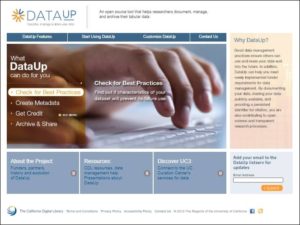
DataUp from the California Digital Library won a 2013 Innovation Award in the Project category. DataUp was recognized for creating an open-source tool uniquely built to assist individuals aiming to preserve research datasets by guiding them through the digital stewardship workflow process from dataset creation and description to the deposit of their datasets into public repositories. The following individuals are recognized for their contributions to DataUp and subsequent projects, and responses to this Q&A.

The original CDL DataUp team included:

  • Stephen Abrams, then CDL Associate Director of the UC Curation Center, currently Head of Digital Preservation, Harvard Library
  • Patricia Cruse, then CDL Director of the UC Curation Center, subsequently Executive Director of DataCite, and now retired
  • John Kunze, CDL Identifier Systems Architect
  • Carly Strasser, then CDL Data Curation Project Manager, currently Program Manager for Open Science at the Chan Zuckerberg Initiative

Current CDL staff responsible for the successor Dash and Dryad projects are:

  • John Chodacki, CDL Director of the UC Curation Center
  • Daniella Lowenberg, CDL Research Data Specialist and Product Manager

What has DataUp been doing since receiving an NDSA Innovation Award?

DataUp was conceived by the University of California Curation Center (UC3) at the California Digital Library (CDL) as an immediate response to the needs of researchers for an intuitive, effective, and self-service data curation platform.  DataUp initially targeted support for tabular datasets via an easy-to-use UI accessible to researchers themselves, rather than requiring mediation by librarians or archivists.  At the same time, CDL was engaged in other related initiatives, including the DataShare open data publication system.  Over time, the curatorial intentions and functional capabilities of both systems began to overlap considerably.  Consequently, in 2014 CDL decided to converge the two systems into a common technical platform under the Dash name.  More recently, similar synergies were recognized between Dash and the Dryad research data repository, which led to the integration of the Dash system as the new Dryad technology platform.  Throughout this multi-year evolution, the core principles and goals of the original DataUp project have remained steadfast: providing the best possible support to the scholarly community for the long-term curation, publication, and reuse of critical research data.

What did receiving the NDSA Award mean to you?

Receiving the NDSA Innovation Award was very gratifying as public affirmation by a significant stakeholder community of the value and beneficial impact of the DataUp vision, project, product, and service.  While the DataUp team was convinced of that value right from the start, it is always nice to have those beliefs recognized and confirmed by colleagues and peers.

What efforts, advances, or ideas over the last few years have you been impressed with or admired in the area of digital stewardship?

Tremendous strides forward have been made in digital stewardship over the past years.  This has been facilitated in large part by mutual recognition of all implicated stakeholders – scholars, administrators, librarians, archivists, funders – of the nature of common problems and needs and the necessity for coordinated response.  Positive outcomes have followed from the open contribution of their individual perspectives and strengths in collaborative efforts.  For example, the success of the DataUp/DataShare/Dash/Dryad activity called upon the active participation over many years by the CDL, University of California Libraries, the DataONE network, Microsoft Research, the Gordan and Betty Moore Foundation, the Alfred P. Sloan Foundation, DataCite, the Make Data Count initiative, and the Dryad community.  Looking towards the future, there are very promising avenues of exploration regarding the application of big data and machine learning techniques to the proactive curation of research data and other forms and genres of digital content deserving long-term stewardship.

The DataUp project began in 2011 – nearly a decade ago! Various challenges of preserving and providing access to research data sets continue to be discussed, and have been addressed in the 2014, 2015, and 2020 NDSA Agendas for Digital Stewardship. Where do we go from here?

The guiding tenets originally encapsulated by DataUp and its DataShare, Dash, and Dryad successors are fully consistent with the NDSA Agenda’s recommendations for organizing and ensuring long-term access to scientific data sets, including support for at-scale curation, promotion of the FAIR principles, and collaborative attention to innovation and sustainability (https://osf.io/7sfc6/, p. 26).  Three specific concerns seem particularly challenging and call out for concerted attention.  First, the academy as a whole needs to continue development of more flexible and sustainable financial practices concerning the curation of all legitimate research outputs, including research data, to avoid dis-incentivizing and confounding widespread adoption of effective RDM tools and practices.  Second, greater automation and intuitive self-service operation is still needed regarding the contribution of research data to managed curation environments such as Dryad.  Ideally, these actions would be automatic side-effects of other, more primary activities and workflows with which scholars and researchers are already engaged.  And third, more can be done regarding actionable linkages between research publication, research data, and research software, all of which interact within a cohesive and co-dependent web of scholarly activity and communication.  We feel that DataUp provided a pioneering attempt at addressing these issues and look forward to continuing progress towards these important goals.

Catching up with past NDSA Innovation Awards Winners: Dr. Anthony Cocciolo


Nominations are now being accepted for the NDSA 2020 Innovation Awards.

Anthony Cocciolo won a 2012 Innovation Award in the Individual category. He was Anthony Cocciolo portraitrecognized for his innovative approaches to teaching digital preservation practices, in particular his work partnering classes with archival institutions to work on the digitization and digital preservation of analog audio collections. Cocciolo is currently the Dean of the Pratt Institute School of Information.
 

What have you been doing since receiving an NDSA Innovation Award? 

In 2012, I was an Assistant Professor at Pratt Institute School of Information.  In 2020, I am still at Pratt, but now I am the Dean of the School.  I still teach the course “Projects in Digital Archives,” where the class is teamed up with a local archive to do digital archives projects, and what I had received the NDSA award for.  You can find this recent article from Pratt about some of the recent work going on in the class, which has included a lot of early LGBTQ+ radio and TV preservation work.

These days I oversee the School of Information, which is the oldest information school in North America, having started training librarians in 1890.  Today the school is based in Manhattan and enrolls about 230 graduate students across several Masters programs.  The pandemic has kept things challenging, as we work to return to campus in the fall, address issues for international students, and work to keep each other healthy and safe.

What did receiving the NDSA Innovation award in 2012 mean to you?

I think it really helped solidify my interests in digital preservation.  I am still very much involved with digital preservation work.  Pratt, in collaboration with NYU’s Moving Image Archiving and Preservation program (MIAP), has taken over the Digital Preservation Outreach and Education (DPOE) program from Library of Congress in 2018.  Just recently we received a grant from The Andrew W. Mellon Foundation to restore activity to the project, relaunching it as DPOE Network (DPOE-N), which is exciting.  You can find out more about the project at dpoe.network.

What efforts, advances, or ideas over the last 5-8 years have caught your attention or interest in the area of digital stewardship?

I think that audiovisual preservation is finally getting more attention now than it did back in 2012.  I wrote a book back in 2017 called Moving Image and Sound Collections for Archivists that argued that analog audio and video needed to be digitized, and I am happy to see that idea is viewed as more positively these days.

Overall, I am just happy to see the spread of digital stewardship and the notion that digital materials do not just preserve themselves, and that digital devices are where information of enduring value is largely created.

As the Dean at Pratt Institute School of Information, how has pedagogy grown and/or innovated as it relates to digital stewardship and digital preservation?

I think my pedagogy is largely the same (e.g., having students work on real-world problems in teams), I do try to keep it interesting by changing up the projects.  The past year we were starting to work on repairing open reel tapes with broken splices for digitization when the pandemic hit (the materials we finished are available here). Other times I have had students work on born-digital project with lots of forgotten file formats.  We’ve done projects featuring U.S. Presidents (e.g., digitizing photographs from the New York Times’ “morgue”), early Gay TV programs on U-Matic tape and more.  The variety keeps things interesting.

What are some priorities or challenges you see for digital stewardship?

I do think that audiovisual continues to be a challenge and priority. Trying to buy U-Matic VTRs for digitization is getting increasingly difficult.  I think web archiving, while with some exciting newer advancements (like the WebRecorder), still needs more attention and coordinated work.  Digital preservation education is still a needs area, as we do still see examples where archives/special collections have not made the transition to collection born-digital materials.  I am hopeful that the DPOE-N project mentioned earlier will help address this need.

Catching up with past NDSA Innovation Awards Winners: Mat Kelly, PhD


Nominations are now being accepted for the
NDSA 2020 Innovation Awards.

Mat Kelly won a 2012 Innovation Award in the Future Steward category when he was a graduate student at Old Dominion University. He won the award in recognition of his work on WARCreate, a Google Chrome extension that allows users to create a Web ARChive (WARC) file from any browsable web page. Kelly is currently an assistant professor in the Information Science department at Drexel University’s College of Computing and Informatics. 


What have you been doing since receiving an NDSA Innovation Award?

I was a Master’s degree student at Old Dominion University’s Web Science and Digital Libraries (WS-DL) Research Group when I received the award. The award brought to light in the web archiving community some aspects of preservation that were being neglected due to technical difficulties and the need for more work and research on web archiving. My MS thesis partially entailed the work for which I received the NDSA Innovation Award. After receiving my MS in 2012, I continued onto my PhD with the same group and defended my PhD dissertation, pertaining to the same subject for which I received the award, in 2019. I have since taken a position as a tenure track assistant professor in the Information Science department at Drexel University’s College of Computing and Informatics. I continue to focus my research of neglected aspects of web archiving that continue to remain a difficult area to explore due to the nature of the medium.

What did receiving the NDSA award mean to you?

The award gave credence that the programmatic work I was doing was worthwhile. The focus of the tool for which I was awarded was not just to create software, but demonstrate the need for simple user interfaces with powerful, standards-based approaches to encourage individuals to be able to archive the part of the web they care about. This helped to seed further research in the area, both for myself as well as others.

What efforts/advances/ideas of the last few years have you been impressed with or admired in the field?

I am in awe at the Webrecorder project, particularly the work of Ilya Kreymer. I appreciate the efforts the organization has done to encourage personal preservation and to do so with with usable software that does not need to rely on a central endpoint or institution for web archiving. Additionally, I have also been impressed with the breadth of the research performed by the other members of the WS-DL research group under the supervision of Drs. Michael L. Nelson and Michele C. Weigle. They have managed students taking interdisciplinary approaches toward neglected but necessary areas of research beyond the computer science area under which they are housed.

What advice do you have for future stewards in the digital preservation field?

The project for which I was awarded did not have an end-goal of attaining notoriety, though it was a pleasant surprise early in my career as a graduate student. It was a passion project to fill a need for those that want to accomplish something but may not have the technical know-how. This is a common occurrence. I would encourage others to further explore the area and exercise the skills for which they have expertise to determine a niche to which they can contribute.

Is there anything else we didn’t ask that you’d like to add?

I am thankful for the NDSA for considering me for the award early in my academic career and for my research group fostering innovation and enabling the opportunity to use what was once a passion project to have greater impact than it would have originally.

Happy Birthday to NDSA!

As we close in on the end of July we celebrate 10 years of the NDSA!!  

NDSA was initiated by the Library of Congress as a way to sustain and increase partnerships created through the National Digital Information Infrastructure and Preservation Program (NDIIPP).  Participants of NDIIPP were many of the initial members of NDSA.  There were 58 members in 2010, with membership now standing at over 250 in 2020.  Bill LeFurgy, one of the creators of NDSA, discusses the development and history of NDSA as part of NDIIPP, which, incidentally, would have turned 20 in December, and has a report on their first 10 years available as well. 

NDSA started with four groups developed to foster communication and partnerships which has grown in ten years to include three standing Interest groups and at least nine Working groups.  Working groups allow members to focus on specific activities of interest which often produce reports or documentation for the wider community to benefit from.  

In 2016 the Library of Congress passed along the role of Host Institution to the Digital Library Federation (DLF). The DLF has been a good home for the NDSA as well as including DigiPres, the annual NDSA Digital Preservation conference, in their own conference activity planning.   

NDSA is well known for the Agenda for Digital Stewardship and the Levels of Preservation, both with recent updates and publications. NDSA Interest and Working groups have also been busy over the years publishing survey reports (9), case studies (5), and topical interest research pieces (4).  These materials can be found on the NDSA OSF site and the Publications section of the website.  We have taken a renewed approach to strategic planning and transparency to the wider preservation community. We have also expanded significantly into the international scene with new members and partners from across the globe. There is also increased representation at the leadership level, including the elected Coordinating Committee as well as the co-chairs for Interest and Working groups, bringing the Leadership Team to over 20 individuals. 

Moving into the next 10 years, we recognize preservation is a global challenge and as such, we hope to continue expanding our international collaborations and increase our research output and advocacy to help all levels within our preservation community.  NDSA would not exist without you and we want to thank you for 10 amazing years and look forward to approaching the next ten together!

We always welcome new ideas and perspectives, so please feel free to share your thoughts, ideas, and feedback! Email us ndsa.digipres@gmail.com.


Now Accepting Nominations for NDSA 2020 Innovation Awards

Nominations are now open for the NDSA 2020 Innovation Awards! The NDSA established the Awards in 2012 to encourage innovation in the field of digital preservation by highlighting and commending creative individuals, projects, organizations, educators, and future stewards demonstrating originality and excellence in their contributions to the field.  The 38 past winners are a veritable who’s-who of impactful leaders advancing digital stewardship theory and practice.

Please help acknowledge and celebrate a new cohort of innovation by submitting worthy nominees via this form by Friday, September 4, 2020. Nominees do not have to be NDSA member institutions or individuals or project staff affiliated with members.  Similarly, nominators do not need NDSA affiliation.  Self-nominations are accepted and we encourage submission of nominees from historically underrepresented communities and their allies.

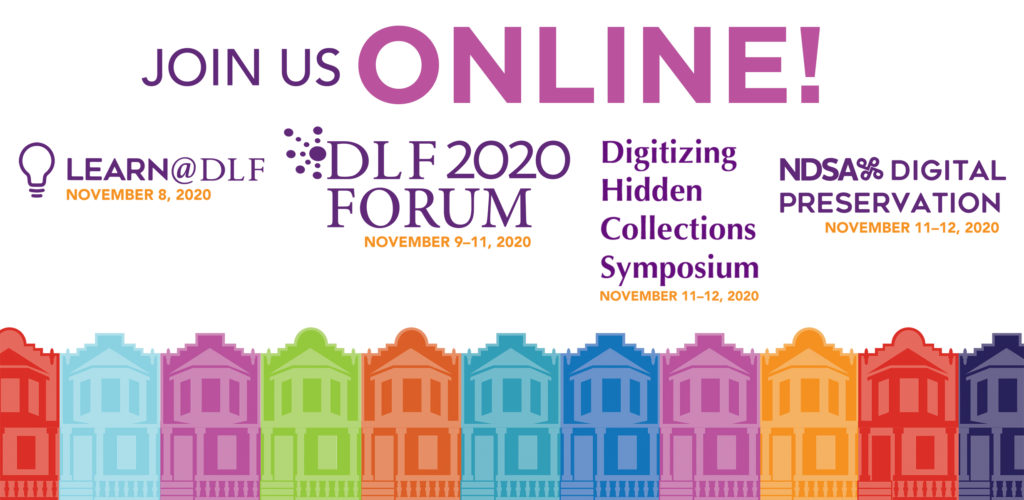
The Awards will be presented during the upcoming NDSA Digital Preservation conference, to be held online in November.

Looking for your feedback on the V2.0 of the Levels of Preservation

We can’t believe it’s been almost 9 months since Version 2 of the Levels of Preservation was released at DigiPres 2019! As we continue to move forward with other resources that build on the revised Levels, we wanted to hear from you about how the revisions and associated documents like the Implementation Guidelines and Assessment Tool have worked for you over these past 9 months.  

If you have used the revised Levels or associated materials, we would love to know how you used them and how they were useful to you and your organization! Please send us an email at ndsa-digipres@gmail.com or fill out this form.  Responses are requested by July 31, 2020.  

~ The Levels of Preservation Steering Group

Turkish Translations of the 2019 Levels of Preservation Implementation Guide and Matrix

The NDSA is pleased to announce that the 2019 Levels of Preservation documents have been translated into Turkish by Özhan SAĞLIK who is working as a lecturer in the Bursa Uludag University Library. Levels are desired to use for institutions to assess their digital preservation activities in Turkey.

Translations were completed for the Implementation Document of the 2019 Levels of Digital Preservation, and the black and white version of the Levels of Digital Preservation Matrix.

Links to these documents are found on the 2019 Levels of Digital Preservation OSF site (https://osf.io/qgz98/).

If you would be interested in translating the Levels of Digital Preservation V2.0 into another language please contact us at ndsa.digipres@gmail.com.

NDSA, 2019 Koruma Düzeyleri çalışmasının Bursa Uludağ Üniversitesi Kütüphanesinde öğretim görevlisi olarak çalışan Özhan Sağlık tarafından Türçe’ye tercüme edildiğini duyurmaktan kıvanç duyar. Düzeylerin Türkiye’deki kurumların sayısal koruma faaliyetlerini değerlendirmek amacıyla kullanılması hedeflenmektedir.

Tercüme, 2019 Sayısal Koruma Düzeylerinin Uygulama Dokümanı ve Sayısal Koruma Düzeyleri Matriksinin siyah-beyaz versiyonlarını içermektedir.

Bu çalışmaların bağlantıları OSF’de 2019 Sayısal Koruma Düzeyleri sayfasında yer almaktadır (https://osf.io/qgz98/).

Now Available: French Translations of the 2019 Levels of Preservation and Associated Documents

The NDSA is pleased to announce that the 2019 Levels of Preservation documents have been translated into French by our colleagues from the French National watch unit on file formats which includes institutions like the National Library of France, the Departmental Archives of Moselle, or the École nationale des Chartes.

Translations for the Assessment Tool Documentation and Case Studies, the Assessment Tool Template, the Implementation Document of the 2019 Levels of Digital Preservation, and both versions of the Levels of Digital Preservation Matrix were completed.  

Links to these documents are found on the 2019 Levels of Digital Preservation OSF site (https://osf.io/qgz98/) as well as below.

  • Levels of Digital Preservation Implementation Document and Matrices: hal-02551807
  • Assessment Tool Documentation and Template: hal-02552208

If you would be interested in translating the Levels of Digital Preservation V2.0 into another language please contact us at ndsa.digipres@gmail.com


Version française des Niveaux de Préservation Numérique  2019 (NDSA) et les documents associés

La NDSA a le plaisir de vous annoncer que la version 2019 des documents sur les Niveaux de Préservation ont été traduits en français par les collègues de la Cellule Nationale de veille sur les formats, qui inclut des institutions telles que la Bibliothèque nationale de France, les Archives Départementales de la Moselle ou l’École nationale des Chartes.

Les versions traduites incluent le document 2019 sur “l’Utilisation des Niveaux de Préservation Numérique”, accompagnant les 2 versions des matrices du Niveaux de Préservation, ainsi que le mode d’emploi pour “Utiliser les Niveaux de Préservation Numérique comme un outil d’évaluation”, avec le modèle correspondant.

Des liens vers ces documents peuvent être trouvés sur le site OSF du “2019 Levels of Digital Preservation”, ou bien ci-dessous.  OSF: https://osf.io/qgz98/

  • Utilisation des Niveaux de Préservation Numérique : hal-02551807
  • Utiliser les Niveaux de Préservation Numérique comme un outil d’évaluation : hal-02552208

Si vous êtes intéressé pour traduire les Niveaux de Préservation Numérique v2.0 dans une autre langue, merci de nous contacter à l’adresse ndsa.digipres@gmail.com


DLF Forum and Fall Events Move Online

2020 Forum & Affiliated Events

Based on the overwhelming responses to our community survey, the number and distribution of proposals for all CFPs, and CLIR’s ongoing monitoring of the pandemic situation, it has become clear to us that for the health and safety of our attendees and presenters, we must transition all of our fall events to a virtual format. We are sorry we won’t be able to explore Baltimore in 2020, but we’re already making arrangements to hold our 2022 events there, so we’ll just have to wait a bit longer to enjoy time together in Charm City.

What does this mean for 2020? We are not entirely sure yet, but we would love your input. We are happy to share this second community survey about virtual events in which we ask for your thoughts on what you’d like to see from a virtual CLIR/DLF event or series of events this fall. We would appreciate your input by Monday, June 1.

We understand that you may have questions, and while we may not have the answers just yet, we welcome the dialogue with you. Please don’t hesitate to reach out to us at forum@diglib.org, and thank you so much for your understanding and patience during this unprecedented time. Stay healthy and safe, and we’ll be in touch with more soon.

NDSA Welcomes Three New Members!

As of April 2020, the NDSA Leadership unanimously voted to welcome its three most recent applicants into the membership.

  • University of Dayton
  • Rhode Island School of Design (RISD)
  • University of California, Berkeley Library

This brings the total membership to number over 250 members! Each of these new members brings a host of skills and experience to our group. Dayton works actively to support scholarship teaching and learning; RISD has over 18TB of digital materials and has an IMLS grant to implement a new DAMS; Berkeley, led by Coordinating Committee Member, Salwa Ismail, has been solidifying its born digital workflows and is developing a web-archiving program. 

Each of these organizations has new additions to our various interest and working groups – so keep an eye out for them on your calls and be sure to give them a shout out. Please join me in welcoming our new members. To review our list of members, you can see them here.


Skip to content