It’s here, the 2023 NDSA Preservation Storage Infrastructure Survey!

Do you manage and preserve content? If so, we’d like to know about your preservation storage infrastructure! The NDSA Preservation Storage Infrastructure Working Group is back again, with our latest iteration of the NSDA Preservation Storage Infrastructure survey. Please contribute to our longitudinal research designed to gain insight into how organizations worldwide use preservation storage to ensure long-term access to their digital content and to learn how real-world capacity and best practices differ.  

The survey will remain open until November 22, 2023 and should take approximately 30 minutes to complete. We will make our best effort to protect your individual responses so that no one will be able to connect your responses with you or your organization. Any personal information that could identify you or your organization will be removed or changed before survey results are made public. We will combine your responses along with the responses of others and make the aggregated results public in mid-2024. To assist with completing the survey all of the survey questions can be viewed in advance

The results of our previous studies are provided here for your perusal:  2011, 2013, 2019

Please do not hesitate to reach out to the survey Co-chairs, Amy Allen (ala005 [at] uark [dot] edu) and Sibyl Schaefer (sschaefer [at] ucsd [dot] edu) with any questions you have about the survey.  

Thank you for your participation, and thank you for helping NDSA and our community define and advance digital preservation!

~ The NDSA Storage Infrastructure Survey Working Group

Announcing Incoming NDSA Coordinating Committee Members for 2024-2026

Please join me in welcoming the three newly elected Coordinating Committee members: Michael Barera, Chelsea Denault, and Jessica Venlet. Their terms begin January 1, 2024 and run through December 31, 2026.  Read more about their backgrounds and interest below.  

Michael Barera

Michael Barera has been the Assistant Archivist and Digitization Specialist at the Milwaukee County Historical Society (MCHS) Research Library since June 2022. This position ranges broadly from traditional archival responsibilities such as digitization, processing, and reference to unique and often innovative programs and projects related to Milwaukee history, including creating questions for and calling Milwaukee History Trivia Nights at local breweries and leading historical kayak tours on the Milwaukee River. Michael earned a Bachelor of Arts (BA) in history from the University of Michigan in 2012 and obtained a Master of Science in Information (MSI) in both Archives and Records Management (ARM) and Preservation of Information (PI) from the University of Michigan School of Information in 2014. Prior to taking his current position at MCHS, he previously served as an Assistant Archivist at the Texas A&M University-Commerce Libraries (from 2015 to 2019) and as the University and Labor Archivist at the University of Texas at Arlington Libraries (from 2019 to 2022). He has been a Certified Archivist since 2016.

Michael ran for NDSA Coordinating Committee for two primary reasons. The first is to bring the perspective of a small but innovative county historical society to the committee. The second is to learn from the committee and engage more deeply with NDSA as a whole, with the ultimate goal of learning more born-digital and digitization best practices that can be realistically implemented at MCHS and thus raise its level of practice.

Chelsea Denault

Chelsea leads the Michigan Digital Preservation Network, a program of the Midwest Collaborative for Library Services with support from the Library of Michigan. As the MDPN’s Coordinator, she works to build a community-centered statewide service focused on leveraging shared resources and expertise to make digital preservation affordable and accessible to all cultural memory institutions. As part of her efforts, Chelsea provides guidance and training on digital preservation in Michigan and leads the MDPN’s policy development and member recruitment. She also serves as the PI for the MDPN’s IMLS-funded grant to explore simplifying digital preservation workflows and provide training for non-technical users at under-resourced institutions in Michigan and beyond. Chelsea has served the NDSA on the DigiPres Conference Planning Committee (2021-2023) and the Long-Term Conference Planning Working Group. She also represents the MDPN in the Private LOCKSS Network (PLN) Community, and contributes to the Cross-PLN Technical Committee and the Shared Messaging Group. Before joining the MDPN, Chelsea was a public historian engaged in community outreach and collections work, and she holds an MA and a PhD in Public History/US History from Loyola University Chicago. Chelsea is guided by the MDPN’s commitment to small, underserved organizations, and plans to represent their needs on the Coordinating Committee.

Jessica Venlet

Jessica Venlet works as the Assistant University Archivist for Digital Records and Records Management at the University of North Carolina at Chapel Hill Libraries. In this role, she is responsible for a variety of things related to both records management and digital preservation. In particular, she leads the processing and management of born-digital archival materials.

Jessica is drawn to participation with NDSA because of how valuable the resources and network are to her work and to the profession overall. She has recently participated in working groups for the 2019 Levels of Digital Preservation Reboot (assessment subgroup), the 2021 NDSA Staffing Survey, and the 2023 NDSA Excellence Awards. She is excited to join the Coordinating Committee and contribute to the continued development of the NDSA organization and all its associated programs and working groups.


We are also grateful to all of the very talented, qualified candidates who participated in this election.

We are indebted to our outgoing Coordinating Committee members, Elizabeth England, Jes Neal, and Linda Tadic, for their service and many contributions. To sustain a vibrant, robust community of practice, we rely on and deeply value the contributions of all members, including those who took part in voting.

Bethany Scott, Vice Chair, on behalf of the NDSA Coordinating Committee

Catching up with past NDSA Excellence Awards Winners: Tessa Walsh

The NDSA Individual Excellence Award honors individuals making significant contributions to the digital preservation community. In 2019, Tessa Walsh was one of two awardees in this category. Tessa has created an evolving suite of robust open source tools meeting many core needs of the stewardship community in appraising, processing, and reporting upon born-digital collections. At the time of the award, her projects included the Brunnhilde characterization tool; BulkReviewer, for identifying PII and other sensitive information; the METSFlask viewer for Archivematica METS files; SCOPE, an access interface for Archivematica dissemination information packages; and CCA Tools, for creating submission packages from a variety of folder and disk image sources. Taken together, these tools support a very wide gamut of both technical and curatorial activities. 

We recently caught up with Tessa to chat about the Excellence Awards. Read on to hear more about what Tessa has been working on recently! 

1) What have you been doing since receiving an NDSA Excellence Award?

I’ve been busy! Other than the whole global pandemic bit, I shifted from an archivist/librarian coding off the side of my desk to a professional software developer working on open source digital preservation tools, which has been a dream.

From March 2020 (the same week lockdown started here in Montreal) to September 2022, I worked as a Software Developer at Artefactual Systems, primarily on the Archivematica and Access to Memory (AtoM) projects. Getting a chance to grow leaps and bounds as a developer while working on open source software that the digital preservation and archival communities are heavily invested in was a dream come true. And as anyone who has had the chance to work with the folks at Artefactual will know, it’s a really supportive environment filled with kind, curious, multi-skilled people. I’m proud of some of the features I was able to work on there, including implementing an storage adapter for Archivematica to work with nearly any cloud storage provider, adding single sign-on to Archivematica and AtoM, helping users with their migration and theming projects, and working on some supplementary tools for things like reporting and audit logging.

In September 2022, I took a new role as Senior Applications and Tools Engineer at Webrecorder. Getting to work on a friendly and talented small team developing user-friendly open source solutions to challenging problems in web archiving has been fantastic. Since starting at Webrecorder, I’ve made contributions to pywb and Browsertrix Crawler, and have been heavily involved in the development of Browsertrix Cloud, a new open source cloud-native browser-based crawling service that unifies several Webrecorder tools into a single easy-to-use web application for creating, managing, curating, and sharing web archives. We’ve been hard at work developing both the software as well as a sustainable open source business model around it, and will be launching a hosted service as well as support models for the open source software in the coming months and year. It’s a really exciting time to be at Webrecorder, and I’m excited for us to continue furthering Webrecorder’s mission of web archiving for all.

I’ve also kept developing and maintaining a small set of my own open source projects, including putting out several releases of Bulk Reviewer (https://github.com/bulk-reviewer/bulk-reviewer/), a desktop application that aids users in finding and managing private and sensitive information in digital archives that is now included in the BitCurator Environment.

Finally, I’ve had the pleasure of being involved in a few research projects that I hope are helping to push forward thinking on topics that are of special interest to me. With Keith Pendergrass, Walker Sampson, and Laura Alagna, I published the paper “Toward Environmentally Sustainable Digital Preservation” in American Archivist in late 2019, which explores the environmental impact of digital preservation practice and suggests ways for the field to move forward in a more sustainable fashion. With Aliza Leventhal and Julie Collins, I published “Of Grasshoppers and Rhinos: A Visual Literacy Approach to Born-Digital Design Records,” also in American Archivist, in 2021. The paper applies a visual literacy approach to notoriously difficult digital design records such as CAD/BIM and 3D models in architectural archives with the hopes of making these materials more approachable to those responsible for preserving and providing access to them. And finally, with Jess Whyte, I’ve also been conducting interviews with Canadian memory workers on the issues they face and strategies they use in managing private and sensitive information in digital collections. Our paper, titled “‘Carefully and Cautiously’: How Canadian Cultural Memory Workers Review Digital Materials for Private and Sensitive Information,” will be published later this year in the open access journal Partnership: The Canadian Journal of Library and Information Practice and Research.

2) What did receiving the NDSA award mean to you?

Receiving the NDSA award validated the work that I was doing in trying to develop and maintain open source software that makes digital archiving and digital preservation work easier for practitioners. It helped me get over a bit of imposter syndrome and find the confidence to pursue software development as a career rather than just an interest, which I’m deeply grateful for! I hope and suspect it also introduced some new folks to some of the tools that I’d been working on, which is always nice.

3) What efforts/advances/ideas of the last few years have you been impressed with or admired in the field of data stewardship and/or digital preservation?

I think the conversations around environmental sustainability that have been happening in the last few years are wonderful and needed, especially as we see the effects of climate change unfold in real time. Digital stewardship will need to both respond to increasing risks of events like data center outages, and it behooves us to try to reduce our footprint as we can through classic archival practices like careful selection and new techniques like threat modeling and using defined levels of preservation tiers appropriate for various types of content being stored.

In the web archiving space, I’ve been really excited about the possibilities afforded by client-side replay in the browser made possible by Webrecorder’s replayweb.page tool. By being able to render and rewrite web archives in the browser we remove the need to upload data to a server in order to replay web archives and open up new exciting possibilities for access such as embedding web archive viewers into preservation and access systems (for more on that, see: https://replayweb.page/docs/embedding). I’m a big proponent of putting the focus on access to content that we’re preserving and I think this is a big step forward for web archives on that front!

4) How has your work evolved since you won the Excellence Award?

Since winning the Excellence Award, I’ve been fortunate to receive a lot of mentoring and have grown into a senior developer, which is really exciting personally. I’ve also had the opportunity to deepen my thinking on the sustainability of open source projects that the digital stewardship and preservation fields rely on through firsthand experience as a solo maintainer and as a person working on larger open source projects with many contributors. It’s a difficult thing to get right but really important, as we don’t want the burden of maintaining these tools to fall on individuals who aren’t compensated for their labor or for projects to become abandoned after being widely adopted.

5) What do you currently see as some of the biggest challenges or opportunities in digital preservation?

One thing I see as both a challenge and an opportunity currently is beginning to shift the focus from preserving content to providing open, sophisticated, useful access. Ultimately the goal of preservation is (or should be!) for someone to come use what we’re preserving. As the field matures and gets more comfortable in our preservation practices, I think there are a lot of interesting opportunities to demonstrate our value by connecting preserved content to users in forms that are useful to them, whether that means providing computational access to data, making it easier to integrate preserved content with our access systems, or pushing content to where people already are.

I’d also love to see us continue to lower the technical barriers to entry for digital preservation practice. A lot of the tools we rely on assume a certain level of competence with command line interfaces and scripting languages. Those tools can be great for providing a lot of flexibility to practitioners, and the field has done a lot to make learning these skills easier. That said, requiring such skills can also make it difficult to hire and mentor the next generation of digital stewards. I’d love to see our common toolsets continue to get more approachable and easier to use so that we can continue to grow and diversify our field of practitioners.

6) Are you working on any new digital preservation related tools at the moment? If so, could you please share a bit about the tool(s).

I’ve mentioned a few tools already, but I’d like to talk a little bit more about Browsertrix Cloud, the focus of a lot of my activity at Webrecorder these days. In the early days of development, a lot of our focus was on supporting functionality that were already possible through tools like Browsertrix Crawler in a more user-friendly and modern user interface. Now we’re focusing on building features that are new to Webrecorder, such as building and publicly sharing curated collections of web content, and integrating Browsertrix Cloud with existing tools like the archiveweb.page Chrome extension for manually archiving websites in your browser. By the end of the year, we’ll be working on some features that are I think relatively new to the web archiving field as a whole. I’m particularly excited about starting to work on software-assisted quality assurance (QA) of crawls, where we will be analyzing the WACZ files created by our crawler and presenting information to the end user about the relative quality of capture for the pages that have been crawled. That’s really just a start and I’m sure we’ll continue to refine what assisted QA can entail, but it aligns super well with my personal mission of using software to make currently onerous tasks easier for digital stewards, freeing them to use their time on the tasks where our expertise is most valuable.

Click here to read about other winners from the 2019 NDSA Innovation Awards!

How do you use the NDSA Levels of Digital Preservation?

Earlier this year the Levels Steering Group gathered feedback from the community about how the Levels of Digital Preservation were used. Some of our findings have already been shared in the following blog posts – Finding out more about the use of the NDSA Levels of Digital Preservation and National Libraries and the Levels of Digital Preservation. This is the third and final blog post in this series.

As noted in previous blog posts, there was a modest number of responses to our scenarios gathering exercise, so the results shared below offer only a small snapshot of community use of the Levels rather than representing a statistically valid set of results.

Here we focus on just one of the questions that was asked in our scenarios survey, though note this was actually several questions in one, digging into some of the different aspects of how organizations use the Levels. We’ll take each of those sub-questions in turn…

Describe how your organization uses the NDSA Levels.

The responses included some interesting examples of how people use the NDSA Levels, with some using them in quite specific ways.

  • One organization uses an approximation of the NDSA storage levels to define the different types of storage available for their digital assets.
  • A nice example of how one respondent uses the levels is their use to create and implement a basic repository-wide digital preservation system.
  • Another respondent notes a preference for DPC’s Rapid Assessment Model (DPC RAM), but states that they do like to directly refer to the NDSA Levels when they have a reason to articulate maturity levels relating to a specific row (for example metadata).
  • A couple of other responses mention using the Levels alongside other tools – one as a quick assessment tool alongside DPC RAM and another in conjunction with both DPC RAM and the DiaGRAM tool.
  • Another mentioned using the Levels as a means of teaching both students and practicing professionals about digital preservation.

One response to this question was that the Levels are not currently used at all because initial steps to persuade senior administrators about the need for digital preservation have not yet been made.

How frequently do you use them?

Out of the answers provided to this question, it seemed that the Levels are not typically used on a regular cycle (for example as an activity that is carried out to an agreed schedule every 1 or 2 years), rather they are used in a more ad hoc fashion or as a result of specific triggers or drivers.

  • One respondent mentioned that “we do not use the NDSA Levels in a systematic way”.
  • Another noted that though they aim to complete it annually, in reality they might actually have a delay of two or three years in between assessments.
  • Particular triggers that were noted by other respondents that could lead to a re-assessment using the Levels might be when digital preservation policies and plans are being reviewed or if other tools that rely on the Levels are being applied (the DiAGRAM tool from The National Archives UK was mentioned in this context).
  • Another respondent mentioned that they had used the NDSA Levels at the start of their digital preservation journey and have used it to check in on progress a couple of times since. They have a plan to continue to incorporate regular assessment going forward.

Who gets involved?

There were a range of responses to this question, with some answers stating that the digital archivist will carry out a self-assessment using the Levels alone, a couple of answers mentioning that a colleagues in either their department or in IT will also be involved and another stating that though the assessment is driven by the digital archivist, other internal stakeholders would be consulted as appropriate.

Who is the resulting information communicated to?

Some of the responses to this included:

  • Information produced as part of an assessment using the Levels is typically communicated internally with colleagues – both staff within the respondent’s department, senior administrative staff and other stakeholders. In particular, senior staff were considered to be an important audience for this information.
  • One respondent noted that the information was used “as a way to help explain community expectations to traditional IT staff”.
  • Another noted that the information was communicated outside of their organization as evidence for their application for Archives Accreditation.

It is encouraging to see the NDSA Levels being used as an advocacy and communication tool within several organizations.

What documentation is maintained about the process?

There was little response to this sub-question, but one respondent noted that they retain a filled in report for their records and to facilitate the tracking of progress over time. Another noted that documentation about their self assessment using the Levels is kept as part of their organizational records and another specified that both the assessment and notes about it were kept on their internal wiki area. This is encouraging to see – given the Levels can be used to track and monitor progress over time, keeping records of previous assessments and notes relating to why a particular level was selected is an important way to facilitate future comparisons.

Does this process tie in with organizational review and planning cycles?

Several respondents mention how their use of the Levels ties in with planning.

  • One states the Levels are used to plan their digital preservation program and also that the use of the Levels does tie in with planning for future software and equipment upgrades.
  • Another states that their use of the levels ties into planning cycles so they can identify target areas for resource investment.
  • Another mentions that they have referenced the Levels in the Digital preservation Strategic Plan and mapped out strategic priorities and actions against it.
  • One person stated that “it does not tie in with any organizational review or planning cycles.

There are likely to be benefits in regularly using the Levels as a check in when reviewing progress and planning future work, so it is encouraging to see that several people were using them in this way.

Summary

It is interesting as ever to share information about the different ways that the community uses the NDSA Levels of Digital Preservation. Hopefully this small snapshot gives you some ideas to take away and use within your own organizations.

Thank you and next steps

Thanks again to all of those who submitted information to us on their uses of the Levels. As always, we encourage the whole community to provide feedback on the Levels at any time. We are currently considering whether a review or update to the Levels is required in 2024 and are interested in hearing from the community if there are things that you think need to change. You are also welcome to come to our next Open Office Hour session on October 18th at 11:30 AM Eastern Time. Connection details and notes from past sessions are available here


NDSA Welcomes Two New Members in Quarter 3 of 2023

As of September 2023, the NDSA Leadership unanimously voted to welcome its two most recent applicants into the membership. Each new member brings a host of skills and experience to our group. Keep an eye out for them on your calls and be sure to give them a shout out. Please join me in welcoming our new members! To review our list of all members, you can see them here.

~ Bethany Scott, NDSA Coordinating Committee Vice-Chair

Loras College Center for Dubuque History

The Center for Dubuque History is home to many rare images, documents, and AV materials, and they are committed to making them more accessible through digitization. They are still in the early stages of this process, but after attending a Digital POWRR Institute, they are on their way and are eager to join a group where they can both learn and share our experiences with others as they gain expertise. 

Open Preservation Foundation

The Open Preservation Foundation are a global not-for-profit membership organization working to advance shared standards and solutions for the long-term preservation of digital content. Through the development of open source tools, they enable memory institutions to preserve their digital collections. Two of their staff are already contributing to NDSA by being part of the DigiPres Program Committee.


Catching up with past NDSA Excellence Awards Winners – Arina Melkozernova

In 2021, Arina Melkozernova received the Future Steward award in recognition for her work and advocacy for “community-driven research that adopts Indigenous methodological and analytical frameworks” that contribute to “advancing knowledge across a variety of fields.” One project was the curation and translation in support of “A Journal of the Plague Year: An Archive of Covid-19,” created in response to the needs of Indigenous partners during the pandemic. Another project provided assistance to a partnership between Coushatta Tribal Archives and Arizona State University. Through this partnership she “explored new tools and software to help preserve, manage, and provide access to digitized material” and increase access to Coushatta history. Alongside archivists from the Coushatta Heritage Department, Arina worked with Mukurtu developers to create a site to ”satisfy the needs of a digital library, featuring important tribal governing documents, reports, photographs, maps,” and “shared herknowledge of best practices.”

Arina continues to advocate for and contribute to best practices that utilize Indigenous knowledge and methodologies. When we contacted her about her recent work at the Smithsonian, she offered the following responses.

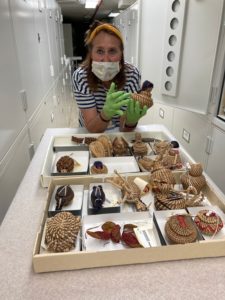
Arina Melkozernova looking at woven baskets

1) What have you been doing since receiving an NDSA Excellence Award?

The NDSA award coincided with an invitation to join the “Mapping Traditional Knowledge and Land Use Practices among Southern Tribes/Leadership and Integrative Studies” project with the MOWA Tribal Band of Choctaw Indians led by Dr. Denise Bates. When I had a privilege to explore the Smithsonian collection as a SIMA fellow, I conducted an inventory of Koasati baskets and archival materials about Choctaw culture in the Museum Support Center. The two narratives arose from this data: one about everyday use of baskets made by weavers from the Coushatta Tribe of Louisiana and another – about the ecological resource usage preserved through the stories of the place of the Coushatta and MOWA Choctaw communities. 

2) What did receiving the NDSA award mean to you?

I am thankful for the NDSA recognition of my modest efforts. The NDSA award made me aware of my responsibilities as a researcher and as a member of digital preservation community. The concept of the object’s biographies introduced during the SIMA fellowship combined with a non-western perspective on the baskets’ living properties afforded the opportunity to tell stories about basket weavers in a way that empowers their community and restores their spiritual connections with a place. It highlights the role of women in the tribal economy. The values of Object stories are in reconnection to the place because baskets are the “physical manifestation of knowledge our ancestors left to us. Our responsibilities to take care of the objects and learn from them” as Joe Horse Capture, second-generation indigenous curator, described (lecture, SIMA, June 27 2022)

The most crucial is to recognize that there are different knowledges. Kindly, allow me to tell my story from many years ago when I traveled to the Far East of Russia to do a fieldwork. 

Imagine sitting in a shallow motor boat in the ocean surrounded by thick fog, so thick that you cannot see a palm of your hand in front of your face. You heard that this fog from rapidly melting icebergs could last for couple of weeks. Women and kids in the boat are crying fearing of drifting into the open sea without water or food. There I was, almost ready to graduate with my life science degree, completely disoriented and despaired. The fisherman on the boat saved our lives. He was Nivkh, the local indigenous person. He found the path to the land in zero visibility. The Nivkh fisherman had learned from his culture how-to navigate the surroundings that cannot be explained or framed with any oral language, only rest on this particular experience. I am here today because of this Nivkh fisherman’s skills and his knowledge of a sea navigation in extreme fog. Unfortunately, there is no technology to preserve certain embodied skills without supporting traditional lifestyle.

Although our data show that Coushatta and MOWA Choctaw communities are facing the common challenges to preserve their traditional lifestyle, my work is focused on translating the traditional knowledges and with technologies that are available today. For example, using the eco-geographical mapping method allows visualizing cultural intelligence and preserving community memories to secure the future of the next generations. Having guided by mentors access to searchable databases at the Smithsonian during the SIMA fellowship facilitated my ability to connect the baskets’ tangible and intangible qualities to the traditional knowledge embedded in them and to basket weavers, who embodied this entanglement.

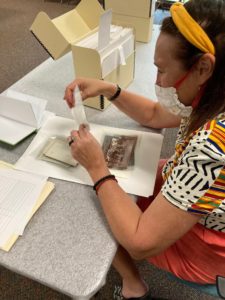
3) What efforts/advances/ideas of the last few years have you been impressed with or admired in the field of data stewardship and/or digital preservation?Arina Melkozernova looking at photographs

I see how the museum culture is changing to embrace non-Western knowledge systems. I appreciate the everyday efforts and baby steps that transforming the fields of anthropology and biology. I observe how the Smithsonian museum is becoming a meeting space to build allies. Their Repatriation Office collaborates with Native American, Alaska Native and Native Hawaiian tribal representatives. Multiple databases are searchable and accessible. I was

pleasantly surprised that herbariums are completely digitized! And some descriptions contain common names listed in native languages with English transcription! (Try to search for Abelmoschus moschatus Medik). However, the references to the traditional ecological knowledge is missing. This will be my next collaborative project.

4) How has your curation evolved since you won the Excellence Award?

I am grateful to Dr. Denise Bates, Museum Director Maggie Rivers, and the members of the MOWA Band of Choctaw Indians for the opportunity to prepare a collection of traditionally cultivated plants for the display in the MOWA Choctaw museum. To extend the narrative, I plan to analyze further in depth the ecological resource usage preserved through the stories of the place along with the traditional knowledge embedded in them. Data from the various documents from the National Archives that describes medicinal, sacred and nutritional qualities of source materials along with stories of plants gathered locally will be presented in Choctaw language. Every deliverable will be evaluated by the community and approved by the director of the museum.

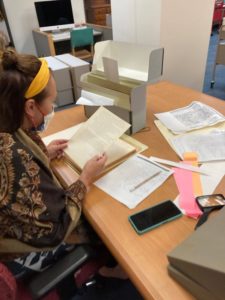
Arina Melkozernova looking at documents

5) What do you currently see as some of the biggest challenges in digital preservation?  

As a non-indigenous researcher involved in collaborations with tribes, I see personal challenges that are common for the field of digital preservation. To become a Western interdisciplinary scholar, who supports involvement of indigenous knowledge holders in framing research questions, shaping analyses, and determining research instruments based on their assumptions, values, concepts, orientations, and priorities for co-producing results means to unlearn colonial gaze and relearn two-eye seeing. The biggest challenge is to set the rules for the knowledge sharing and decide on the format that is not harmful to the community. Making such decisions requires building the trust, which takes time. Following the principles of the community-driven participatory research support is important for arriving to a common space from which the collaboration between Indigenous scholars and TEK holders and Western scientists could emerge. In digital preservation field, the expectations are the same – respect, reciprocity and data sovereignty.

Reach out to Arina via her Twitter handle –   @melkozernova

Read about other 2021 Excellence Awards winners here!

NDSA Announces 2023 Slate of Candidates for Coordinating Committee

NDSA is happy to announce the 2023 slate of Coordinating Committee (CC) candidates. Elections will soon be held for three (3) CC members. The CC is dedicated to ensuring a strategic direction for NDSA, to the advancement of NDSA activities to achieve community goals, and to further communication among digital preservation professionals and NDSA member organizations. The CC is responsible for reviewing and approving NDSA membership applications and publications; updating eligibility standards for membership in the alliance, and other strategic documents; engaging with stakeholders in the community; and working to enroll new members committed to our core mission. The successful candidates will each serve a three year term. Ballots will be sent to membership organization contacts in the coming weeks.  (Only one vote per organization.)

Michael Barera

Michael Barera has been the Assistant Archivist and Digitization Specialist at the Milwaukee County Historical Society (MCHS) Research Library since June 2022. This position ranges broadly from traditional archival responsibilities such as digitization, processing, and reference to unique and often innovative programs and projects related to Milwaukee history, including creating questions for and calling Milwaukee History Trivia Nights at local breweries and leading historical kayak tours on the Milwaukee River. Michael earned a Bachelor of Arts (BA) in history from the University of Michigan in 2012 and obtained a Master of Science in Information (MSI) in both Archives and Records Management (ARM) and Preservation of Information (PI) from the University of Michigan School of Information in 2014. Prior to taking his current position at MCHS, he previously served as an Assistant Archivist at the Texas A&M University-Commerce Libraries (from 2015 to 2019) and as the University and Labor Archivist at the University of Texas at Arlington Libraries (from 2019 to 2022). He has been a Certified Archivist since 2016.

Michael is running for NDSA Coordinating Committee for two primary reasons. The first is to bring the perspective of a small but innovative county historical society to the committee. The second is to learn from the committee and engage more deeply with NDSA as a whole, with the ultimate goal of learning more born-digital and digitization best practices that can be realistically implemented at MCHS and thus raise its level of practice.

Chelsea Denault

Chelsea leads the Michigan Digital Preservation Network, a program of the Midwest Collaborative for Library Services with support from the Library of Michigan. As the MDPN’s Coordinator, she works to build a community-centered statewide service focused on leveraging shared resources and expertise to make digital preservation affordable and accessible to all cultural memory institutions. As part of her efforts, Chelsea provides guidance and training on digital preservation in Michigan and leads the MDPN’s policy development and member recruitment. She also serves as the PI for the MDPN’s IMLS-funded grant to explore simplifying digital preservation workflows and provide training for non-technical users at under-resourced institutions in Michigan and beyond. Chelsea has served the NDSA on the DigiPres Conference Planning Committee (2021-2023) and the Long-Term Conference Planning Working Group. She also represents the MDPN in the Private LOCKSS Network (PLN) Community, and contributes to the Cross-PLN Technical Committee and the Shared Messaging Group. Before joining the MDPN, Chelsea was a public historian engaged in community outreach and collections work, and she holds an MA and a PhD in Public History/US History from Loyola University Chicago. Chelsea is guided by the MDPN’s commitment to small, underserved organizations, and is interested in representing their needs on the Coordinating Committee.

Brenna Edwards

Brenna Edwards is currently Manager for Digital Archives at the Harry Ransom Center at The University of Texas at Austin. Previously, she was Project Digital Archivist at the Stuart A. Rose Manuscript, Archives, and Rare Book Library at Emory University. She has a BS from Tennessee Tech University and an MSLS from the University of North Carolina at Chapel Hill. Outside of work, she can be found either reading, knitting, or watching movies – some of them at the same time! 

Having been involved with the 2022 NDSA Staffing Survey and helping plan the 2022 NDSA Conference, Brenna is interested in joining the Coordinating Committee to help further expand the goals of the organization. She has also recently worked with an on-campus digital preservation group focusing on the NDSA Levels and how they can be best implemented across campus. Brenna has also served as co-leader for the DLF Born Digital Description in Finding Aids subgroup of Born Digital Access Working Group to document various ways born digital materials are described in finding aids across a variety of institutions.

Thomas Pulhamus

Tom is the Digital Technology Librarian at the University of Delaware, where he has worked for the past fifteen years. He started as a salaried staff member before his position was professionalized in 2018 and he assumed his current title. Tom works on various facets of digitization and digital preservation for the UD Library, Museums and Press. Currently that work includes developing a digital preservation plan for the UD Library, Museums and Press as well as incorporating reparative justice and harm reduction practices into digitization and digital preservation workflows. Tom is deeply interested in issues of representation and access in digitization and digital preservation and sees the chance to serve on the Coordinating Committee as an opportunity to advance the key operational values of inclusiveness and collaboration. He has served on the DigiPres Planning Committee since 2020 and is also currently a member of the Long Term Conference Planning Working Group. Tom has a BA from Rutgers University, an MA in English from the University of Illinois Champaign-Urbana and an MLIS from the University of Wisconsin-Milwaukee.

Danielle Spalenka

Danielle Spalenka is the Digital Preservation Librarian at Indiana University. She provides vision and leadership in the development of digital preservation strategies for departments on the IU campus. She has over 10 years of experience providing education, outreach, consultation, and assessments related to preservation and digital preservation, with a focus on smaller institutions. She has been involved in the Digital POWRR Project in various roles since 2013, including instructor and Project Director. Danielle holds a BA in history from Saint Mary’s College (Notre Dame, IN), and earned her MA-LIS from the University of Wisconsin-Madison.

Jessica Venlet

Jessica Venlet works as the Assistant University Archivist for Digital Records and Records Management at the University of North Carolina at Chapel Hill Libraries. In this role, she is responsible for a variety of things related to both records management and digital preservation. In particular, she leads the processing and management of born-digital archival materials.

Jessica is drawn to participation with NDSA because of how valuable the resources and network are to her work and to the profession overall. She has recently participated in working groups for the 2019 Levels of Digital Preservation Reboot (assessment subgroup), the 2021 NDSA Staffing Survey, and the 2023 NDSA Excellence Awards. She is excited about the possibility of joining the coordinating committee and contributing to the continued development of the NDSA organization and all its associated programs and working groups.


NDSA Strategic Partnership Office Hours at iPRES

If you’re attending iPRES next week, come find NDSA on September 20th, 2:20-3:00pm in HH3! Representatives from NDSA will be holding office hours where members of other digital preservation communities are encouraged to drop in to discuss options for working together.

NDSA is looking for strategic partners across digital preservation, repository, and open infrastructure communities to work towards a common goal of advancing and advocating for digital stewardship. We are interested in exploring partnerships for conferencing, training, outreach, and advocacy, as well as having discussions around how best to align the efforts of digital preservation communities and membership organizations.

We will have ways for both in-person and virtual attendees to participate. We hope to see you there!


Peer Recognition and Motivation: Krista Oldham on the NDSA Excellence Awards

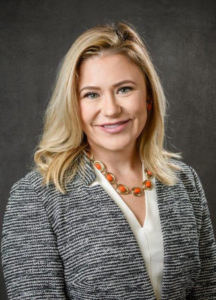
Krista Oldham headshot

Krista Oldham is the University Archivist at Texas A&M University, College Station, where her responsibilities include overseeing the acquisition, description, and preservation of University records, as well as supporting and promoting their use. Additionally, Krista provides oversight for the Texas A&M records management program. Prior to starting her position at Texas A&M, Krista worked at Clemson University as the University Archivist, Haverford College as the College Archivist/Records Manager for Quaker and Special Collections and at the University of Arkansas, Fayetteville Special Collections as the Senior Archivist and the Senior Archives Manager. In addition to her archival work, Krista served as Co-Director of the Arkansas Delta Oral History Project and  co-author of The Arkansas Delta Oral History Project: Culture, Place, and Authenticity, published in 2016.

Krista also co-chaired the Excellence Awards Working Group from 2021 to 2023. So, we reached out to her to ask for her perspective on these awards.

In what way are you connected to the National Digital Stewardship Alliance?

Currently, I am serving on the NDSA’s Long-term Conference Planning Working Group and I just confirmed my commitment to serving as a member of the NDSA Storage Survey Working Group. 

From your perspective, what do the NDSA Excellence Awards represent?

I think that they represent peer recognition of excellence in the field of digital preservation. I think the award encourages and motivates individuals to strive to advance digital preservation through meaningful contributions at an individual level and an institutional/programmatic level.

What efforts/advances/ideas of the last few years have you been impressed with or admired in the field of data stewardship and/or digital preservation?

For me, I have really enjoyed the community-driven digital preservation projects that have emerged in the last few years. I am extremely impressed when folk get together, collaborate, and pool resources to help others achieve their goals.

How do you feel the Excellence Awards encourage practitioners of digital stewardship/preservation?

I hope it encourages ideas and shows folks that their hard work matters and that the future success of digital preservation is a collaborative venture.

What do you currently see as some of the biggest challenges in digital preservation?

Not having the appropriate amount of resources and that can be monetary or staffing. The NDSA Staffing Survey, which I was a member of the WG, clearly indicated that staffing-levels are not where they need to be. I also think a challenge is working toward being environmentally sustainable with our digital preservation practices.

Mini-Job Fair at NDSA DigiPres 2023

While large professional organizations like ALA and SAA have organized job fairs to coincide with conferences, NDSA hasn’t yet done this, until now. After noticing people recruiting at digital preservation conferences in the past year, I began to think why not? Well, one good reason is that NDSA is not a dues-collecting professional organization and doesn’t have the same resources or capacity of ALA or SAA. It falls to individuals at member institutions to propose ideas and so I submitted a vague proposal that necessarily did not contain a lot of details. When it was accepted, I immediately realized that I needed help, even for a “mini” job fair and enlisted Robin Ruggaber, also a past NDSA Coordinating Committee Chair, to help pull it off. This blog post describes our vision for this session. 

In the coming months, Robin and I will be scouring listservs and job boards and reaching out to employers to identify five open jobs that can be highlighted during the session. We hope to represent different types of employers, such as higher education, government, service providers, and other cultural heritage organizations, small and large; and different types of jobs involving digital preservation skills such as, digital preservation librarian, preservation infrastructure engineer, digital archivist, or service manager. Preference will be given to employers that disclose pay, demonstrate a commitment to hiring and retaining a diverse and welcoming workforce, and to organizations that promote employee wellbeing. If you are or are planning to recruit for a digital preservation position during the time of the conference and are interested in participating, please contact Nathan Tallman (ntt7@psu.edu) or Robin Ruggaber (robin.ruggaber@virginia.edu). 

Each of these five jobs will be presented to the audience, hopefully by someone from the hiring organization. Presenters will be asked to share the expected impacts of a successful candidate within one week, one month, and one year of hire. Other details we expect to be shared include salary range, examples of how required and preferred qualifications may be met, and how to apply. No interviews are planned as part of this event. If there is extra time, other employers will be able to engage the audience in position design for anticipated digital preservation jobs. 

But that’s not all! In addition to highlighting five open jobs, Robin and I will recruit digital preservation managers willing to review resumes/CVs and coach applicants conducting a job search. We hope there will be enough space in Regency A to allow both activities to occur concurrently, but if needed resume/CV review and job coaching may occur throughout the venue. 

These are our goals for this session. Our ability to be successful largely depends on the job market this fall and the availability of digital preservation hiring managers during the conference. Some of these details might change for practical reasons as Robin and I carry out planning and logistics, but we are optimistic. As NDSA grows, more organizations are looking to hire. We hope this session will help make connections between people and employers and set a precedent in our community. 

Please join us on November 15th, 2:30-3:30pm in Regency A. 

~ Nathan Tallman, Past NDSA Coordinating Committee Chair 

Skip to content