Catching up with past NDSA Innovation Awards Winners: Mid-Michigan Digital Practitioners

The Mid-Michigan Digital Practitioners (MMDP) won a 2016 Innovation Award in the Organization category. MMDP was recognized for taking an innovative approach to providing support and guidance to the digital preservation community. The responses to this Q&A were provided by Rick Adler, Ed Busch, and Bryan Whitledge.

What have you/the project team been doing since receiving an NDSA Innovation Award?

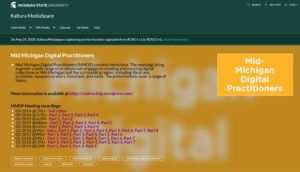
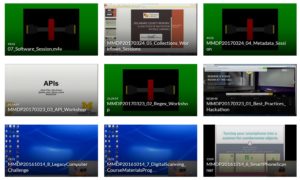
Since receiving the award, we have continued to do what we do best – connecting archivists, librarians, curators, historians, digital humanities experts, and other kindred professionals and students across Michigan. Cultural heritage workers have Screen shot of past Mid-Michigan Digital Practitioners meeting recordings on the MSU Kaltura websitea disposition to share knowledge with others. MMDP is all about sharing knowledge and our constituency is other cultural heritage workers. We connect via our semi-annual meetings (which, thanks to support from the Library of Michigan, and other institutions, have remained free for attendees) and through our listserv list.
In light of the public health emergency, we didn’t hold a spring meeting, but we did hold some virtual check-ins to connect with the MMDP community and share experiences about working from home, dealing with job cuts at our institutions, or returning to the physical workspace. We are looking forward to a fully virtual fall meeting – we think that the Mid-Michigan Digital Practitioners should be able to pull off a great virtual meeting!

One effort we undertook a few years ago was to create a directory of experts. Conferences and meetings are great, and so is a listserv list, but sometimes it is nice for one person to connect with another to speak in-depth about a specific topic. The directory is a list of MMDP members who are willing to share their expertise in different skills and tools with other MMDP members on a one-on-one basis. If someone is looking for someone with policy-writing skills, we’ve got that. If another person needs some help with StoryMapJS, we’ve got that, too. And if another MMDP member needs some help cataloging Cherokee-language materials, there is an expert who can help with that!

We also have an MMDP member who led a pilot grant in Michigan to explore the creation of a statewide digital preservation network. While the MMDP wasn’t part of the grant, we definitely contributed to getting the word out across the state. MMDP members have been at the table every step of the way. The project is now moving to the next phase in creating a digital preservation network and the MMDP is one venue for sharing information about the project with the people most likely to work with it.

What did receiving the NDSA Innovation award in 2016 for MMDP mean to you and/or the project team?

Back when we started, we were an experiment… and it worked. So, the recognition was very meaningful. The award definitely raised our profile outside of Michigan. Hopefully, we have inspired other digital practitioners from around the country to form similar groups. For us, in terms of our Michigan constituency, it reinforced our conviction that what we are doing is valuable and needs to be sustained. Many of our more recent members might not know about the NDSA Innovation award, but the commitment, effort, and spirit that led NDSA to bestow the award upon us are still present in everything we strive to do for our community.

What efforts, advances, or ideas over the last 5-8 years have caught your attention or interest in the area of digital stewardship?

Lowering the barriers to entry—across the board—for digital culture. The barriers are numerous and they aren’t solely financial. The network we mentioned a moment ago is an example of that. Here in Michigan, we have some world-class institutions and they can create homegrown digital preservation environments that are second-to-none. But we also have many small historical societies with historical collections that are just as important, yet they don’t have the tools, the staff, or the finances to allow them to join a major digital-preservation endeavor. MMDP members can help to make digital preservation accessible to institutions of all stripes in Michigan. Our members have varying levels of knowhow about a wide range of digital stewardship topics (advocacy, governance, technical infrastructure skills, developing training materials, etc.), and encouraging them to share what they know expands the potential of cultural heritage professionals around Michigan. Also, we can lean on the Screen shot of past Mid-Michigan Digital Practitioners meeting recordings on the MSU Kaltura websitetechnological tools and skills at those institutions that support the network to make the essential technology of digital preservation accessible to all at a relatively low cost. Hopefully, through a project like this, every library, archives, museum, and historical society in the state can jump in and join the digital preservation effort. And we can get all of those historic photos off of old flash drives!
Another set of barriers that we hope to do away with are the limits to access that surround much of our digital cultural content. We are inspired by all of the various digital efforts across the state and the country. But there are so many fantastic resources that are buried behind paywalls and even more fantastic resources that don’t see the light of day because of the costs associated with making them available. One of our members works with cultural institutions all across the state to help them share their collection metadata through the Digital Public Library of America and a new state portal called Michigan Memories. But that isn’t enough. We also need to find resources for institutions with fantastic content but no means to host it, and help them preserve it or make it accessible with low-cost or free tools. It includes developing K-12 lesson plans and curricula supported by the freely available primary sources—we know how great this content is, but we also have to be aware that many of our target audiences are swamped with information and they might not have time to wade through hundreds of primary sources across several different platforms to develop a the perfect lesson. If we can help with that, students across the state benefit.

The MMDP project provides a great example of a regional collective that represents a wide range of libraries, archives, and museums. What successes or challenges have emerged over the now 7 years of this project?

As with any endeavor, especially one operated solely by volunteers, it can be difficult to sustain. But we have been fortunate to keep this going with new volunteers who rotate on and off our planning team as they have time. Our leadership and governance is truly 100% flexible. This means that our planning team varies in size and composition all the time. We have had planning team members tell us that their other responsibilities in life have picked up, so they have to take a break from MMDP. One year later, they are back on the planning team conference calls and recruiting speakers for our next workshop.

Overall, one of the major successes has been the low-risk opportunity for leadership afforded to our members. Becoming a member of the planning team is as simple as saying, “I would like to help.” From there, the responsibilities are divvied up as needed. When we say “low-risk,” it doesn’t necessarily mean easy or not important. Putting together a conference for 80+ attendees is no simple feat. But we have such a great group and the low-pressure nature of the MMDP really allows a new leader to learn the ins and outs without fear of failure. And, of course, the veteran MMDP members are always available as a safety net to help out as needed. Dozens of cultural heritage workers in Michigan can include a stint with MMDP’s planning team as part of their leadership experience.

We have had another success in that our efforts have been recognized by the Library of Michigan and a few of the professional organizations in Michigan for librarians, archivists, and museum professionals. We have been offered space in the Library of Michigan’s facilities to host our conferences, and we have been able to partner with other professional organizations to host a one-day workshop or a panel on digital stewardship in their conferences. It is great that other organizations and institutions in Michigan recognize that we are a special group and they support us—it allows us to keep serving anyone in Michigan looking for more information about anything and everything related to digital stewardship. 

What are some priorities or challenges you see for digital stewardship?

2020 has definitely brought about many challenges in all aspects of life. Because of the current public health emergency, the resulting budget cuts, and calls for meaningful change in policies related to equity and inclusion, the priorities for digital stewardship will have to change, too. Digital cultural heritage seemed to many people like a nice “extra” thing in their lives. With remote learning, we saw how digital cultural heritage immediately became a necessity for students. And it became a comfort for people looking for a moment of peace—they could explore a museum’s holdings through a public-facing DAM or do some genealogy using digital newspapers. We also need to take stock of the work we are doing and how it can best serve all of our communities, which may mean reorienting some of the priorities we defined before March of 2020.

In light of the seismic upheavals on many fronts, MMDP foresees tough times in trying to execute our priority of continuing to facilitate the sharing of digital stewardship information among our members. With tightening budgets on the horizon and more demands for digital cultural heritage, our members need to be able to get the most out of the limited time and funds that we have. There are so many new tools, new initiatives, and new skills—every one of us could spend a lifetime learning about them (and spend a ton of money in the process). By sharing some information and offering advice like “try this, and avoid that,” we hopefully can save people a lot of time, effort, and money to accomplish their digital stewardship goals.

Another priority will be to continue to lower the barriers to entry to digital stewardship. Michigan is a big state with a wide variety of needs in that realm. MMDP is one helpful piece in a larger puzzle of knowledge-sharing and collaboration that will be needed to ensure that Michigan’s cultural heritage is preserved and made accessible to the people who could use it.
Meet the NDSA Coordinating Committee Candidates for the 2020 Election

This year we have four people who have thrown their hats into the ring to run for the NDSA’s Coordinating Committee (CC), of which we will elect three. The CC is dedicated to ensuring a strategic direction for NDSA, to the advancement of NDSA activities to achieve community goals, and to further communication among digital preservation professionals and NDSA member organizations. The CC is responsible for reviewing and approving NDSA membership applications and publications; updating eligibility standards for membership in the alliance, and other strategic documents; engaging with stakeholders in the community; and working to enroll new members committed to our core mission. The successful candidates will each serve a three year term. 

Each member organization will receive an email invitation to the ballot in the coming weeks. But right now let’s meet the candidates!


  • Elizabeth England, Digital Preservation Specialist, U.S. National Archives and Records Administration 

Elizabeth England is a Digital Preservation Specialist at the U.S. National Archives and Records Administration, where she participates in strategic and operational initiatives and services for the preservation of born-digital and digitized records. She previously was the Digital Archivist and a National Digital Stewardship Resident at Johns Hopkins University. Elizabeth currently serves on the NDSA Communications and Publications group and the DigiPres 2020 Planning Committee. As a past recipient of the NDSA Future Steward award, Elizabeth is interested in advancing NDSA as a resource and community for students and early-career digital stewards, and strengthening the Alliance by increasing representation and inclusion of smaller institutions and colleagues from groups marginalized in the field. Elizabeth is interested in joining the Coordinating Committee to help further realize this work as well as priorities identified in the 2020 Agenda, particularly around the value of digital preservation labor and exploring sustainability models for digital stewardship educational and training programs.


  • Jessica C. Neal, College Archivist, Hampshire College 

Jessica is a Black, queer, millennial archivist and memory worker from Mobile, AL. In addition to her work in academia, Jessica has centered her career on building frameworks around the ethics of documentation that focus on Black-led social movements, art, literature, and struggle throughout the diaspora. Specifically, she is committed to partnering with communities of color to recover, document, and maintain autonomy over the processes in which their narratives and narrative art are preserved and accessed, particularly through the oral history tradition and digital environments. Jessica also has experience working in academic libraries and archives, historical societies, federal government, and private sector organizations. She is currently the College Archivist at Hampshire College, a workshop facilitator with DocNow and a member of NDSA’s DigiPres 2020 Planning Committee.


  • Linda Tadic, Founder/CEO, Digital Bedrock   

Linda has served on the Coordinating Committee for the past two years. During this time, she has promoted the Levels of Digital Preservation to broader communities, in particular to media and entertainment organizations and non-academic institutions. She was a co-presenter on the Levels at the 2019 conference of the Association of Moving Image Archivists (AMIA), of which she is a founding member and former President . As an educator, she incorporates NDSA reports and projects into her courses in the UCLA Information Studies department, and has previously served as an adjunct in NYU’s Moving Image Archiving and Preservation program. Linda brings to the CC her diverse experience working in non-profit and educational archives, managing digital asset management systems, and founding Digital Bedrock, a managed digital preservation service provider. She has over 30 years of experience in leading preservation, metadata, and digital production operations at organizations such as ARTstor, HBO, the Media Archives and Peabody Awards Collection at the University of Georgia, and the Getty Research Institute. If re-elected, Linda will continue promoting NDSA, its activities, and digital preservation concepts to new potential constituencies. Linda participates in the Infrastructure Working Group.


  • Frederick Zarndt, Consultant, Digital Divide Data / Recollect CMS

Frederick has worked with historic and contemporary newspaper, journal, magazine, book, and records digitization since computer speeds, software, technology, storage, and costs first made it practical. He has experience in every aspect of digitization projects including project requirements development, project management, conversion operations (both in-house and outsourced), acceptance testing, software development for production and delivery of digital data, and digital preservation. Frederick has been a member of the IFLA Governing Board, as well as, Chair of its Division II and former secretary and chair of the IFLA News Media Section. For 8 years, he was the administrative chair of the ALTO XML Editorial Board. Frederick has more than 25 years’ experience in software development and is a member of ACM and IEEE and a Certified Software Development Professional (CSDP). He is a member of ALA and IFLA. Frederick has Master’s Degrees in Computer Science and Physics.


Catching up with past NDSA Innovation Awards Winners: Martin Gengenbach


Nominations are now being accepted for the NDSA 2020 Innovation Awards.

Martin Gengenbach won a 2013 Innovation Award in the Future Steward category. Martin was recognized for his work documenting digital forensics tools and workflows, especially his paper, “The Way We Do it Here: Mapping Digital Forensics Workflows in Collecting Institutions” and his work cataloging the DFXML schema. He is currently the Lead, Preservation at Gates Archive.

What have you been doing since receiving an NDSA Innovation Award?

When I received the 2013 NDSA Innovation Award for Future Steward, I had just accepted a position at Gates Archive in Seattle, WA, and I am still there! Gates Archive is the trusted custodian for the personal and philanthropic collections of the Gates Family. In my current role as Lead, Preservation, I oversee physical and digital preservation activities at the archive. I also teach courses in Digital Forensics for the SAA Digital Archives Specialist Certification. The DAS courses (both Fundamentals and Advanced) have been an important way for me to continue to grow in my understanding about digital forensics for archives and special collections and engage with practitioners across the country. 

On a more personal note, my most recent activity has been to take some family leave time to care for my 6-month old son, Henry.

What did receiving the NDSA Award mean to you?

I felt so honored to receive the NDSA Innovation Award! As a newbie archivist and recipient of the “Future Steward” award, this recognition provided a major boost to my professional confidence, and helped me to manage the imposter syndrome that we all feel, particularly as a new member of the profession. Also, by attending the Digital Preservation conference I met so many other scholars and practitioners in the field who I have stayed in touch with, both as colleagues and as friends. Many of the people and projects that I first encountered through the Digital Preservation conference are still important resources in my everyday professional life.

What efforts, advances, or ideas over the last few years have you been impressed with or admired in the area of digital stewardship?

One finding I noted in my research on digital forensics workflows in 2012 was the limited examples of documentation for processing or providing access to born digital content. Thankfully this is no longer the case, and I’m really impressed by the proliferation of born-digital arrangement and description guidelines that are now available online. I’m particularly excited about the recently released version 4 of the Guidelines for Efficient Archival Processing in the University of California Libraries, as previous versions were really helpful in developing my views on digital processing as part of a broader processing program. I’ve also been following the DLF Born Digital Access Group, and the work they have been doing to push digital stewards to think more critically about policies and practices around access to digital holdings. These resources are great for the digital stewardship community, as they provide examples for organizations that may have mature processes for acquiring and preserving digital content but are still working on developing ways to process that content, and what those processing decisions mean when it comes to providing access to users.

Digital and analog preservation are often kept very separate organizationally; there is “preservation” and then there is “digital preservation.” Has your current position changed your thinking about (digital) preservation?

Most organizations have had to incorporate digital preservation into existing systems and workflows as they began to receive digital content over time. Gates Archive is a relatively new archive and we have had the opportunity to build an organization from day one with the assumption that collecting and delivering digital content will be central to our business; we have the benefit of not having to “fit digital into” any existing structures. In practice, the result is that all archive staff are comfortable and capable working with physical or digital materials, and digital expertise is distributed. It makes all of our work better to be able to have additional inputs into a developing process or policy, and there is no “that’s not my job.” We are all invested in developing a successful digital preservation program.

For me, this integrated model has been further highlighted by research I presented at the Digital Preservation conference in 2014. In a follow-up to the work for which I was recognized, I went back to each of the institutions and discovered many digital forensics workflows that were operational in 2012 had paused or halted work due to employee turnover. This reinforced the need for a comprehensive approach to cultural heritage stewardship that integrates digital and physical workflows to ensure that stewardship is not limited by individual technical skills and expertise. I’ve got the recent article, “What’s Wrong With Digital Stewardship: Evaluating the Organization of Digital Preservation Programs from Practitioners’ Perspectives” at the top of my to-read list, and I’m excited to see what that group of authors has to say.

Catching up with past NDSA Innovation Awards Winners: Samantha Abrams


Nominations are now being accepted for the NDSA 2020 Innovation Awards.Samantha Abrams

Samantha Abrams won a 2016 Innovation Award in the Future Steward category. Samantha was recognized for her work with the Madison Public Library and its Personal Archiving Lab as well as her initiative to create innovative projects and classes. She is currently the Web Resources Collection Librarian for the Ivy Plus Libraries Confederation.

What have you been doing since receiving an NDSA Innovation Award?

Since May 2017, I’ve been the Web Resources Collection Librarian (read: Web Archivist) for the Ivy Plus Libraries Confederation, based at Columbia University. (When I received the award, I was the Community Archivist at StoryCorps.) In support of the Confederation, I manage the Web Collecting Program, a collaborative collection development effort to build curated, thematic collections of freely available, but at-risk, web content in order to support research at participating Libraries and beyond. Right now, we have 21 public collections on topics ranging from elections, to webcomics, to video games, to vaccination, and just about everything in between. We’re also working on a Coronavirus collection that will document social responses to the virus — music videos, art, writing, and more — in countries all over the world.

I’ve also been teaching Introduction to Web Archiving at the University of Wisconsin-Madison’s iSchool — one course for Master’s students, and one for Continuing Education students. I’ve engineered the course to be an overview of web archiving concepts: students pick a theme around which to collect, write a collection policy, use Archive-It, Conifer, and Perma.cc to crawl identified websites, and then, at the end of the course, make the case — or not! — for web archiving at their institution. It’s been a lot of fun!

What did receiving the NDSA Award mean to you?

I received the Future Steward award in 2016, right before I graduated with my Master’s degree in Library and Information Studies, which felt like a huge vote of confidence, personally — like I had picked the right path, and that I should keep at it. Receiving the award also motivated me to get more involved with both the National Digital Stewardship Alliance and the Digital Library Federation — I served as a member of the Planning Committee for the DLF Forum in 2019, and as a member of NDSA’s Innovation Working Group (which selects Innovation Award winners) in both 2019 and 2020. Both are excellent organizations with which to work!

What efforts, advances, or ideas over the last few years have you been impressed with or admired in the area of digital stewardship?

I still deeply admire the work of Documenting the Now — after the murder of George Floyd, Documenting the Now launched Archivists Supporting Activists, which connects archivists and memory workers willing to volunteer their time and expertise with with activists interested in documenting their vital work. In the same vein, the Blackivists — ‘a collective of trained Black archivists who prioritize Black cultural heritage preservation and memory work’ — recently released a call to action to ‘ethically and comprehensively archive’ both the Black experience during the ongoing Covid-19 pandemic and the current uprisings brought about by racist police violence against Black people. Both organizations — and others, like Project Stand —  encourage archivists to ethically and carefully engage with the communities they serve and document, and to be deliberate in their work as they collect and attempt to make sense of current events. I also remain deeply inspired by so many of my students — their creativity and willingness to approach web archiving and digital preservation with a careful eye is refreshing, and constantly recenters and reframes my own day-to-day work.

The 2020 NDSA Agenda discusses a number of web and social media archiving challenges, one of them being how labor-intensive much of the work is. How do you make visible your labor? Do you have any tips on advocating for additional resources for web archiving?

Oh, this is such a good question. I’m lucky because my position with the Confederation is full-time — I spend 40 hours per week on web archiving, and nothing else. (I’m also deeply indebted to Jean Park, the Program’s Bibliographic Assistant, who helps with metadata creation, quality assurance, and just about everything in between.) I make sure I’m direct with supervisors and colleagues about how long it will take to make our collections public — I can’t just drop a bunch of sites into Archive-It and make them available to researchers the next day: there’s metadata creation, running crawls, and quality assurance. And it’s quality assurance that takes the longest: I’ve easily spent a few hundred work hours since April performing quality assurance on the Confederation’s forthcoming Coronavirus collection — does this video play? Was this spreadsheet captured? Do the images look like their counterparts on the live site? Our goal, Program-wise, is to view each crawled website at least once before it’s made public — and sometimes that means a site won’t be made public for weeks or months. (I also have my students spend a week on quality assurance, which I know they don’t love — but it prepares them to go back to their own supervisors and directors and really push for the resources — and time — they’ll need to adequately support a fleshed-out web archiving program at their own institutions.)

Is there anything we didn’t ask you that you want to add?

We’re still accepting nominations for the 2020 Innovation Awards! Please help acknowledge and celebrate a new cohort of innovators by submitting worthy nominees — or by nominating yourself — via this form. Nominations are due by Friday, September 4, 2020.

Catching up with past NDSA Innovation Awards Winners: Archive Team


Nominations are now being accepted for the NDSA 2020 Innovation Awards.

Archive Team won a 2013 Innovation Award in the Organization category. Archive Team was recognized for both for its aggressive, vital work in preserving websites and digital content slated for deletion and for its work advocating for the preservation of digital culture within the technology and computing sectors. The answers below were provided by Jason Scott.


What has Archive Team been doing since receiving an NDSA Innovation Award? 

Since receiving the award, Archive Team has gone through a half-dozen generations of volunteers, entering idealistic young eggs and leaving as some sort of burnt-crisp buffalo wings. Our numbers have grown and shrank but generally are high, as people realize how fundamentally fragile and undependable the web continues to be and the need for someone, anyone, to provide a decent mirroring of user data.

We’ve been involved in well over 100 major projects to save websites and especially user-created works over the years, and untold thousands of tiny one-off jobs that our automated mirror service, ArchiveBot, has been sent over to do. On an average day, we generate a terabyte of preserved web content that often ends up at Internet Archive.

At the NDSA event we announced we had modified WGET to support WARC – just this year we have a new version of our use of WGET which has a strong attention to compression, meaning we’re saving a lot of space. For a rag-tag set of maniacs, that’s pretty good.

What did receiving the NDSA Award mean to you?

It mostly let us poke our head into established archivist world, which is a nice world even if we’re not a part of it. Being an activist can make you start to believe you’re the only force in the world, running forward without any need of collaboration or peers. The award gave us contact and awareness that we’re not alone, which made us better and mindful of practices and efforts that were doing items similar to us. We’re still the funniest, though.

What efforts, advances, or ideas over the last few years have you been impressed with or admired in the area of digital stewardship?

The Software Heritage foundation has been tireless in recognizing the important meaning of software and the source code behind it to keep that level of history alive. From a few people advocating to it to companies like github now working to mirror as many repositories as possible in solid data stores is a big deal.

The discovery and rediscovery that history is not only written by the winners, but stored as well; along with this is a greater need to have records of websites and history to prove points and provide evidence, and we’ve been delighted to be part of that.

One of the 2020 NDSA Agenda research priorities is environmental sustainability and sustainability of digital collections. How is Archive Team addressing these issues?

We’re not; we’re too busy saving thousands of URLs that are dying out from underneath us. We haven’t caught a breath in 11 years.

Is there anything we didn’t ask that you want to add? 

Hello, established Archive People! Archive Team is always looking for you to moonlight and join the rough and tumble band of singing dancing chorus line of volunteers we run through like off-brand batteries. Test yourself at https://archiveteam.org.

Catching up with past NDSA Innovation Awards Winners: DataUp


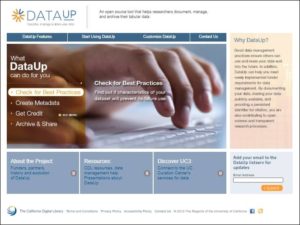
Nominations are now being accepted for the NDSA 2020 Innovation Awards.Screenshot of the DataUp interface

DataUp from the California Digital Library won a 2013 Innovation Award in the Project category. DataUp was recognized for creating an open-source tool uniquely built to assist individuals aiming to preserve research datasets by guiding them through the digital stewardship workflow process from dataset creation and description to the deposit of their datasets into public repositories. The following individuals are recognized for their contributions to DataUp and subsequent projects, and responses to this Q&A.

The original CDL DataUp team included:

  • Stephen Abrams, then CDL Associate Director of the UC Curation Center, currently Head of Digital Preservation, Harvard Library
  • Patricia Cruse, then CDL Director of the UC Curation Center, subsequently Executive Director of DataCite, and now retired
  • John Kunze, CDL Identifier Systems Architect
  • Carly Strasser, then CDL Data Curation Project Manager, currently Program Manager for Open Science at the Chan Zuckerberg Initiative

Current CDL staff responsible for the successor Dash and Dryad projects are:

  • John Chodacki, CDL Director of the UC Curation Center
  • Daniella Lowenberg, CDL Research Data Specialist and Product Manager

What has DataUp been doing since receiving an NDSA Innovation Award?

DataUp was conceived by the University of California Curation Center (UC3) at the California Digital Library (CDL) as an immediate response to the needs of researchers for an intuitive, effective, and self-service data curation platform.  DataUp initially targeted support for tabular datasets via an easy-to-use UI accessible to researchers themselves, rather than requiring mediation by librarians or archivists.  At the same time, CDL was engaged in other related initiatives, including the DataShare open data publication system.  Over time, the curatorial intentions and functional capabilities of both systems began to overlap considerably.  Consequently, in 2014 CDL decided to converge the two systems into a common technical platform under the Dash name.  More recently, similar synergies were recognized between Dash and the Dryad research data repository, which led to the integration of the Dash system as the new Dryad technology platform.  Throughout this multi-year evolution, the core principles and goals of the original DataUp project have remained steadfast: providing the best possible support to the scholarly community for the long-term curation, publication, and reuse of critical research data.

What did receiving the NDSA Award mean to you?

Receiving the NDSA Innovation Award was very gratifying as public affirmation by a significant stakeholder community of the value and beneficial impact of the DataUp vision, project, product, and service.  While the DataUp team was convinced of that value right from the start, it is always nice to have those beliefs recognized and confirmed by colleagues and peers.

What efforts, advances, or ideas over the last few years have you been impressed with or admired in the area of digital stewardship?

Tremendous strides forward have been made in digital stewardship over the past years.  This has been facilitated in large part by mutual recognition of all implicated stakeholders – scholars, administrators, librarians, archivists, funders – of the nature of common problems and needs and the necessity for coordinated response.  Positive outcomes have followed from the open contribution of their individual perspectives and strengths in collaborative efforts.  For example, the success of the DataUp/DataShare/Dash/Dryad activity called upon the active participation over many years by the CDL, University of California Libraries, the DataONE network, Microsoft Research, the Gordan and Betty Moore Foundation, the Alfred P. Sloan Foundation, DataCite, the Make Data Count initiative, and the Dryad community.  Looking towards the future, there are very promising avenues of exploration regarding the application of big data and machine learning techniques to the proactive curation of research data and other forms and genres of digital content deserving long-term stewardship.

The DataUp project began in 2011 – nearly a decade ago! Various challenges of preserving and providing access to research data sets continue to be discussed, and have been addressed in the 2014, 2015, and 2020 NDSA Agendas for Digital Stewardship. Where do we go from here?

The guiding tenets originally encapsulated by DataUp and its DataShare, Dash, and Dryad successors are fully consistent with the NDSA Agenda’s recommendations for organizing and ensuring long-term access to scientific data sets, including support for at-scale curation, promotion of the FAIR principles, and collaborative attention to innovation and sustainability (https://osf.io/7sfc6/, p. 26).  Three specific concerns seem particularly challenging and call out for concerted attention.  First, the academy as a whole needs to continue development of more flexible and sustainable financial practices concerning the curation of all legitimate research outputs, including research data, to avoid dis-incentivizing and confounding widespread adoption of effective RDM tools and practices.  Second, greater automation and intuitive self-service operation is still needed regarding the contribution of research data to managed curation environments such as Dryad.  Ideally, these actions would be automatic side-effects of other, more primary activities and workflows with which scholars and researchers are already engaged.  And third, more can be done regarding actionable linkages between research publication, research data, and research software, all of which interact within a cohesive and co-dependent web of scholarly activity and communication.  We feel that DataUp provided a pioneering attempt at addressing these issues and look forward to continuing progress towards these important goals.

Catching up with past NDSA Innovation Awards Winners: Dr. Anthony Cocciolo


Nominations are now being accepted for the NDSA 2020 Innovation Awards.

Anthony Cocciolo won a 2012 Innovation Award in the Individual category. He was Anthony Cocciolo portraitrecognized for his innovative approaches to teaching digital preservation practices, in particular his work partnering classes with archival institutions to work on the digitization and digital preservation of analog audio collections. Cocciolo is currently the Dean of the Pratt Institute School of Information.


What have you been doing since receiving an NDSA Innovation Award? 

In 2012, I was an Assistant Professor at Pratt Institute School of Information.  In 2020, I am still at Pratt, but now I am the Dean of the School.  I still teach the course “Projects in Digital Archives,” where the class is teamed up with a local archive to do digital archives projects, and what I had received the NDSA award for.  You can find this recent article from Pratt about some of the recent work going on in the class, which has included a lot of early LGBTQ+ radio and TV preservation work.

These days I oversee the School of Information, which is the oldest information school in North America, having started training librarians in 1890.  Today the school is based in Manhattan and enrolls about 230 graduate students across several Masters programs.  The pandemic has kept things challenging, as we work to return to campus in the fall, address issues for international students, and work to keep each other healthy and safe.

What did receiving the NDSA Innovation award in 2012 mean to you?

I think it really helped solidify my interests in digital preservation.  I am still very much involved with digital preservation work.  Pratt, in collaboration with NYU’s Moving Image Archiving and Preservation program (MIAP), has taken over the Digital Preservation Outreach and Education (DPOE) program from Library of Congress in 2018.  Just recently we received a grant from The Andrew W. Mellon Foundation to restore activity to the project, relaunching it as DPOE Network (DPOE-N), which is exciting.  You can find out more about the project at dpoe.network.

What efforts, advances, or ideas over the last 5-8 years have caught your attention or interest in the area of digital stewardship?

I think that audiovisual preservation is finally getting more attention now than it did back in 2012.  I wrote a book back in 2017 called Moving Image and Sound Collections for Archivists that argued that analog audio and video needed to be digitized, and I am happy to see that idea is viewed as more positively these days.

Overall, I am just happy to see the spread of digital stewardship and the notion that digital materials do not just preserve themselves, and that digital devices are where information of enduring value is largely created.

As the Dean at Pratt Institute School of Information, how has pedagogy grown and/or innovated as it relates to digital stewardship and digital preservation?

I think my pedagogy is largely the same (e.g., having students work on real-world problems in teams), I do try to keep it interesting by changing up the projects.  The past year we were starting to work on repairing open reel tapes with broken splices for digitization when the pandemic hit (the materials we finished are available here). Other times I have had students work on born-digital project with lots of forgotten file formats.  We’ve done projects featuring U.S. Presidents (e.g., digitizing photographs from the New York Times’ “morgue”), early Gay TV programs on U-Matic tape and more.  The variety keeps things interesting.

What are some priorities or challenges you see for digital stewardship?

I do think that audiovisual continues to be a challenge and priority. Trying to buy U-Matic VTRs for digitization is getting increasingly difficult.  I think web archiving, while with some exciting newer advancements (like the WebRecorder), still needs more attention and coordinated work.  Digital preservation education is still a needs area, as we do still see examples where archives/special collections have not made the transition to collection born-digital materials.  I am hopeful that the DPOE-N project mentioned earlier will help address this need.

Catching up with past NDSA Innovation Awards Winners: Mat Kelly, PhD


Nominations are now being accepted for the
NDSA 2020 Innovation Awards.

Mat Kelly won a 2012 Innovation Award in the Future Steward category when he was a graduate student at Old Dominion University. He won the award in recognition of his work on WARCreate, a Google Chrome extension that allows users to create a Web ARChive (WARC) file from any browsable web page. Kelly is currently an assistant professor in the Information Science department at Drexel University’s College of Computing and Informatics. 


What have you been doing since receiving an NDSA Innovation Award?

I was a Master’s degree student at Old Dominion University’s Web Science and Digital Libraries (WS-DL) Research Group when I received the award. The award brought to light in the web archiving community some aspects of preservation that were being neglected due to technical difficulties and the need for more work and research on web archiving. My MS thesis partially entailed the work for which I received the NDSA Innovation Award. After receiving my MS in 2012, I continued onto my PhD with the same group and defended my PhD dissertation, pertaining to the same subject for which I received the award, in 2019. I have since taken a position as a tenure track assistant professor in the Information Science department at Drexel University’s College of Computing and Informatics. I continue to focus my research of neglected aspects of web archiving that continue to remain a difficult area to explore due to the nature of the medium.

What did receiving the NDSA award mean to you?

The award gave credence that the programmatic work I was doing was worthwhile. The focus of the tool for which I was awarded was not just to create software, but demonstrate the need for simple user interfaces with powerful, standards-based approaches to encourage individuals to be able to archive the part of the web they care about. This helped to seed further research in the area, both for myself as well as others.

What efforts/advances/ideas of the last few years have you been impressed with or admired in the field?

I am in awe at the Webrecorder project, particularly the work of Ilya Kreymer. I appreciate the efforts the organization has done to encourage personal preservation and to do so with with usable software that does not need to rely on a central endpoint or institution for web archiving. Additionally, I have also been impressed with the breadth of the research performed by the other members of the WS-DL research group under the supervision of Drs. Michael L. Nelson and Michele C. Weigle. They have managed students taking interdisciplinary approaches toward neglected but necessary areas of research beyond the computer science area under which they are housed.

What advice do you have for future stewards in the digital preservation field?

The project for which I was awarded did not have an end-goal of attaining notoriety, though it was a pleasant surprise early in my career as a graduate student. It was a passion project to fill a need for those that want to accomplish something but may not have the technical know-how. This is a common occurrence. I would encourage others to further explore the area and exercise the skills for which they have expertise to determine a niche to which they can contribute.

Is there anything else we didn’t ask that you’d like to add?

I am thankful for the NDSA for considering me for the award early in my academic career and for my research group fostering innovation and enabling the opportunity to use what was once a passion project to have greater impact than it would have originally.

Happy Birthday to NDSA!

As we close in on the end of July we celebrate 10 years of the NDSA!!  

NDSA was initiated by the Library of Congress as a way to sustain and increase partnerships created through the National Digital Information Infrastructure and Preservation Program (NDIIPP).  Participants of NDIIPP were many of the initial members of NDSA.  There were 58 members in 2010, with membership now standing at over 250 in 2020.  Bill LeFurgy, one of the creators of NDSA, discusses the development and history of NDSA as part of NDIIPP, which, incidentally, would have turned 20 in December, and has a report on their first 10 years available as well. 

NDSA started with four groups developed to foster communication and partnerships which has grown in ten years to include three standing Interest groups and at least nine Working groups.  Working groups allow members to focus on specific activities of interest which often produce reports or documentation for the wider community to benefit from.  

In 2016 the Library of Congress passed along the role of Host Institution to the Digital Library Federation (DLF). The DLF has been a good home for the NDSA as well as including DigiPres, the annual NDSA Digital Preservation conference, in their own conference activity planning.   

NDSA is well known for the Agenda for Digital Stewardship and the Levels of Preservation, both with recent updates and publications. NDSA Interest and Working groups have also been busy over the years publishing survey reports (9), case studies (5), and topical interest research pieces (4).  These materials can be found on the NDSA OSF site and the Publications section of the website.  We have taken a renewed approach to strategic planning and transparency to the wider preservation community. We have also expanded significantly into the international scene with new members and partners from across the globe. There is also increased representation at the leadership level, including the elected Coordinating Committee as well as the co-chairs for Interest and Working groups, bringing the Leadership Team to over 20 individuals. 

Moving into the next 10 years, we recognize preservation is a global challenge and as such, we hope to continue expanding our international collaborations and increase our research output and advocacy to help all levels within our preservation community.  NDSA would not exist without you and we want to thank you for 10 amazing years and look forward to approaching the next ten together!

We always welcome new ideas and perspectives, so please feel free to share your thoughts, ideas, and feedback! Email us ndsa.digipres@gmail.com.


Now Accepting Nominations for NDSA 2020 Innovation Awards

Nominations are now open for the NDSA 2020 Innovation Awards! The NDSA established the Awards in 2012 to encourage innovation in the field of digital preservation by highlighting and commending creative individuals, projects, organizations, educators, and future stewards demonstrating originality and excellence in their contributions to the field.  The 38 past winners are a veritable who’s-who of impactful leaders advancing digital stewardship theory and practice.

Please help acknowledge and celebrate a new cohort of innovation by submitting worthy nominees via this form by Friday, September 4, 2020. Nominees do not have to be NDSA member institutions or individuals or project staff affiliated with members.  Similarly, nominators do not need NDSA affiliation.  Self-nominations are accepted and we encourage submission of nominees from historically underrepresented communities and their allies.

The Awards will be presented during the upcoming NDSA Digital Preservation conference, to be held online in November.

Skip to content