
Catching up with past NDSA Innovation Awards Winners: ePADD

Nominations are now being accepted for the NDSA 2021 Excellence Awards.

In 2017, ePADD won the NDSA Innovation Award in the Project category. At that time, this project was an undertaking to develop free and open-source computational analysis software that facilitates screening, browsing, and access for historically and culturally significant email collections. The software incorporates techniques from computer science and computational linguistics, including natural language processing, named entity recognition, and other statistical machine-learning associated processes. Glynn Edwards accepted the award on behalf of the project. She is currently the Assistant Director in the Department of Special Collections & University Archives at Stanford University and kindly took a few minutes to help us catch up on where the project stands today.

What have you been doing since receiving an NDSA Innovation Award in 2017?

We completed two additional phases of software development for ePADD. Phase 2, funded by the Institute of Museum & Library Studies (IMLS) National Leadership Grant (NLG) and Phase 3, funded by the Andrew W. Mellon Foundation. These rounds of development focused on adding new features and functionality to the software to support the appraisal, processing, discovery, and delivery of email collections of historic value. Our project team also changed before this third phase with Sally DeBauche, our new digital archivist, taking over project management full-time for 18 months. 

Before Phase 3 launched in January 2020 with Harvard Library as our official partner, Jessica Smith, Ian Gifford, and Jochen Farwer from the University of Manchester contacted us about their own independent project to redevelop aspects of ePADD. They created a prototype version of ePADD that would display a full-text email archive in the Discovery Module, allowing users to view an email collection online. 

Meetings with the Harvard team, represented by Tricia Patterson & Stephen Abrams, progressed to the proposal of ceasing the redevelopment of their in-house email processing and preservation software, EAS, and instead collaborating with us to add specific preservation functionality to ePADD. At this stage, we brought the team from the University of Manchester into those discussions to help us shape the requirements for a new version of ePADD with greater support for preservation workflows. Concurrently with our Phase 3 grant, our three institutions began working on a joint grant proposal for Phase 4 of ePADD’s software development, funded by the University of Illinois’s Email Archives: Building Capacity and Community (EA:BCC) re-grant program, supported by the Andrew W. Mellon Foundation. We have been meeting together for the past year as we document requirements, identify roles and responsibilities for each of our units to carry out this work. For this phase of the project, we have contracted with an independent software development team, Sartography, to implement changes to the software, while retaining ePADD’s original development team to ensure consistency in our approach.

Internally at Stanford, we continue to use ePADD as our production tool for appraising, processing, and delivering email archives at Stanford. Our digital archives team, Sally DeBauche & Annie Schweikert, have presented on the software to our group of curators and have been in contact with them about appraising and processing new acquisitions. Annie & Sally have processed several new email collections, including the Ted Nelson email archive and the Don Knuth email archive. We have also launched a new multi-institutional online ePADD Discovery website at epadd.org, featuring the archive of literary critic and historical theorist, Hayden White, from the UC Santa Cruz archives. To accompany the site, we have created documentation about contributing to the Discovery site

What did receiving the NDSA award mean to you?

Beyond the recognition of our colleagues, it raised the profile of the ePADD software which garnered more users and interest. This greater following gave us the impetus for our third grant from the Mellon Foundation and allowed us to create a more stable program that can be used as a production tool for email archives.

What efforts/advances/ideas of the last few years have you been impressed with or admired in the field of data stewardship and/or digital preservation?

There has been a lot of development in the field since we started with the ePADD project. But I have been very impressed with the EaaSI project (emulation), for which Stanford serves as a node host. This project will be a game changer for our stakeholders across the university and beyond, as well as colleagues throughout the library who use this platform to provide access to legacy software and files that rely on unique and outdated software.

How has the ePADD project evolved since you won the Innovation Award?

I included a lot of this in #1 above – but I would add that the raised profile and increased interest and use of ePADD, has brought dedicated partners. The Stanford-Harvard-Manchester partnership began during our third grant and has increased exposure of ePADD+ (as we now refer to it) and with the greater involvement from colleagues at each institution has allowed the larger team to focus on different aspects of running and managing the project. One exciting outcome is the commitment of more software testers and greater input from a wider community.

What do you currently see as some of the biggest challenges in email assessment and preservation?

While I am still hoping for a more holistic way to search across all types of archival content, I think that sustainability is one of the major issues facing open-source software development projects. The cost of bug-fixes and updates with new versions of underlying programs might not always be inordinate, but securing dedicated funding is not simple and is often very time consuming. Even more difficult is getting concrete buy-in for funds needed to pay developers to create significant enhancements. We are excited to see the progress from the It Takes a Village in Practice project that aims to provide guidance to open-source software development projects on sustainability. We are engaged in beta testing for the tools that they are developing, and it will be very interesting to see how they can be of service to the broader community.

Levels of Preservation Teaching, Advocacy, and Outreach Update

The Levels of Preservation Steering Group is pleased to announce the official release of its first round of training support materials for those who want to teach and educate others in the Levels of Preservation. This has been the product of many months’ refinement and editing – not to mention lots of wordsmithing! Our heartfelt thanks go out to Nance McGovern (MIT) and the rest of the TAO group for their hard work on this project.

The training support packet includes a comprehensive slide deck packed with information as well as a guide for users to help determine the relevant components of the slide for any style of presentation. The deck can be edited and repurposed to suit your needs or audience. Slides could be used for a full day workshop, a webinar, or just a quick infomercial like presentation. The guide helps break down which slides may be most useful for each type of presentation, however feel free to use the slides that work for your purpose or audience. We simply ask that you cite NDSA as the source as noted in the deck.

The materials (as well as a whole host of other NDSA publications) can be found here: https://osf.io/je439/

~ Bradley J. Daigle; Chair, Levels Steering Working Group

NDSA Adds Three New Members

As of 8 June 2021, the NDSA Leadership unanimously voted to welcome its three most recent applicants into the membership.

Each new member brings a host of skills and experience to our group. UCLA is the largest digital library in the University of California system and collects every format, they collect, preserve, and publish petabytes of data. The Crowley Company has provided commercial and archival digitization and micrographic services for those needing to digitally preserve content since 1980. Matthew Breitbart, NDSA’s first Affiliate Member, is an expert at FADGI standards and an M-19-21-SME who has worked with digital information in museums and the private sector.

Each organization participates in one or more of the various interest and working groups – so keep an eye out for them on your calls and be sure to give them a shout out. Please join me in welcoming our new members. To review our list of members, you can see them here.

~ Nathan Tallman, NDSA Vice Chair

It’s here, the 2021 NDSA Fixity Survey!

Do you manage and preserve content? If so, we’d like to know what your fixity practices are! The NDSA Fixity Working Group is back again, with our latest iteration of the NSDA Fixity survey. Please contribute to our longitudinal research designed to gain insight into how organizations worldwide use various fixity methods to ensure the stability of their digital content and to learn how real-world capacity and best practices differ.  

The survey is available until June 18, 2021. The survey is expected to take approximately 20-25 minutes to complete. To assist with completing the survey all of the survey questions can be viewed in advance by following the link to this Google PDF.

Interested in the results of our previous study done in 2017? Please check it out on the code book, data, and report on the 2017 Fixity Survey OSF page

If you have questions or concerns about this survey, please contact the NDSA Fixity Working Group at NDSA-FIXITY@lists.clir.org.

Thank you for helping NDSA and our community define and advance digital preservation!

~ The NDSA Fixity Survey Working Group

Announcing the NDSA Excellence Awards!

The NDSA Excellence Awards Working Group (formerly the Innovation Awards Working Group) is excited to announce the expansion and renaming of the awards to recognize the important contributions that are being made in the areas of sustainability and maintenance. The NDSA Excellence Awards will highlight and commend all forms of creative and meaningful contributions by individuals, projects, sustainability activities, organizations, future stewards, and educators to the field of digital preservation.

Prior winners of the “Future Stewards” award originally proposed the change and worked together with the Excellence Awards Working Group to make it possible. Please see below for more information!


When reflecting on the 2020 NDSA Digital Preservation conference, much of our conversation centered around the “What’s Wrong with Digital Stewardship: Evaluating the Organization of Digital Preservation Programs from Practitioners’ Perspectives” panel discussion, based on the eponymous paper by Karl Blumenthal, Peggy Griesinger, Julia Y. Kim, Shira Peltzman, and Vicky Steeves. Like many practitioners in the field, the paper identified themes and articulated scenarios we had experienced or observed ourselves, particularly around issues of labor, leadership, and funding.

We wondered what we could, and should, do to better acknowledge and celebrate digital stewards for under-recognized maintenance work, and coalesced on proposing a new NDSA award category focused on maintenance and sustainability work, as well as renaming the awards to reflect an expanded scope beyond innovation. We’re each recipients of Future Steward awards, and reached out to the other Future Stewards to co-sign our proposal; we are grateful for their support in collectively raising our voices to suggest change in order to best reflect the state of the field. You can read our proposal here.

-Samantha Abrams, Elizabeth England, and Lauren Work


The Excellence Awards Working Group sees this as one small step, as there is much more work to be done to shift from the continued use of “innovation” as a main driver for recognition not just within the field, but by organizations’ leadership and funders. In short – we need YOU! Review the new Excellence Awards structure here, particularly the newly added Sustainability Award, and get ready to nominate colleagues in a few weeks!

German Translation for the 2019 Levels of Preservation Matrix Now Available

GERMAN TRANSLATION FOR THE 2019 LEVELS OF PRESERVATION MATRIX 

The 2019 NDSA Levels of Digital Preservation Matrix has been translated into German. Please find a link to the German translation below. 

Citation information and a link to the German translation is as follows: 

Lindlar, Micky (Orcid: 0000-0003-3709-5608); Rudnik, Pia (Orcid: 0000-0003-4081-9646)  (2021). NDSA 2019 Digital Preservation Levels Translation: German Translation of Version 2.0. 

2.0 in German https://osf.io/3na96/ and https://doi.org/10.5281/zenodo.4718661 

Translators’ note:

In the English version of the Levels of Digital Preservation, the term “content” is used synonymously with “digital content” (see https://www.dpconline.org/blog/introducing-the-new-ndsa-levels-of-preservation).

In the German translation, the term “content” is translated as “digital content” in each of the four levels and in the associated catalog of measures. This makes it clear that the measures described in the LoPs refer to digital (content) objects with both physical, logical and semantic properties and that the focus is not only on semantic-intellectual content. 

The functional areas “Control” and “Content” have been provided with additions in the German translation for the purpose of better understanding and for conciseness; these additions are in parenthesis in each case: In the “(Zugriffs-)Kontrolle” functional area, the control measures described refer primarily to access rights for persons and software applications and to associated access measures (such as deleting a file). The addition of “(essenzielle Eigenschaften)” to the “Content” functional area was made to clarify that the measures described here relate in particular to technical properties, such as file formats, which are regarded essential for digital content in the context of long-term archiving. 

The additions were made in consultation with the NDSA Levels of Digital Preservation Steering Committee. 

*If you would be interested in translating the Levels of Digital Preservation V2.0 into another language please contact us at ndsa.digipres@gmail.com.  


DEUTSCHE ÜBERSETZUNG DER 2019 LEVELS OF PRESERVATION MATRIX 

Die 2019 NDSA Levels of Digital Preservation Matrix wurden ins Deutsche übersetzt. Die deutsche Übersetzung ist über den unten aufgeführten Link erreichbar. 

Zitiationsangabe und Link auf die deutsche Übersetzung: 

Lindlar, Micky (Orcid: 0000-0003-3709-5608); Rudnik, Pia (Orcid: 0000-0003-4081-9646) (2021). NDSA 2019 Digital Preservation Levels Translation: German Translation of Version 2.0. 

2.0 auf Deutsch https://osf.io/3na96/ und https://doi.org/10.5281/zenodo.4718661 

Anmerkung zur Übersetzung:

In der englischen Version der Levels of Digital Preservation wird die Bezeichnung “content” synonym zu “digital content” verwendet (s. https://www.dpconline.org/blog/introducing-the-new-ndsa-levels-of-preservation)

In der deutschen Übersetzung wird der Begriff “content” in den vier Levels sowie in dem dazugehörigen Maßnahmenkatalog jeweils als “digitaler Inhalt” übersetzt. Dies macht deutlich, dass sich die in den LoPs beschriebenen Maßnahmen auf digitale (Inhalts-)Objekte mit sowohl physischen, logischen als auch semantischen Eigenschaften beziehen und der Fokus nicht nur auf semantisch-intellektuellen Inhalten liegt. 

Die Funktionsbereiche “Control” und “Content” sind in der deutschen Übersetzung zum Zwecke der besseren Verständlichkeit und zur Konkretisierung mit Ergänzungen versehen worden, die jeweils in Klammern stehen: Im Funktionsbereich “(Zugriffs-)Kontrolle” beziehen sich die beschriebenen Kontroll-Maßnahmen vordergründig auf die Zugriffsrechte für Personen und Softwareanwendungen und auf damit verbundene Zugriffsmaßnahmen (wie z.B. Löschen einer Datei). Die Ergänzung des Funktionsbereichs “Inhalt” um den Zusatz “(essenzielle Eigenschaften)” wurde vorgenommen, um zu verdeutlichen, dass sich die hier beschriebenen Maßnahmen insbesondere auf technische Eigenschaften wie zum Beispiel Dateiformate beziehen, die im Kontext der Langzeitarchivierung als essenziell für digitale Inhalte angesehen werden. 

Die Ergänzungen erfolgten in Abstimmung mit dem NDSA “Levels of Digital Preservation” Steering Committee. 


Call for Proposals open for NDSA Digital Preservation 2021!

NDSA Digital Preservation Banner

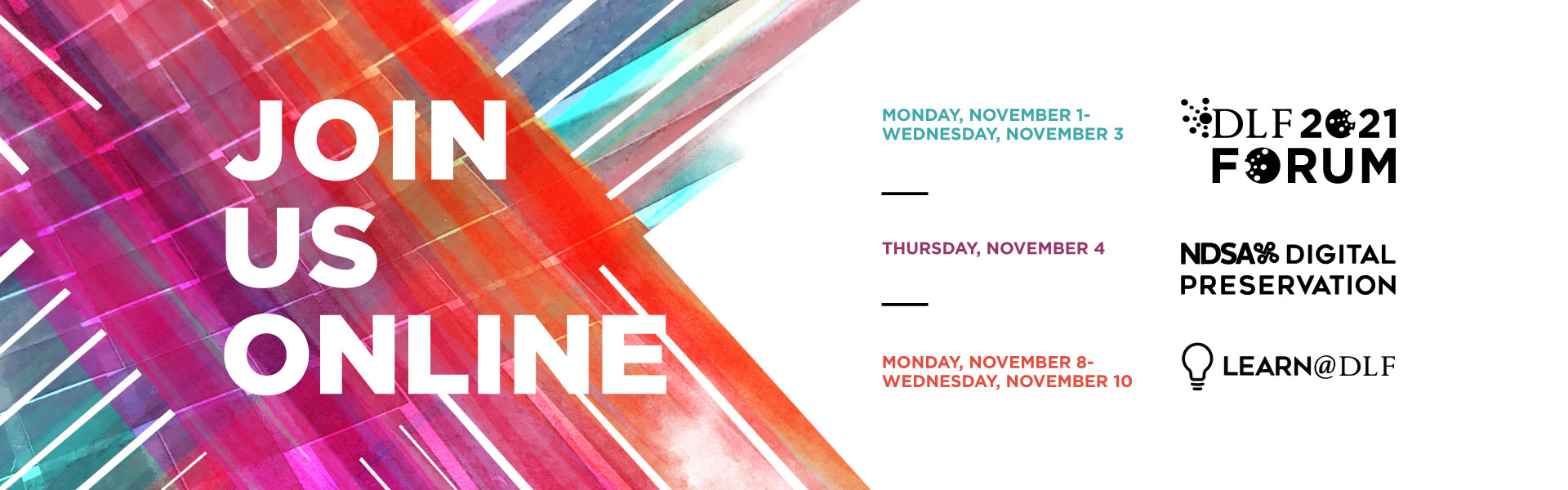
The NDSA is very pleased to announce the Call for Proposals is open for Digital Preservation 2021: Embracing Digitality (#DigiPres21) to be held ONLINE this year on November 4th, 2021 during World Digital Preservation Day.

Submissions from members and nonmembers alike are welcome, and you can learn more about session format options through the CFP. The deadline to submit proposals is Monday, May 17, at 11:59pm Eastern Time.

Digital Preservation 2021 (#DigiPres21) is held in partnership with our host organization, the Council on Library and Information Resources’ (CLIR) Digital Library Federation. Separate calls are being issued for CLIR+DLF’s 2021 events, the 2021 DLF Forum (November 1-3) and associated workshop series Learn@DLF (November 8-10). NDSA strives to create a safe, accessible, welcoming, and inclusive event, and adheres to DLF’s Code of Conduct.

We look forward to seeing you online on November 4th,

~ 2021 DigiPres Planning Committee

2021 DLF Forum, DigiPres, and Learn@DLF Calls for Proposals

Join us online

We’re delighted to share that it’s CFP season for CLIR’s annual events.

Based on community feedback, we’ve made the decision to take our events online again in 2021. We look forward to new and better ways to come together—as always, with community at the center.

Our events will take place on the following dates:

For all events, we encourage proposals from members and non-members; regulars and newcomers; digital library practitioners and those in adjacent fields such as institutional research and educational technology; and students, early-career professionals and senior staff alike. Proposals to more than one event are permitted, though please submit different proposals for each. 

The DLF Forum and Learn@DLF CFP is here: https://forum2021.diglib.org/call-for-proposals/ 

NDSA’s Digital Preservation 2021: Embracing Digitality CFP is here: https://ndsa.org/conference/digital-preservation-2021/cfp/

Session options range from 5-minute lighting talks at the Forum to half-day workshops at Learn@DLF, with many options in between.

The deadline for all opportunities is Monday, May 17, at 11:59pm Eastern Time.

If you have any questions, please write to us at forum@diglib.org, and be sure to subscribe to our Forum newsletter to stay up on all Forum-related news. We’re looking forward to seeing you this fall.

-Team DLF

Good Migrations: A Checklist for Migrating Your Digital Preservation Infrastructure

My, how time flies. About half a decade ago, in 2015, I became one of the NDSA Infrastructure Interest Group co-chairs. This was part of the NDSA transition from being hosted by the Library of Congress to a new host, which would eventually be CLIR/DLF. Earlier that year, the Infrastructure Working Group (as it was known back then) drafted a document designed to be a checklist for system migrations. The draft was put out to the community for comments, but then, as the influence of the Library of Congress faded into the background during the move from one host to another, so did the main impetus for publishing the checklist. Ah, the sweet irony of a migration checklist being forgotten during a migration!

However, the checklist was not completely forgotten: it existed as a potential project in my head, one that I was interested in completing once other projects wrapped up. Yet the years passed and there were always other projects. Finally, in the summer of 2020, two events occurred: several significant projects finally did conclude and Nathan Tallman, an NDSA Coordinating Committee member and former co-chair of the Infrastructure Interest Group, reached out to me asking about the status of the Migration Checklist. “It’s time,” I thought. And it was. 

With that preface, I now introduce to you, “Good Migrations: A Checklist for Migrating Your Digital Preservation Infrastructure.” This checklist has changed significantly from its 2015 version due to the incredible amount of community feedback received in 2020. The 2020 Good Migrations Working Group; which consisted of myself, Nathan Tallman, Paige Walker, Linda Tadic and Matt Schultz; not only incorporated the community response, but also placed the checklist into a Levels of Preservation framework in order to better highlight how migration steps match preservation areas. Over the past six months, we have worked diligently to clarify scope and provide a comprehensive yet still succinct checklist that will hopefully aid those who are tackling a migration process. 

NDSA is interested in feedback from anyone who is using the Good Migrations checklist. Based on the level of community interest, NDSA may consider a followup working group to gather illustrative use cases to accompany the document and document methods for accomplishing checklist items. Please let us know if you use the Checklist and have found it to be of assistance

~Sibyl Schaefer, Chair of the Good Migrations Working Group

Request for Participation in Fixity and Staffing Survey Working Groups

Proposals have been accepted by the NDSA Coordinating Committee for starting up the Staffing Survey Working Group and the Fixity Survey Working Group. Both surveys were last published in 2017. If you are interested in participating in either of these groups please read the scope of work for each and complete the form below by April 2, 2021.

It is expected that work for both surveys would start Spring 2021 and end about a year/year and a half later, with groups generally meeting on a monthly basis. Work would also be done between meetings to review the survey questions and results, and to write a final report. We especially welcome participation from international NDSA members and members who have not previously participated in NDSA groups.

Fixity Survey Scope of Work: Review of survey, survey deployment, data analysis, writing final report

Staffing Survey Scope of Work: Survey redesign, survey deployment, data analysis, research, writing final report

If you have questions, please contact:

Fixity: Carol Kussmann (kussmann@umn.edu)

Staffing: Lauren Work (lw2cd@virginia.edu) or Elizabeth England (elizabeth.england@nara.gov)

Please complete this form by April 2, 2021.

Skip to content