NDSA Call for Volunteers: Digital Preservation 2017

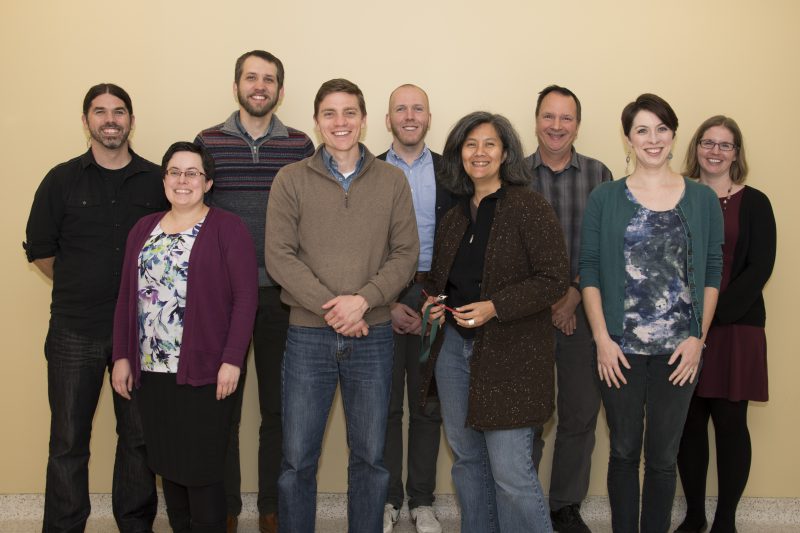
The National Digital Stewardship Alliance calls for volunteers from NDSA member organizations to join the Planning Committee for Digital Preservation 2017.

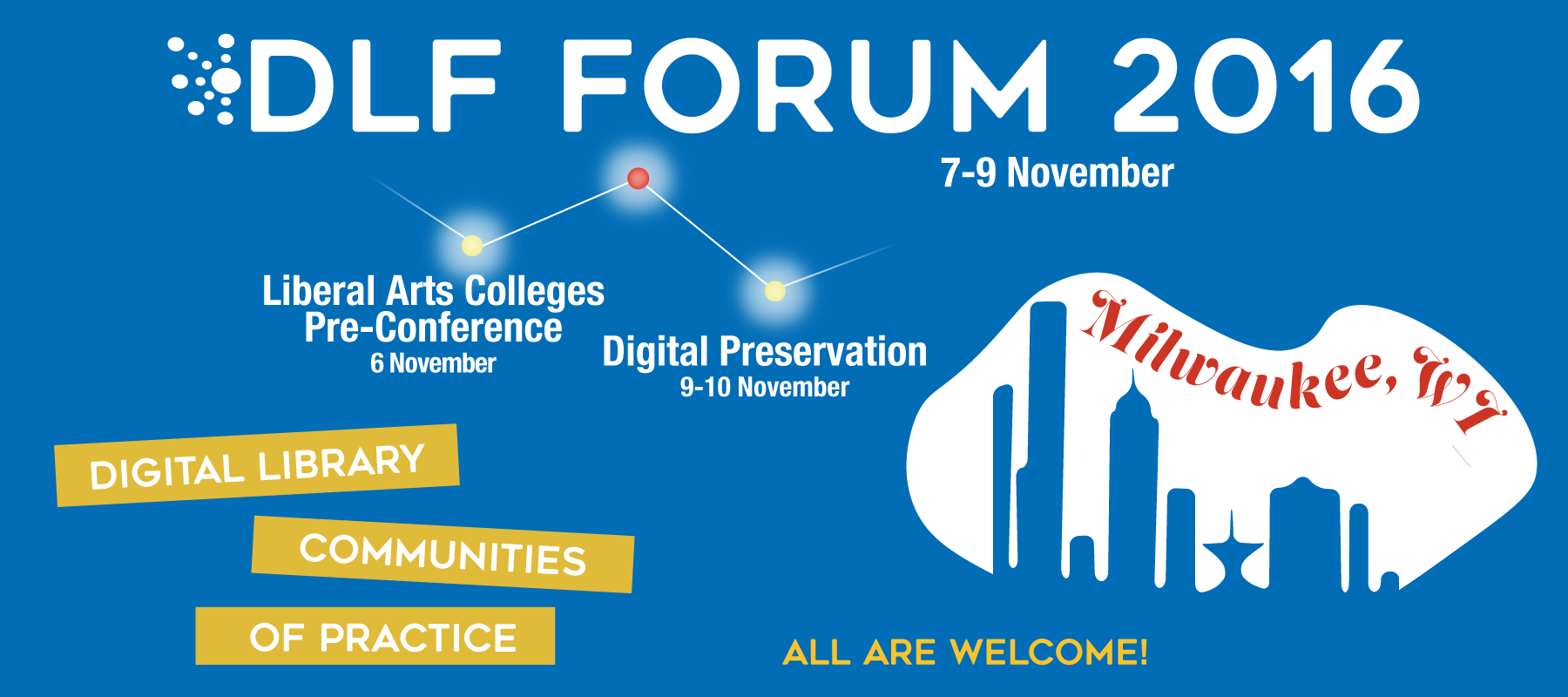
Digital Preservation is the NDSA’s major meeting and conference—open to members and non-members alike—focusing on digital stewardship and preservation, data curation, and related issues. This year, it will be held in Pittsburgh, Pennsylvania, October 25-26, 2017 after the DLF Forum.

Logistical arrangements will be handled by the Digital Library Federation, so that this committee can focus more fully on the program for #digipres17. Duties involve defining the vision for the event, drafting and circulating a CFP, coordinating the review and selection of proposals, crafting and publicizing the schedule, and collaborating with the DLF Forum planning committee to make this conference partnership a success. We anticipate monthly group calls and regular email exchanges April-October.

This is an opportunity to help shape a crucial venue for intellectual exchange, community-building, development of best practices, and national-level agenda-setting in the field of digital preservation—as well as to set the tone and direction for future NDSA events. Join us!

Volunteers from NDSA member organizations are asked to complete this form by Monday, March 6th.

“Archives have never been neutral:” An NDSA Interview with Jarrett Drake

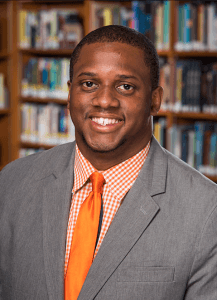
Jarrett M. DrakeWe are very excited to talk with Jarrett Drake, digital archivist at Princeton University’s Mudd Manuscript Library. He was awarded an Innovation Award from the National Digital Stewardship Alliance (NDSA) in 2016 for his work in challenging and re-examining the practices of archiving and documenting history, particularly relating to preserving the under-represented voices in history. Follow his writings here, and you can find all of our interviews with the NDSA Innovation Award winners here.

We learned more about Jarrett and his work in the following interview:

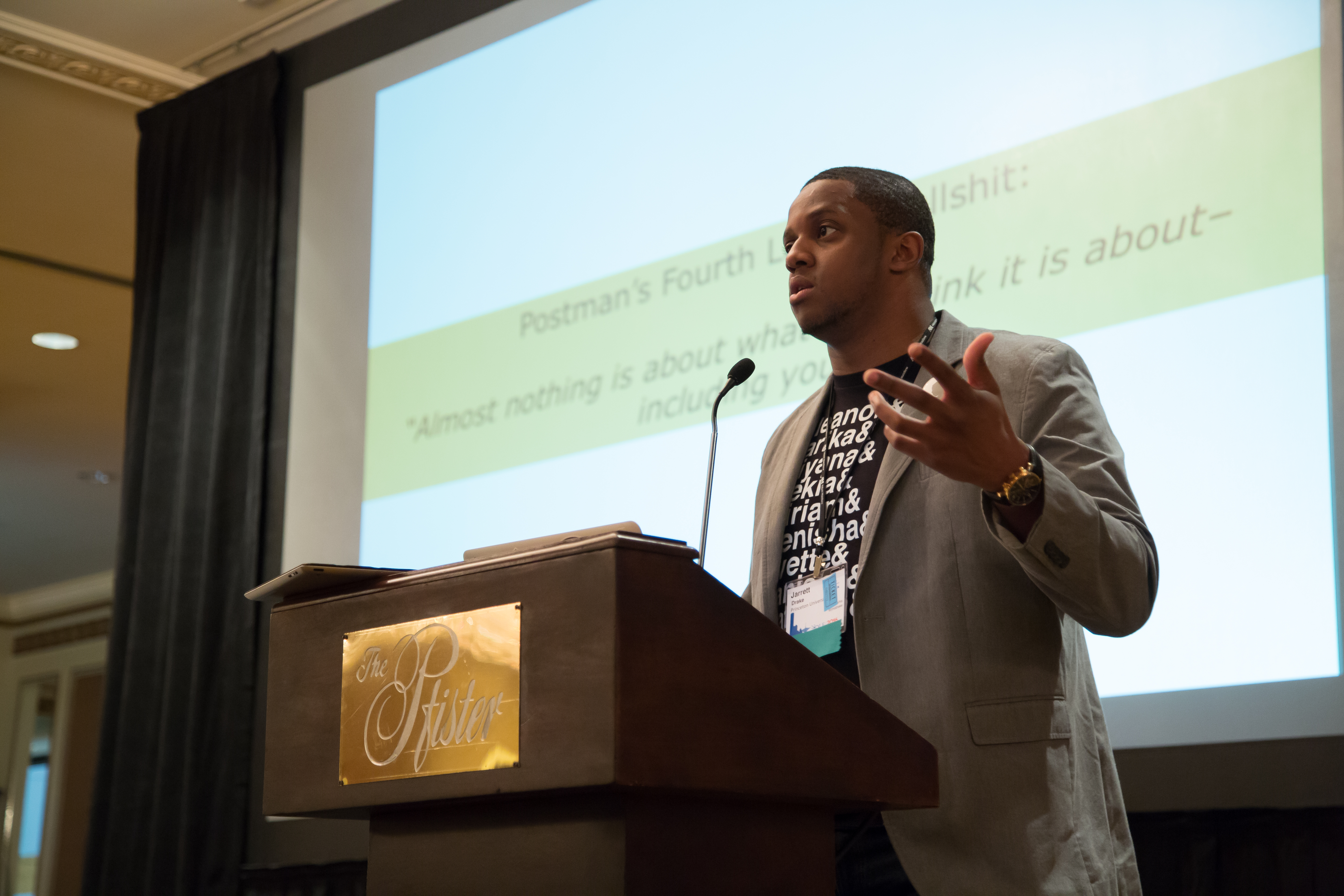
You gave the keynote at the DLF Liberal Arts pre-conference in November with the title, “Documenting Dissent in the Contemporary College Archive.” In your talk, you cited Neil Postman’s Fourth Law from his essay on “Bullshit and the Art of Crap-Detection:” “Almost nothing is about what you think it is about–including you.” Can you talk about why you cited this, and how it relates to archiving and documenting history?

I read the article during a class I was teaching in prison, English 101. It was on the syllabus, and I read it as an instructor. Ever since I read it, I see those types of categories not only within archives, but elsewhere. The University of Washington Information School is doing something interesting: they are proposing a new course called “Calling Bullshit in the Age of Big Data.”

We need to develop stronger information literacy skills in the public. Postman’s essay is a great place to start.

In that keynote, you end by saying that “we need archives to be liberational and have liberational value.” Can you talk about how you think this can happen in the archival community? 

We have to involve new types of communities in the entirety of the archival process. That’s a new type of declaration. Bringing stakeholders of all variety (like community members as selectors) will be really important, and connecting that process to the larger process for liberation. The more work I do, the more apparent it is that there’s no way to talk about liberational value if you don’t address the needs communities are facing. LGBT and black and indigenous communities – we need to have them as central. We need to center on justice and not be afraid of politics. Archives have never been neutral – they are the creation of human beings, who have politics in their nature. Centering the goals of liberation is at the heart of the issue.

What specifically can community members do to be leaders and teachers in expanding the scope of archives?

We can all be listeners and learn from these communities. We need to think of it as an information exchange. There are communities who have been fighting to hang on to their history, and institutions that have money would do well to listen to the communities and partner together to ensure a more robust record of human activity. Technology may be different for digital archives, but foundation is the same as other archives – building trust, and protecting user privacy. Archives are much more a social endeavor – they must also encourage use and promote value. Community members are more successful at that than archival institutions.

Can you talk about the parallels between the community of liberal arts colleges and the broader digital preservation community, in terms of archiving past and future?

The differences have to do with immediate environments. There is an archival tradition in state and Federal governments – a much longer tradition than for other communities. For example, they sometimes face the threat of significant budget cuts or even complete de-funding. Archivists in academia don’t face this. As the line becomes blurred between higher education and governments, some politicization issues might creep into academic archives. For example, the US Department of Education is a funder of academia; if that department is increasingly politicized, those impacts may be felt at college campuses, and may affect archives.

Your work supporting “A People’s Archive of Police Violence in Cleveland” has quickly become an example for a variety of projects in the field. You also recently initiated a project at Princeton: Archiving Student Activism at Princeton (ASAP). Can you talk about what was challenging in this work? What you found surprising? 

First, both of these are very collaborative efforts and draw on labor from dozens of other archivists and lay citizens. Second, while the work on the Police Violence archive was unfolding, there were things that I hadn’t experienced – metadata issues, file format issues, content type issues. Then we faced same challenges at Princeton with the Student Activism project. I thought that I could anticipate digital problems that would arise; I realized that wasn’t the case. You need to know when to abandon existing ways of thinking of things and realize that knowledge is always relative and contextual.

Can you talk about challenges in identifying and preserving provenance in digital archives and your ideas for how to imagine a new principle in this area?

After doing work with the collaborative Police Violence and Princeton Student Activism projects, it became evident that the traditional way of thinking of provenance was increasingly outdated. We need to have a new way of thinking about this. Angela Davis has made an argument when writing about the history of prisons–are prisons obsolete? Have they run their course and do we need new ways to think about justice? I think we can make same arguments about provenance. Why have we adhered so uniformly to a principle of provenance that was defined almost two centuries ago? Maybe it’s time to assert different types of principles. Maybe we need a multiplicity of ways of engaging the past, and bring people in.

Can you talk about challenges of describing archives and archival items, and what you think is most important to the researcher? And how should we make changes in what we are doing in this area?

New principles – higher level abstract principles – will necessarily inform metadata, and maybe remove emphasis on metadata. Before Edward Snowden, only librarians and archivists used that word, “metadata.” It’s not the only useful way to get access to the past. New principles might incorporate metadata but maybe it’s less and less relevant. Traditional metadata serves the need of users who come to the archive as individuals (such as researchers), mining multiple sources to product a monograph, for example. Maybe community usage requires different principles — less emphasis on citation and disambiguation and more emphasis of integration into people’s every day lives. We should think about options for less emphasis on research needs and more on community-driven and public-facing needs.

How does the community-driven work relate to crowd-sourcing?

Crowd-sourcing may be an element of it, but it goes beyond that. I was reading an article about archives in Egypt, which talks about tapping into an archive by having a big community gathering, and projecting old films with significance to the community on to a big screen. We should be encouraging other kinds of usages – we need to get a large number of people to interpret and to enjoy the process. My office at Princeton is right next to the reading room – I literally get to see everyone who comes into the reading room, and they are always so serious. Would it be so bad to encourage people to smile or enjoy for the sake of enjoyment?

What do you think the innovations have been in the area of archiving in the past few years? And where do you think innovation plays a role?

I associate that word “innovation” with Silicon Valley, tech start-ups. We are leveraging technology that didn’t exist previously; for example the Cleveland Police Violence archive gets a lot of its inspiration from examples of communities of people doing ad hoc organizing on Twitter. We now see how people do organizing through Twitter. That inspired how we communicated. We have tools that didn’t exist 10 years before. These are not just social media; but also crowd-funding; and campaign websites. This leads to new tools – such as “Documenting the Now” application. Hopefully there will be a large-scale project that someone will build using that kind of tool. I see innovators as those who can create new types of tools that people can take advantage of.

Can you talk about the parallels between analog and digital in your work? Can you talk about the challenges of perceptions in this area?

Both processes involve people at all steps in the way. In both cases, we need to develop and formulate trust with communities; we need to demonstrate responsibility in terms of keeping materials. People have to believe that you will treat their materials respectfully and responsibly. There is also the issue of raising awareness of the existence of your materials. Both digital and traditional archives have been struggling with this.

Differences stem from technological differences in paper vs. digital technologies. There is a greater variety in digital records and there are more complex relationships among creators. It is increasingly difficult to identify who is the creator or the owner of a digital object. I referenced this in my talk at the Radcliffe Institute, available at here. Maybe we can use technology tools in the future to discover and describe multiple ownerships of materials.

The site for the Archiving Student Activism at Princeton (ASAP) has a statement that the university archive will assure the confidentiality of the records for up to 20 years. How do you think the researcher 20 years from now may be served differently than we serve researchers today?

We had recently updated the access policies for Princeton University archives. For university records (e.g., administrative office or academic office), we close access for 40 years from the date of creation. Records from student organizations typically were open from the moment of transfer. We knew this would be an area that could introduce risk to creators of records, so for ASAP, we came up with a solution that let the groups pick. 80% of the groups picked no access restriction at all, and some picked 10 years; and some picked 20 years. We worked to make the policy a little clearer. We want to be honest and make it clear to the groups that records will be open probably during their lifetime. We try to coach the student organizations in these issues.

We try to include as much contextual information as possible at the time we receive records; we still create finding aids and other access tools for collections with 20 year embargoes and we hope a researcher in 20 years will have the same knowledge at that point as we had we created the finding aid. We also hope more sophisticated tools will exist in 20 years. We hope that we will be leveraging some of the textual analysis software applications by then – and making those more suitable for graphical access. But I wouldn’t be completely surprised if usage and tools aren’t that different. I am surprised that we’re not further along than we are. People talk about the Information Revolution and the Information Economy; however, we seem to be getting worse at making sense of a lot of information.

What ideas in your area of interest do you think are the most challenging for people in your field? Or for people outside of it?

I will say that there are challenges in archives focused in certain areas. For example, there has been a lot of discussion about the goals and the work resulting from #ArchivesforBlackLives. Some ardent archivists in Philadelphia, where I currently live, picked up the hashtag and are starting to organize around it, which is great. But it’s unfortunate that some people in the field have been critical of their efforts, so we have to ask ourselves a hard question, which is: why does an emphasis on black lives disturb people in this field, and in this country, so much? Why does an affirmation of black humanity offend you, if black people are indeed people to you? Of all the ideas or arguments I’ve circulated in the last few years, #ArchivesForBlackLives is the only one to my knowledge that’s received open pushback and criticism. This reality makes the work that much more crucial.

Based on your work and areas of interest, what kinds of work would you like to see the digital preservation and stewardship community take on?

We should be attuned to issues of surveillance, privacy and digital rights (including rights to be forgotten). There are sectors of community engaging in these topics – like “Documenting the Now.” A huge surveillance apparatus has grown since 9/11. There’s the possibility of using those tools in new ways. There will be archivists inside and outside the government that will be asked to do things in the course of their jobs that potentially pose human rights violations, and the community needs to support colleagues in efforts to use knowledge and skills sets responsibly and judiciously.

Can you suggest other people who are doing interesting or innovative work that you think might be of interest to the digital preservation community?

I’m always interested in finding and talking to bright minds in the field of archives, and I try to emphasize on uplifting newer names in the field as opposed to older ones.

Here are some of work and people who I am aware of:

The people, such as Bergis Jules and Ed Summers, working on “Documenting the Now”;

The people, like Eira Tansey, working on Project ARCC (climate change archives);

Everything that Stacie Williams, most recently of the University of Kentucky, writes or does should have the attention of everyone in the field;

The ASAP project wouldn’t have happened like it did without the inspiration from Kent State University’s Lae’l Hughes-Watkins and the project she organized there.

Those folks are not new to this, they’re true to this. Any library would be lucky to have them as a director.

Newer on the scene but also with great ideas, energy, and direction (key ingredients for innovation) are folks like Elvia Arroyo-Ramirez, Micha Broadnax, Elena Colon-Marrero, Carmel Curtis, Harvey Long, Dominique Luster, and Itza Carbajal, just to name a few. Each of them possesses a deep knowledge of archival praxis, including born-digital challenges, and will be—already are—change agents in the world around us.

 

Innovation Sharing and Knowledge Exchange in Mid-Michigan: An NDSA Interview with MMDP

Nicole Garrett Smeltekop
Matt Schultz

Every year, the National Digital Stewardship Alliance recognizes and encourages innovation in the field of digital preservation stewardship through its Innovation Awards. We’re thrilled to continue our interview series with two planning committee members of the Mid-Michigan Digital Practitioners group (MMDP), Nicole Garrett Smeltekop and Matt Schultz. The MMDP received NDSA’s Innovation Award for organizations due to its taking an innovative approach to providing support and guidance to the digital preservation community. You can find all of our interviews with the NDSA Innovation Award winners here.

Recognized for its highly original and successful organizational model in fostering innovation sharing and knowledge exchange, the MMDP will convene for its next meeting in March 23-24 2017.

Please tell us a little bit about yourselves and how you both became involved with the MMDP!

Nicole: I first became involved with MMDP at the the very beginning in 2013, but I didn’t join the planning group until the following year. In 2013, I was a lone arranger archivist, and very excited to be part of a low-key group that talked about the realities of digital preservation. My budget was near $0, but standards were important to me. I remember some great talks and consensus that best practice is really beyond the resources of anyone right now, so finding a good enough solution for your institution is totally fine. It was such a relief to hear that at a professional meeting! In 2014, I switched jobs to become a special materials cataloger and metadata librarian at a much larger library. My job deals with the metadata aspects of things, so going to meetings and hearing about other facets of digital curation/scholarship/etc. is really helpful as I think about decisions beyond my metadata based perspective for our digital repository.

Matt: My first intersections with MMDP started with a visit to the community’s Fall 2015 meeting at Albion College. I had just come on board as Grand Valley State University’s new Metadata & Digital Curation Librarian. I was blown away by the format and quality of the meeting, and even more so by the camaraderie of the group. There was an immediate sense of welcome and invitation to dive in and connect. Not surprisingly I was eager and happy to help host the next Spring 2016 meeting at GVSU. Working with the planning committee to prepare for that meeting was also incredibly enlightening. Very open, but also very on-task and focused.

The MMDP was awarded the NDSA Innovation Award for Organizations for its highly original and successful organizational model in fostering innovation sharing and knowledge exchange. Could you talk a bit about MMDP’s organizational model and the planning group?

Nicole: The planning group is a self selected group of people who help plan the meetings. Most of us are from Michigan State University, but we have a few others from other Michigan institutions. For the format of the meetings, I think we looked around at what wasn’t being done and filled a hole. Lightning talks, discussions, and time for general networking time rather than standard panels makes us unique. We also keep our meetings free and pretty low-key, so I think it encourages new people and fosters more real discussion. From what I can tell, no one is in “expert” mode – we’re all dedicated to learning more from each other and respect the knowledge each of us brings.

Matt: I just would echo all of what Nicole said. As we concluded the Spring 2016 meeting at GVSU, I was pretty humbled to be immediately approached by the planning team to come on board with an open-ended invitation to contribute some of my own guidance and leadership to planning for future meetings. There were no hoops to jump through with the existing planners. As we fired up discussions for the Fall 2016 meeting at MSU, I was also really struck by the willingness of the planning team to open up our calls to the entire MMDP community. Anybody could drop in and be a fly on the wall or throw in their two cents. I think that is so important to keeping in step as a community and carving out space for new ideas. The DLF Assessment Interest Group takes a similar open, low barrier to entry approach and I think it really just expands the landscape of mutual interests, concerns, and approaches.

MMDP meetings bring together a wide range of professionals, including librarians, archivists, museum curators, historians, and more. The meetings also attract student groups, practicing professionals, vendors, and the general public. How has membership grown and are there particular groups you’d like to increase in participation or continue to tap into?

Nicole: I’d like to see more lone arranger and small shop participation. When I was a lone arranger, I found just talking to people at larger institutions so incredibly helpful in figuring out what was feasible for me and what wasn’t. Also, those jobs require a lot of creativity with resources, time, and skills, so the people filling them are usually excited, driven and creative!

Matt: I haven’t been with the group since the very beginning, but my sense is that it has grown steadily year upon year. One interesting bit of culture within this group seems to be less of a focus on tracking numbers, but more on creating new spaces and opportunities with each meeting to add to the diversity of both institution types and professional backgrounds. With each meeting we’re looking to hit a region and demographic we haven’t yet or that we haven’t hit very recently. We put a Code of Conduct in place that enshrines our inclusivity and enlists the community in upholding that standard. Within that Code of Conduct we also carved out a respectful space for vendors, and I think they feel welcome, and the attending institutions don’t feel pitched at, if you know what I mean.

The MMDP held its first meeting at MSU in August 2013 and the group will convene for its next workshop and meeting on March 23-24 2017. Could you share a few insights that you’ve learned over previous meetings?

Nicole: Perhaps unsurprisingly, people didn’t like the hour long talks and preferred time for networking. We also readjusted our lightning talks and birds of feather discussions to mimic each other, as some feedback was that the lightning talks were exciting, but participants felt like they wanted time talk further about the topics and avoid the whiplash feeling that can sometimes come after a round of lightning talks.

Matt: Like I said, I haven’t attended all of the meetings over the years, but even looking back across the few meetings I’ve had the privilege of participating in, I have seen some interesting progressions. At the Fall 2016 meeting at Michigan State University we made a point of offering both a technical and a not-so-technical set of half-day workshops. One was on XML/XSLT and the other was on digital preservation policy development. So, there was a little something for everyone. The workshops spanned a whole day back-to-back, and we were curious to see how that might affect attendance, and were just so impressed with the turnout for each workshop. I think the community appreciates the willingness to try new things with the program for each meeting. It keeps it fresh.

The agendas of past meetings signal the compelling and varied work of the professionals engaged in creating and curating digital collections in Mid-Michigan and the surrounding area. Could you discuss a particularly interesting topic or issue trend you’ve seen develop?

Nicole: Matt can speak more on this, but I’m excited to see his idea of a hackfest develop! I also like seeing that although we have a core of devoted attendees, the makeup of each meeting is quite a bit different. I like seeing new faces and am happy to see our outreach efforts are reaching people perhaps not on the typical professional listservs (local historians, corporate archivists, etc.)

Matt: As Nicole is alluding, the idea of incorporating some hackfests into the meetings seems to be taking off. We are using “hackfest” in a very loose sense to span everything from focus grouping a technical workflow, to spitballing wireframes, to breaking up into small action groups and building some new tools and resources for the community. I recently suggested that we “hackfest” a set of lightweight online tools to facilitate knowledge and resource exchange within the MMDP community. Megan Kudzia and Robin Dean from Michigan State University are going to take that ball and run with it for a half-day hackfest workshop at the next Meeting in March at Wayne State University.

MMDP meetings are designed democratically via pre- and post- conference surveys. Based on feedback from previous events, are there new developments you’re excited to try out for the next meeting?

Nicole: We always ask for presentations based on the survey results of what the community wants to hear about. At the last meeting, we expanded the workshops to be half day rather than 2 hours, and based on the feedback on this meeting’s survey, we will continue doing half day workshops. Attendees really liked that more time allowed them to delve deeper into the topics.

Matt: In the run-up to this next meeting there has also been a concerted push to reach out to student groups and get them attending and involved with this community. That and some targeted outreach to professionals, faculty, and students who are interested in digital humanities.

Could you offer advice for folks interested in beginning and sustaining their own regional practitioners group?

Nicole: Having some supportive big institutions and networking with other professional organizations for support is really helpful! We’re able to offer these meetings at no cost (including lunch!) based on the generosity of the larger universities in our area as well as a partnership with the Michigan Archival Association, who sponsors a portion of the meeting cost.

Matt: My advice would be…don’t be afraid to start small and build from there. Avoid thinking too broadly when it comes to your geography. Draw some reasonable lines around the area of community such that it is not too onerous for folks to physically travel to meetings. Make a point to move your events around to different hosts every year or throughout the year. Don’t get too wedded to one format for your meetings or events, but also don’t change things up radically between each meeting. I see the MMDP community at the moment thinking and working through some processes for putting a bit of stable planning infrastructure in place, which is really cool because it feels like an indicator of maturity. But at the same time, watch out that you don’t over-formalize things. Keep the infrastructure lightweight and nimble. Rotate the administrative roles and duties. Pass the batons frequently. Keep a spirit of openness to fresh ideas front and center and on the table always. And just plain have fun! Heavy on the humor and camaraderie!

NDSA Future Steward on Community Web Archiving: An Interview with Samantha Abrams

Every year, the National Digital Stewardship Alliance (NDSA) recognizes and encourages innovation in the field of digital preservation stewardship through its Innovation Awards. We’re delighted to talk with Samantha Abrams, recipient of the 2016 NDSA Future Steward Award, which recognizes emerging leaders taking a creative approach to advancing knowledge of digital preservation issues and practices. You can find all of our interviews with the NDSA Innovation Award winners here.
Samantha recently moved from Madison, Wisconsin, to Brooklyn, New York, where she works as the Community Archivist at StoryCorps. She is recognized for her work with the Madison Public Library and its Personal Archiving Lab as well as her initiative to create innovative projects and classes.

Can you share your thoughts and reflections on the state of community web archiving?

I’d argue — honestly and sincerely — that community web archiving has never been better. More and more smaller organizations — like public libraries, not-for-profit organizations, and small repositories — have started to realize that web archiving is well is within their reach, and they’ve started to do it. It helps, too, that the web archiving community is filled with so many conscious, smart people, who are looking to share what they’ve learned — and what they still have questions about — through doing their own work. One project — among so many — that I’m particularly excited about is Documenting the Now, which is being spearheaded by people genuinely interested in doing this web archiving (and social media archiving) work ethically, and for the greater good.

Can you offer a few suggestions for people interested in establishing a web archiving program for their own communities?

Yes! Two things: start small, and understand that you’ll never create the perfect web archive. Other things to think about: the archive’s target audience; the archive’s access points; how you’ll promote the archive; duplicate work; cost; sustainability; and inclusivity. Thinking critically — often — about the web archiving program you’re attempting to create gives it focus: often the desire to collect it all — quickly — becomes the plan, but what good is an over-saturated, unsearchable, unusable web archive? Define your collection: set parameters, and outline exactly what you will — and will not — collect. Don’t build something that your organization cannot commit to long term. Web archives cost money, and require labor — real, hands-on, consistent labor. And if your web collection is meant to mirror the community you serve, ask your community what they’d like to see in the collection. What websites represent the community? Where do your patrons turn for news? Where do your patrons post their creative work? Don’t be afraid to revise and rethink, either — web collections, like the web itself, aren’t meant to be stagnant.

What advice would you offer to people interested in entering this field?

I have some by-the-book advice, like: take one, or two — or, like, five — technologically-focused courses while you’re in school, and practice those skills — at whatever level possible — as your career unfolds. And if you’re in school, and you have the time and schedule flexibility, take a class or two that has nothing — nothing at all! — to do with your field of study: do it to challenge the way you think and behave, and do it to remember that your way of thinking — and your field’s way of thinking — isn’t the only way of thinking. Other advice? Read — academic journals, fiction, the newspaper, poetry! — as often as you can: on the train, for ten minutes before bed, over lunch. Ask questions, and look towards people who are — right now — where you’d like to be in five years. Understand your community, both as an information professional and as a member of that community. What do the people you serve need? With what do the people you serve struggle? Center your community, and center those who have been excluded, and marginalized, and oppressed. As a student, and as a professional: be considerate, and support your peers and colleagues. And keep learning.

Could you tell us about your role at StoryCorps?

I’m the Community Archivist at StoryCorps — which means several things. Much of my job, and day-to-day work, is quite technical in nature: I process, spot-check, and transfer digital interview files; I receive and review paperwork associated with StoryCorps interviews; and I work with interview metadata (like participant information, keywords, and interview descriptions). The StoryCorps collection is — by any standard — quite large: in thirteen years, StoryCorps employees have collected over sixty-five thousand interviews on the road and in our Booths, and our listeners and participants have used the StoryCorps App — StoryCorps.me — to record over one-hundred and fifteen thousand interviews. And each and every one of these files requires technical, archival care from all of the StoryCorps archivists and our partners at the Library of Congress. I do extensive work, too, with our community partners: I help interested organizations build and receive archival collections using StoryCorps audio, and assure that each partner understands how to care for their collection, which is entirely digital in nature. I also work closely with and train StoryCorps Facilitators, who are integral to the success of the organization: facilitators are the ones who sit in on our interviews, set up and monitor the interview equipment, take notes, and enter interview metadata. There’s always work to be done at StoryCorps, and so much of it involves listening to — and sharing the stories of, and learning from — people.

Are there any projects that you’re currently working on and excited about that you can share with us?

Yes! All of StoryCorps is hard at work on the development of the StoryCorps Public Archive — a project funded by the National Endowment for the Humanities, that will make many full-length interviews from the StoryCorps collection available online, for free, to researchers, educators, and members of the public. It’s sure to be a wonderful collection, and we’re eager to share what we’ve been working on. Personally: I’m working with the fabulous folks over at Programming Historian to draw up a lesson on personal archiving in public libraries, complete with equipment lists and instruction guides and more! And, theoretically, amidst the rest, I’m graduating in May with my Master’s from the University of Wisconsin-Madison’s iSchool! One semester to go!

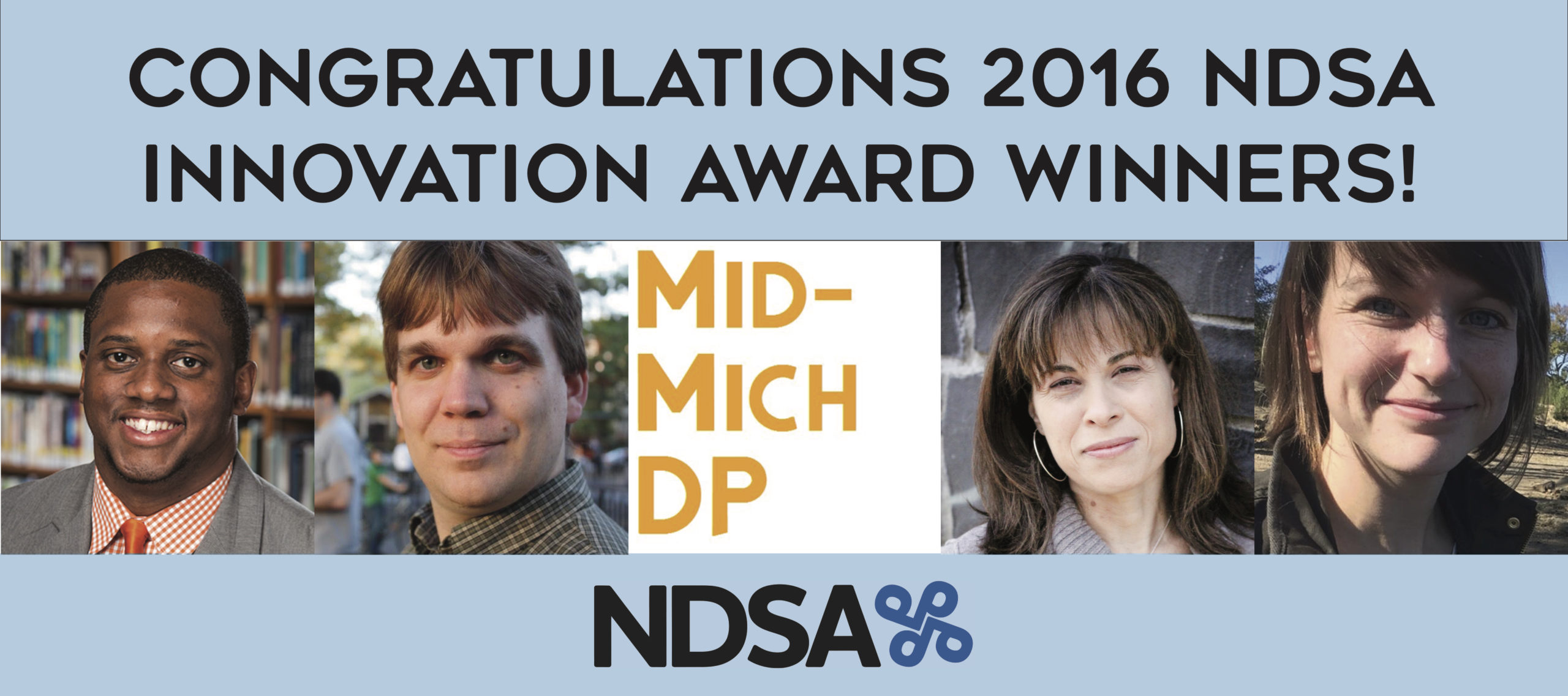
Announcing the 2016 NDSA Award Winners

We are delighted to announce the recipients of the National Digital Stewardship Alliance’s (NDSA) annual Innovation Awards!

This year, the NDSA annual innovation awards committee reviewed eighteen exceptional nominations from across the country. These awards highlight and commend creative individuals, projects, organizations, and future stewards demonstrating originality and excellence in their contributions to the field of digital preservation.

The awardees will be recognized publicly during NDSA’s Digital Preservation 2016 at the reception held the evening of Wednesday, November 9. Please join us in congratulating them for their hard work! Each of the winners will be interviewed later this year, so stay tuned to learn more about their work on our blog.


Individual Awards

Jarrett DrakeJarrett M. Drake is the Digital Archivist at Princeton University’s Seeley G. Mudd Manuscript Library, where his primary responsibilities entail managing the Digital Curation Program, describing born-digital archival collections for the Princeton University Archives, and coordinating the Archiving Student Activism at Princeton (ASAP) initiative. He is also one of the organizers and an advisory archivist of A People’s Archive of Police Violence in Cleveland, an independent community-based archive in Cleveland, Ohio, USA, that collects, preserves, and provide access to the stories, memories, and accounts of police violence as experienced or observed by Cleveland citizens. Jarrett serves on the advisory board of the StoryCorps Justice Project and Documenting the Now: Supporting Scholarly Use and Preservation of Social Media Content.

Jarrett is recognized for his work at Princeton and in the community to challenge and re-examine the practices of archiving and documenting history, particularly relating to preserving the underrepresented voices in history.

Dave RiceDave Rice is an audiovisual archivist and technologist whose work focuses on independent media, open source technical in preservation applications, and quality control analytics. He has worked as an archivist or archival consultant at media organizations like CUNY, Democracy Now, the United Nations, WITNESS, Downtown Community Television, and Bay Area Video Coalition. He is a graduate of the L. Jeffrey Selznick School of Film Preservation.

Dave is recognized for his work in advocating widely for standards and collaboration across countries and organizations as well as his work with nonprofit organizations such as Democracy Now and WITNESS.

Organization Award

The Mid-Michigan Digital Practitioners (MMDP) group is a regional collective of librarians, archivists, museum curators, conservators, historians, scholars and more engaged in creating and curating digital collections in Mid-Michigan and the surrounding region. The mission of the group is to provide an open and local forum for conversation, collaboration and networking for professionals working with digital collections in Michigan.

The MMDP is recognized for its highly original and successful organizational model in fostering innovation sharing and knowledge exchange.

Project Award

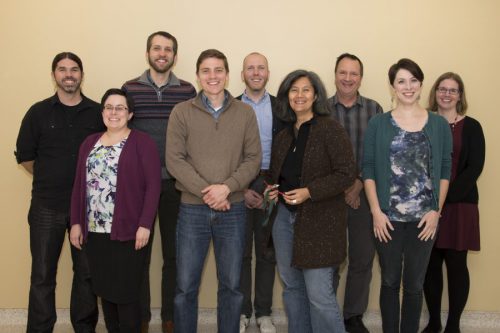
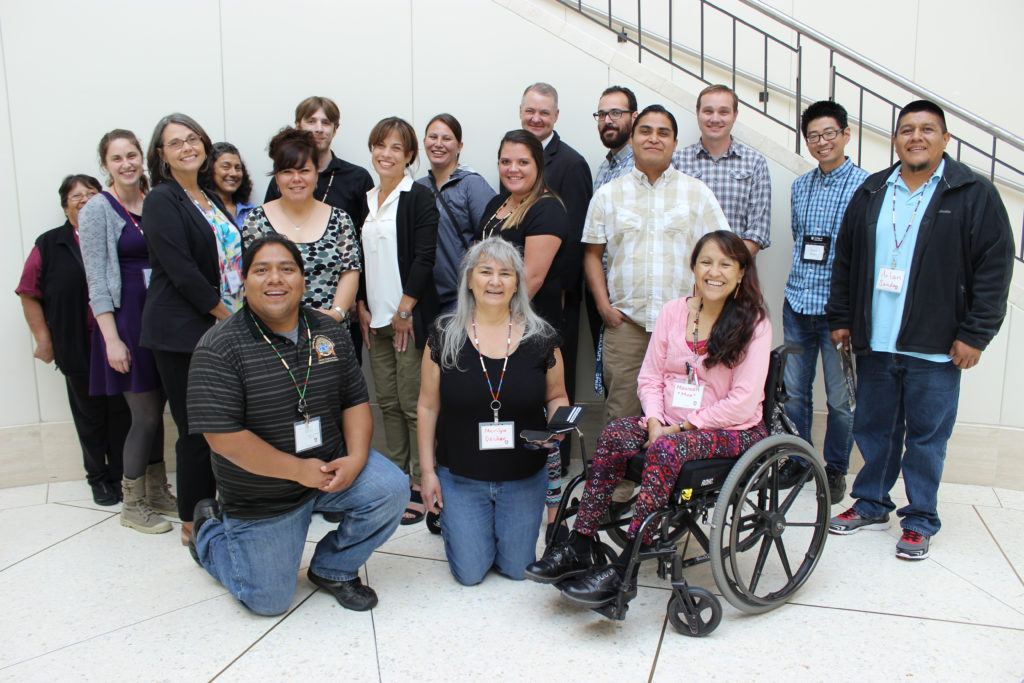
2016-2017 Cohort ClassThe Tribal Stewardship Cohort Program: Digital Heritage Management, Archiving and Mukurtu CMS Training project is a three year program targeting the unique needs of Tribal archives, libraries and museums through a cohort-based educational model emphasizing digitization and preservation of materials in culturally responsive ways. Their goal is to provide long-term educational opportunities in digital heritage management and preservation with an emphasis on flexible models and cohort-specific needs.

The project is recognized for its work in providing long-term educational opportunities in digital heritage management and preservation as well as its dedication to culturally responsive and ethically-minded practices. Kim Christen, the Director of the Tribal Stewardship Cohort Program, will accept this award on behalf of the project.

Future Steward Award

Samantha AbramsSamantha Abrams recently moved from Madison, Wisconsin, to Brooklyn, New York, where she works as the Community Archivist at StoryCorps. She is interested in web and personal archiving, digital preservation, community archives, and digital literacy. At the Madison Public Library, Samantha took the initiative to work with library staff to create its Personal Archiving Lab. The lab provides public access to equipment and instruction that allows for digitization of photos, audio and film formats in a controlled, safe and professional environment.

Samantha is recognized for her work with the Madison Public Library and its Personal Archiving Lab as well as her initiative to create innovative projects and classes.


The annual Innovation Awards were established by the NDSA to recognize and encourage innovation in the field of digital preservation stewardship. The program is administered by a committee drawn from members of the NDSA Innovation Working Group. Learn more about the 2012, 2013, 2014, and 2015 Award recipients.

Full schedules! 2016 DLF Forum & LAC Pre-Conference, Digital Preservation 2016

Thanks to the hard work of three separate program committees, CLIR/DLF staff members, countless volunteer reviewers, and the wider community who proposed sessions in response to our calls, we are very pleased to announce the programs for:

All three conference programs are available to browse now!

We hope you’ll join us in Milwaukee this November, to hear exciting keynote and plenary talks by Jarrett Drake (#dlfLAC), Stacie Williams (#DLFforum), and Bergis Jules and Allison Druin (#digipres16). (See our keynote roundup here!) We’ll also honor winners of DLF’s Community Capacity Awards and Forum fellowships, as well as 2016 NDSA Innovation Award winners!

DLF will additionally sponsor or host a number of affiliated events alongside the Forum, including the Taiga Forum, an Ally Skills Workshop brought to you by the DLF Project Managers interest group, and more.

Registration is open (while spots last), and information about the beautiful Pfister conference hotel (where rooms are going fast) is also available. Finally, if you will be away from home for our events on Election Day, please plan ahead! Full, non-partisan, state-by-state absentee voting info is here.

NDSA’s closing plenary speaker is Allison Druin!

We’re pleased to announce an exciting addition to the program for Digital Preservation 2016, co-sponsored by National Digital Stewardship Alliance and DLF, which will be held immediately following this year’s DLF Forum.

Allison Druin photo
Allison Druin

Dr. Allison Druin joins keynoter Bergis Jules as our closing plenary speaker for the conference. Druin’s talk will take up the conference theme, “building communities of practice,” in the context of “communities of innovation” and her work with America’s National Park Service–presently celebrating its 100th anniversary.

Druin is on two-year leave from her faculty appointment at the University of Maryland’s iSchool while serving as Special Advisor for National Digital Strategy at the National Park Service. Her focus there is on how to better leverage digital tools to excite the next generation of park visitors, to change how the national parks share their stories, and to better preserve our cultural and natural resources.

Druin received her Bachelors of Fine Arts from Rhode Island School of Design, her master’s degree from the MIT Media Lab, and her Ph.D. from the University of New Mexico’s College of Education. In her previous work as the University of Maryland’s first Chief of Futurist and Co-Director of the Future of Information Alliance (FIA), Druin helped establish a FIA partner network with the National Park Service, Newseum, the Smithsonian, National Geographic and other organizations to explore the opportunities and challenges of the rapidly changing information landscapes. At the University of Maryland, she has served as Director of the Human-Computer Interaction Lab, Associate Dean of Research for the iSchool, and an ADVANCE Professor for STEM Women Initiatives. Druin’s personal research has focused on developing new educational technologies for children. Druin has pioneered the development of new co-design methods that bring product-users into the technology design process. Her team of faculty, staff, and graduate students, recently engaged elementary school kids to help design digital elements of the Every Kid in a Park program; an initiative by the White House and Department of the Interior to give all fourth graders and their families free entrance to national parks. She is currently working with NPS leadership to use co-design methods to reimagine the visitor experience for the Lincoln Memorial.

An abstract for her Digital Preservation 2016 plenary talk follows:

BUILDING COMMUNITIES OF PRACTICE FOR A CULTURE OF INNOVATION

The speed of change in the digital world makes it difficult to point to just one tool, technology, or “digital infrastructure” that can support all the education, conservation, and historic preservation priorities of the National Park Service. It is that combination of data (content), software (interactivity), and device (context) that can address the priorities of NPS for the next century. It is important to remember that digital infrastructure can change more quickly than physical infrastructure. The power of digital is that it is so malleable for change, but this is also the challenge. The speed of change and the scale of impact, is unprecedented. Digital innovation makes use of a variety of new tools that can address future challenges with novel solutions. Yet, innovation can be disruptive, transformative, and can still be an achievement that leads to new shared infrastructure. Given this landscape of change and opportunity, we have to ask, how do we create communities of practice that can become true communities of innovation? How can we support workforce development, and build leadership pipelines for the digital work we must undertake? The opportunities are there, but the challenges are many when considering constrained resources, silo-ed structures of leadership, and federal regulations. I will talk about these opportunities and challenges for the next century of service.

Learn more about all of our keynote and plenary speakers for the DLF Forum, DLF Liberal Arts Colleges Pre-Conference, and Digital Preservation 2016 here.

2016 NDSA Coordinating Committee Candidates

This summer the National Digital Stewardship Alliance turns its attention to leadership renewal. We gratefully thank our outgoing working group chairs and Coordinating Committee members for their service across the transition period to our new home at the Digital Library Federation. And we are pleased to welcome new chairs for our working groups — you can learn more about all of these people on the NDSA Leadership page.

Members of the NDSA Coordinating Committee serve staggered three year terms and five members will have completed their terms, retiring as of the Fall meeting. We thank Jonathan Crabtree, Meg Phillips, John Spencer, Helen Tibbo, and Kate Wittenberg for their many contributions.

Following a public call for nominations, we are presenting to members a slate of five candidates to join the Coordinating Committee. Between now and August 15th, NDSA members will have the opportunity to affirm and endorse these candidates by vote. (One vote per member organization, with information sent via email to institutional contacts.)

Here are statements from the candidates, presented in alphabetical order:

Bradley Daigle

Bradley Daigle is currently content and strategic expert for the Academic Preservation Trust as well as cultural heritage initiatives and strategic partnerships at the University of Virginia Library. He has spent the last several years organizing and facilitating the use of enterprise preservation services. He has been PI on an IMLS grant (AIMS: An Inter-Instutional Model for Stewardship) with international partners whose goal was to create successful workflows for born digital materials. He is also governance chair of the statewide partnership, the Virginia Heritage. More at LinkedIn: https://www.linkedin.com/in/bradleydaigle

Building on the NDSA’s previous work, the future holds great promise as we grow membership and increase engagement. Expanding deep focus initiatives beyond the excellent work done with web archiving and balancing between conceptual exploration and practical implementation, the Coordinating Committee should continue to help develop digital preservation methods critical to our profession’s future. Working across the Alliance and with our co-chairs, I will advocate for the systemic changes we need to be effective stewards of our cultural heritage.

Carol Kussmann

My interest in the NDSA Coordinating Committee stems from being involved with NDSA and its various working groups from its inception. During this time of transition, NDSA needs to further develop its partnership with the Digital Library Federation (DLF) while keeping its own identity and strong foundation. The new partnership with DLF increases the diversity of NDSA’s knowledge base by introducing DLF members to the activities of the NDSA. I enjoy working with the diverse organizations (large, small, government, non-profit, for profit…) that come together in NDSA to discuss similar issues. While we will never all need the same thing, NDSA provides a place to discuss concerns, share ideas and explore solutions which is valuable to all. I would like to assist with this endeavor by serving on the Coordinating Committee.

My career with electronic records began at the Minnesota State Archive working within the National Digital Information Infrastructure and Preservation Program, the precursor to NDSA; I am now a Digital Preservation Analyst with the University of Minnesota Libraries. In this role, I work across many departments in the Libraries, and outside the Libraries through the statewide Minnesota Digital Library Program. I address current and future requirements for long-term preservation of electronic records including the areas of arches and special collection, information and data repositories, and journal publishing. As co-chair of the Electronic Records Task Force my efforts focus on developing and implementing workflows for ingesting, processing, and providing access to incoming electronic materials that are part of the Archives and Special Collections units. As an inaugural Digital Preservation Outreach and Education (DPOE) trainer, I work with Minitex to provide digital preservation training in the region on a regular basis. I am also on the Steering Committee of the Electronic Records Section of the Society of American Archivists (SAA) and teach the Arrangement and Description of Electronic Records class for SAA.

Mary Molinaro

Last year I took a position with the Digital Preservation Network (DPN) after having worked for the majority of my career as a librarian at the University of Kentucky Libraries. My tenure at Kentucky afforded me the opportunity to facilitate the transition of our collective work in managing analog collections to creating and preserving digital information. At Kentucky I had the opportunity to work in support of the development of processes for the digitization of collections and in making content available to users. I also worked internationally with libraries in Vietnam, in Tunisia (as a Fulbright Sr. Specialist) and in Ecuador (with the support of the American Embassy) to help local institutions build infrastructure to support broader access for their citizenry to digital information. While working in this digital arena I became increasingly concerned about the long term viability of the digital information on which we have become reliant. It is this concern that pushed my now long-standing interest and commitment to developing real solutions for digital preservation. I serve as an anchor instructor for the Library of Congress Digital Preservation Outreach and Education (DPOE) program and have served on the Steering Committee for that program. As Chief Operating Officer for DPN I have had the opportunity to talk with many institutions about their digital processes and hear about the issues with which they are struggling. It is my firm belief that the solutions for access, tool development, delivery, and the preservation of digital information will come faster and better in community than in isolation. I believe the NDSA has a strong role to play in helping our community work together to develop solutions that work and to create tools that will help us succeed. I would welcome the opportunity to serve NDSA in helping the organization move forward toward developing solutions that work for all.

Gabby Redwine

Since 2013 I have been Digital Archivist at the Beinecke Rare Book & Manuscript Library at Yale University, where I work collaboratively across different units at Yale, as well as with colleagues at other institutions in the US and abroad, to build a sustainable program to support the acquisition, capture, arrangement and description, preservation, and access of born-digital archival materials. I led Yale University Library’s Born Digital Working Group in the development of a vision and three-year roadmap for born-digital archival materials in Yale’s libraries and museums, which we are in the process of implementing. As co-chair of the Yale-wide Web Archiving Working Group, I worked with other group members to develop a Strategic Plan for Web Archiving at Yale and write a report that identified gaps and strategic objectives for the next two years, which we are in the process of implementing. In my capacity as chair of the Advisory Committee on Library Staff Diversity & Inclusion (2015-2016) I led the group in drafting recommendations that position civility and mutual respect training as part of a larger change framework that includes clear behavioral expectations, open communication, and accountability. I also led a joint group of administrators and diversity committee members in drafting Yale University Library (YUL) Community Values. Previously I was Archivist and Electronic Records/Metadata Specialist at the Harry Ransom Center. Recent publications include Collecting Digital Manuscripts and Archives (co-author, SAA’s Trends in Archives Practice series, forthcoming), Personal Digital Archiving (Digital Preservation Coalition, 2015), and Born Digital: Guidance for Donors, Dealers, and Archival Repositories (co-author, CLIR, 2013). I am a member of the NDSA Standards & Practice Working Group and the Society of American Archivists’ Mentoring Program Subcommittee, and have served on the program committees for iPres, DH (Digital Humanities), and the SAA Research Forum, and as a grant reviewer for NEH.

My interest in serving on the NDSA Coordinating Committee stems from my work at Yale to develop strategic vision in different areas related to the stewardship of born-digital materials. I am committed to developing initiatives and devising solutions that address the needs of libraries, archives, museums, and other organizations large and small, well-resourced and underfunded, new and well-established, traditional and ground-breaking. My strong communication, leadership, and administrative skills, as well as my experience and commitment to working collaboratively to identify gaps and solve problems, will contribute to the Coordinating Committee’s efforts to collaborate with the working groups to provide strategic leadership for NDSA.

Helen Tibbo

Dr. Tibbo is a current member of the Coordinating Committee running for re-election and is presently serving as chair of Digital Preservation 2016.

Dr. Tibbo is an Alumni Distinguished Professor at the School of Information and Library Science (SILS) at the University of North Carolina at Chapel Hill (UNC-CH), and teaches in the areas of archives and records management, digital preservation and access, appraisal, and archival reference and outreach. She is also a Fellow of the Society of American Archivists (SAA) and was SAA President 2010-2011. From 2006-2009, Dr. Tibbo was the Principal Investigator (PI) for the IMLS (Institute for Museum and Library Services)-funded DigCCurr I project that developed an International Digital Curation Curriculum for master’s level students. She is also the PI for DigCCurr II (2008-2012) that extends the Digital Curation Curriculum to the doctoral level. In 2009, IMLS awarded Prof. Tibbo two additional projects, Educating Stewards of Public Information in the 21st Century (ESOPI-21) and Closing the Digital Curation Gap (CDCG). ESOPI-21 is a partnership with UNC’s School of Government to provide students with a Master’s of Science in Library/Information Science and a Master’s of Public Administration so that they can work in the public policy arena concerning digital preservation and curation issues and laws. CDCG is a collaboration with the Joint Information Systems Committee (JISC) and the Digital Curation Center (DCC), both of the United Kingdom, to explore educational and guidance needs of cultural heritage information professionals in the digital curation domain in the US and the UK. Dr. Tibbo is a co-PI with collaborators from the University of Michigan and the University of Toronto on a National Historical Publications and Records Commission (NHPRC)-funded project to develop standardized metrics for assessing use and user services for primary sources in government settings. This project extends work that explored user-based evaluation in academic archival settings funded by the Mellon Foundation. Prof. Tibbo is also co-PI on the IMLS-Funded POlicy-Driven Repository Interoperability (PoDRI) project lead by Dr. Richard Marciano and conducted test audits of repositories in Europe and the US with the European Commission-funded ARPARSEN project during the summer of 2011.

Community Voting for DLF Forum, DLF LAC Pre-Conference, and Digital Preservation 2016

The proposals are in for our week of three great events in Milwaukee this November: the DLF Forum, the DLF Liberal Arts Colleges Pre-Conference, and Digital Preservation 2016. Now it’s time to shape the program! From June 8- June 20, proposals will be open for public voting through our brand-new DLF community voting app: voting.diglib.org.

During this period, community members will be able to review titles and abstracts, and cast votes based on their interest in seeing certain presentations as part of each of the three events. After voting closes, the program planning committees for each event will use the community’s input, in combination with results from a concurrent peer review process, to inform its decisions about the conference programs.

People who submitted complete proposals will be notified of status by early August. Presenters will be guaranteed a registration place at the Forum.

[button link=”http://voting.diglib.org/” size=”medium” bgColor=”#f8ca60″ textColor=”#ffffff” align=”center”]Vote Here[/button]

Voting Process

Anyone is welcome to vote. You will need to a create an account on voting.diglib.org. You can cast votes for as many presentations as you’d like, but only one vote per presentation. For each presentation, the proposal type is listed to the right of the “Cast Vote” button.

The title and abstract will be available for each proposal. You can toggle between the three events using the top menu in blue.

Voting closes at 11:59 pm ET on Monday, June 20.

The planning committees for each of the three events will consider community voting results (taking into account the number of community votes it has received) among other factors when making final decisions on the 2016 DLF Forum program.

Thank you for helping to inform our selection process!

call for nominees: NDSA Coordinating Committee

National Digital Stewardship AllianceMembers of the National Digital Stewardship Alliance join together to form a consortium of over 165 partnering organizations, including universities, professional associations, businesses, government agencies, and nonprofit organizations, all committed to the long-term preservation of digital information. Committed to preserving access to our national digital heritage, we each offer our diverse skills, perspectives, experiences, cultures and orientations to achieve what we could not do alone.

NDSA’s Coordinating Committee (CC) provides strategic leadership to the community in coordination with working group co-chairs. Working on the CC is an opportunity to contribute your leadership for the community as a whole while collaborating with a wonderful group of dynamic and motivated professionals. NDSA is a diverse community, working on a critical mission and we seek candidates to join the CC that bring their diverse skills, perspectives, experiences, cultures and orientations to bear on leadership initiatives.

The CC is dedicated to ensuring a strategic direction for NDSA, to the advancement of NDSA activities to achieve strategic goals and furthering communication. One example of collaborative work within the community to further communication is the production of the National Agenda for Digital Stewardship. The CC is responsible for reviewing and approving NDSA membership applications and publications;  updating eligibility standards for membership in the alliance, and other bylaws;engaging with stakeholders in the community; and working to enroll new members committed to our core mission. The CC commitment is for three years. NDSA has an annual membership meeting coordinated with the DLF Forum each fall. The CC meets at the annual meeting and via a monthly conference call.

If you are interested in joining the CC yourself, or want to nominate another member, please send the name, e-mail address, and NDSA-affiliated institution of the nominee to ndsa@diglib.org by June 15.  We particularly encourage and welcome nominations of people from underrepresented groups and sectors.

Skip to content