NISO Interview on NDSA’s 2019 Storage Infrastructure Report

Jill O’Neill, NISO Director of Content, recently interviewed Laura Alagna, Carol Kussmann, and Nathan Tallman to discuss NDSA’s recent 2019 Storage Infrastructure Report.

The 2019 Storage Infrastructure Report, released by the NDSA in late February, offers a much needed glimpse into how academic librarians are currently handling digital storage for their institutions. In another segment of the NISO Interview series, Jill O’Neill sat down with three of the report authors to discuss the findings and possible next steps.

Listen to the complete interview at NISO I/O.

2020 NDSA Agenda for Digital Stewardship Released

The NDSA Agenda Working Group is pleased to announce the publication of the 2020 NDSA Agenda for Digital Stewardship! 

The NDSA Agenda, last published in 2015, represents a complete update around current advances and needs within crucial areas of focus such as digital collections, technological infrastructure, organizational policy and practice, and research priorities. Additionally, the Agenda also builds on results from the 2018 NDSA Institutional Survey on Priority Areas in digital stewardship to better articulate key areas for building research and developing practice.

The 2020 NDSA Agenda has something for everyone: key priorities synthesized for funders, researchers, and organizational leaders, as well as actionable recommendations in key areas for practitioners and communities. 

The NDSA Agenda Working group would also like to thank the community for your role in helping to shape this Agenda by participating in the survey, serving as reviewers, and pursuing the work of digital stewardship in a variety of efforts that allowed us to research, write, and reflect on how your work moves us forward together in 2020.

Best,

The NDSA Agenda Working Group

  • Micah Altman, MIT Libraries, at the Massachusetts Institute of Technology
  • Karen Cariani, WGBH Media Library and Archives
  • Bradley Daigle, Academic Preservation Trust; University of Virginia Library
  • Christie Moffatt, National Library of Medicine (NLM), National Institutes of Health
  • Sibyl Schaefer, University of California, San Diego
  • Bethany Scott, University of Houston Libraries’ Special Collections
  • Lauren Work, University of Virginia Library

Teaching, outreach and advocacy for the NDSA Levels of Preservation

In October 2019 after several months of collaboration and hard work, the NDSA was pleased to announce the publication of version 2 of the Levels of Preservation.

A follow up blog post on the Digital Preservation Coalition blog highlighted in particular the work of the Revision Working Group and flagged up some of the main changes that were made in moving the original Levels to version 2.

Moving forward, the Levels of Preservation reboot effort was more than just the work of the Revision group. Bradley Daigle describes in ‘Levels of Preservation Reboot Overview and Update’ just how many working groups were beavering away behind the scenes and contributing to this wider community effort.

Here he summarises each group and their charge:

  1. Curatorial: craft a pre-LoP set of decisions/guidelines to allow non-technical professionals understand the implications of preservation decisions that happen in and around the appraisal of materials. These decisions could then be mapped to the organization’s implementation of the LoP.
  2. Assessment: explore the past and current use and adaptation of the LoP framework for institutional benchmarking and assessment of digital preservation readiness or as a method to review progress towards institutional preservation goals.
  3. Implementation: discover the use and adaption of the LoP framework to implement or improve digital preservation infrastructure, administration, and maintenance. Who is using the Lop, who isn’t – and why?
  4. Revision: update and add to the current themes included in the LoP (storage, fixity, migration, security, metadata, file formats, etc.).
  5. Documentation: articulate the ways in which the LoP may be transparently and publicly updated, commented on, distributed, critiqued, used, and integrated widely across many groups/sectors – nationally and internationally.
  6. Teaching, Outreach, and Advocacy: Explore the use and adaption of the LoP as a teaching tool for understanding digital preservation concepts and pragmatic use and to advocate for preservation resources.

Whilst most of these groups can now sit back, happy in the knowledge they have met their brief, there is one working group still to roll up their sleeves and start work – Teaching, Outreach and Advocacy.

Now the other elements of the reboot are complete, the task remains to provide some materials for teaching and outreach. As the resources associated with the NDSA Levels of Preservation have increased, there is an increasing need to ensure that the community knows what is available and how to make the most of it. These materials will be the fuel for encouraging advocacy by NDSA members and beyond.

A small working group is considering this issue currently and plans to come up with some training materials, presentations and an FAQ to help guide those who would like to get started with the NDSA Levels and associated materials.

Watch for a follow up from us, we will be looking for members who might be interested in reviewing this content once it’s ready so please shout if you’d like to help out with this continuation of the reboot work. We are aiming to share the finished outcomes of this work at the NDSA Digital Preservation meeting in November 2020.

Nancy McGovern – MIT
Sharon McMeekin – Digital Preservation Coalition
Jenny Mitcham – Digital Preservation Coalition

2019 Storage Survey Report Published

The NDSA is pleased to announce the release of the 2019 Storage Infrastructure Survey Report

From May 23 to June 7, 2019, the 2019 NDSA Storage Infrastructure Survey Working Group conducted a survey designed to gather information on the technologies and practices used in preservation storage infrastructure. This effort builds upon two previous surveys, conducted in 2011 and 2013. Unlike these previous iterations, however, the 2019 Storage Infrastructure Survey encouraged responses from both NDSA members and non-members, in an effort to gather a broader view of approaches to preservation storage. 

Some major takeaways from the report include:

  • The amount of preservation storage needed has continued to grow over time. Approximately 57% of respondents to the 2019 Survey indicated that they required more than 100 terabytes of preservation storage, compared to 33% and 34% of respondents to the 2013 and 2011 surveys, respectively.
  • Many are responding to increasing storage needs by diversifying their infrastructure with different types of technologies. 66% reported using storage that geographically distributes copies, and 46% reported using cloud storage. Of those using cloud storage providers, 71% said they use Amazon Web Services.
  • Preservation storage infrastructure remains a changing field. Over half (54%) of the respondents indicated that their preservation infrastructure was expected to change significantly within the next three years.

The NDSA intends for the Storage Infrastructure Survey to return to a more consistent schedule, allowing for ongoing tracking and analysis of approaches to preservation storage over time.  Interested in participating in the next Storage Infrastructure Working group? A call for group members will go out prior to the next survey year.

~ NDSA Storage Infrastructure Survey Working Group

CFPs are here! 2020 DLF Forum and Affiliated Events


combo banner

UPDATE 3/26/2020: The deadline for all CFPs has been extended to Monday, May 11, 2020. For more updates on DLF Forum & COVID-19, please see the Forum website.

It’s hard to believe, but CFP season is here once again!

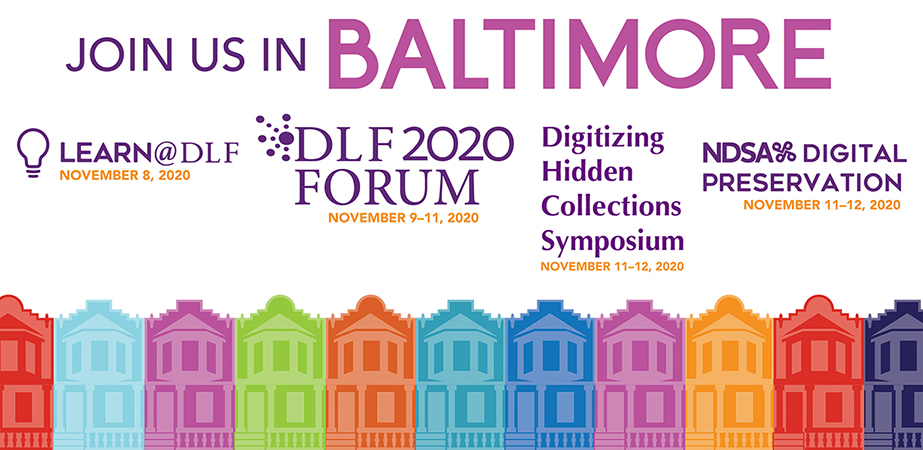
Have a great idea for a session to share at one of our events in Baltimore? You’re in luck! We have just issued Calls for Proposals for our conferences happening this November: the DLF Forum (#DLFforum, November 9-11), our Learn@DLF pre-conference (#LearnAtDLF, November 8), NDSA’s Digital Preservation 2020: Get Active with Digital Preservation (#digipres20, November 11-12), and CLIR’s Digitizing Hidden Collections Symposium (#digHC, November 11-12).

For all events, we welcome submissions from members and nonmembers alike. Students, practitioners, and others from any related field are invited to submit for one conference or multiple (though, different proposals for each, please). Please keep in mind that submissions for the Digitizing Hidden Collections Symposium should come from current or former participants in CLIR Digitizing Hidden Collections grant projects.

The DLF Forum and Learn@DLF CFP is here: https://forum2020.diglib.org/call-for-proposals 

NDSA’s Digital Preservation 2020: Get Active with Digital Preservation CFP is here: https://ndsa.org/digital-preservation-2020-cfp/ 

CLIR’s Digitizing Hidden Collections Symposium CFP is here : https://www.clir.org/hiddencollections/2020-symposium/call-for-proposals/ 

Session options range from 2-minute lighting talk sessions at DigiPres to half-day workshops at Learn@DLF, with many options in between.

New this year, we’ve put together a video with some tips for successful conference proposals. We encourage everyone to watch and incorporate these suggestions clearly into your submissions. Watch the video here: https://youtu.be/xxrIQ273q30 

[youtube https://www.youtube.com/watch?v=xxrIQ273q30&w=560&h=315]

The deadline for all opportunities is Monday, May 11, at 11:59pm Eastern Time.

This is an extension from the original deadline of April 27.

If you have any questions, please write us at forum@diglib.org, and be sure to subscribe to our Forum newsletter to stay up on all Forum-related news. We’re looking forward to seeing you in Baltimore!

French Translation of the 2013 Levels of Preservation Now Available

While all of the recent news has been about the Levels of Digital Preservation V2.0, we have an update to share about the 2013 version of the Levels.  Our colleagues from the National Library of France (BnF) have translated the original Levels of Preservation into French.  

Stay tuned for the release of the Levels of Digital Preservation V2.0 in French which more colleagues from the French watch group on formats are currently drafting!  

If you would be interested in translating the Levels of Digital Preservation V2.0 into another language please contact us at ndsa.digipres@gmail.com


La traduction en français des Niveaux de Préservation Numérique (NDSA Levels) 2013 est maintenant disponible

Bien que les nouvelles récentes concernent essentiellement les Niveaux de Préservation Numérique V2.0, nous avons une mise à jour à partager sur la version 2013 des Niveaux. Nos collègues de la Bibliothèque nationale de France (BnF) ont traduit la première version des Niveaux de Préservation Numérique en français.

Restez à l’écoute pour la sortie de Niveaux de Préservation Numérique V2.0 en français : les collègues de la cellule nationale de veille sur les formats en ont déjà une première ébauche !

Si vous souhaitez traduire les niveaux de préservation numérique V2.0 dans une autre langue, veuillez nous contacter à ndsa.digipres@gmail.com.

Welcome to 2020! News from your NDSA!

Welcome to 2020! News from your NDSA

Greetings one and all. For starters, happy (belated) new year! We have had a lot on the burners this past year and 2020 will be no different. Here are some highlights (past and present):


Governance

We took a long and deep look at our overall governance structure. But what does that mean, exactly? Well, this time last year parts of the Coordinating Committee were meeting weekly to refocus our documentation and structure of our various components: Coordinating Committee, Interest Groups, Working Groups, etc. What we realized is that though good work was getting done, there was not coordination among all the various efforts. In other words, we were missing opportunities to leverage all the great talent from our Membership. We set out to create a structure that changes all that. In 2020, you will see new, publicly available, documentation of the various groups, their charges, and their focus for 2020. This will help us be accountable to you for all the great work that is going on. Stay tuned for more information on that!


NDSA Agenda

The long-awaited Agenda will be published in Q1 2020. I want to thank each and every one of you that contributed your thoughts and feedback to it! We think it is a great representation of digital preservation practice since the last one [2015] came out.


Interest and Working Groups (IG/WG)

So much has been going on in this area that sometimes it is hard to keep track. The NDSA Leadership (Coordinating Committee, IG/WG chairs, DLF) meet monthly to keep each other up to date and accountable. Each IG/WG has its minutes available for others to review for past and present topics and research areas. We have also created a new group – The Communications, Outreach, and Publications Working Group that will be streamlining our actual products (like the Agenda, Levels of Preservation, survey results etc) as well as focusing on a new website structure. Our updated Storage Survey will also be coming out in Q1. Lots will be happening there in 2020.


Levels of Digital Preservation

Many of you have been involved in this work. The Levels of Preservation is an ongoing Working Group (chaired by yours truly) and will be rolling out updates on a more frequent basis. For 2020, the Curatorial Team will be finishing up its work and the new Training and Advocacy Subgroup will be all spun up. I want to thank all of you (there were almost 100 people) who participated on the various reboot teams—from across the globe! Version 2’s matrix and the associated Assessment tool is available with more resources coming soon. 


New Members

One of the best parts of this work is welcoming new members. We had a banner year last year with a bumper crop of new members. Here they are!

  • Clemson University
  • Illinois Institute of Technology
  • Roper Center for Public Opinion and Research (renewal)
  • University of Miami Libraries
  • University of Cincinnati Libraries
  • LIBNOVA, SL
  • University of Connecticut Library
  • The University of Washington Libraries
  • University of Louisville Libraries / William F. Ekstrom Library
  • University of the Balearic Islands
  • University of Colorado Boulder

We could always do more to highlight what each of you does and will work to do more of that in 2020.


DigiPres Conference

We had an amazing conference and turnout this past year in Tampa! Thanks to the entire planning team and DLF for all their hard work! 2020 will be held in Baltimore, 11-12 November. We hope to see you there. Keep an eye out for the CFP – coming soon!

If you are interested in learning more, participating in any part of the NDSA, let me know! Send an email to NDSA@diglib.org If you are not a member, please consider becoming one. The process is painless, I promise!


Wishing you all the best for 2020!

Bradley J. Daigle, Chair NDSA Leadership Team

Announcing Incoming NDSA Coordinating Committee Members for 2020

Please join me in welcoming the three new 2020 elected Coordinating Committee members: Courtney Mumma, Daniel Noonan, and Nathan Tallman.

Courtney C. Mumma, is an archivist and a librarian. She is the Deputy Director of the Texas Digital Library consortium, a collective of university libraries working towards open, sustainable, and secure digital heritage and scholarly communications. She has over a decade of experience in open source software development and maintenance, infrastructure support and digital preservation good practice and education.

Daniel Noonan, Associate Professor/Digital Preservation Librarian at The Ohio State University, plays a key role in developing a trusted digital preservation ethos and infrastructure at The Ohio State University Libraries (OSUL). This position contributes strategy and expertise, and provides leadership through close collaboration with faculty, staff, and other leaders in OSUL’s Information Technology, Preservation & Reformatting, Special Collections & Archives, Archival Description and Access, and Publishing and Repository Services groups. Previously, he was OSUL’s Electronic Records/Digital Resources Archivist and Electronic Records Manager/Archivist. Simultaneously, Dan was an adjunct faculty member for Kent State University, teaching an archives foundations course.

Nathan Tallman, Digital Preservation Librarian at Penn State University, coordinates policies, workflows and practices to ensure the long-term preservation and access of the University Libraries’ born-digital and born-analog collections. He advises on equipment, infrastructure, and vendors for Penn State digital content. Nathan also helps manage access systems by coordinating local practices and support for digital collections.

Members of the NDSA Coordinating Committee serve staggered terms. We thank our outgoing Coordinating Committee members, Carol Kussmann and Helen Tibbo, for their service and many contributions. We are also grateful to the very talented, qualified individuals who participated in this election.

To sustain a vibrant, robust community of practice, we rely on and deeply value the contributions of all members, including those who took part in voting.
Best wishes to all as we welcome Courtney, Dan, and Nathan to their new roles within NDSA!

~ Bradley J. Daigle, Chair NDSA Leadership Team
NDSA Creates the Communications, Outreach, and Publications Working Group

As part of our ongoing effort to be transparent and informative, the Leadership of the NDSA approved the creation of a new working group to assist with communications about NDSA activities with the NDSA membership and beyond.  We are looking for people to join in the effort!  Any interest can be expressed by completing the following form by the end of January 2020. 

Group Purpose: To develop, enhance, and refine the communications strategy with the NDSA membership. 

Group Activities: The main expected activities of the group are listed below by public facing and operational categories.  

Public Facing Activities

  • Website: Review and update website for accuracy and timely information.  Edit web pages as requested by the Leadership team.   
  • Social media: Posting to NDSA Twitter etc about NDSA and member activities, publications, etc
  • Blog: Coordinating and posting blog posts about activities, publications, etc
  • Update the shared online events and activities calendar

Operational Activities 

  • Management of Working Groups: Help monitor the processes of the multiple working groups that run on cycles (e.g. Fixity, Staffing Survey). Facilitate group timelines and work with the groups to produce their final published product. 
    • Set up a schedule of known groups that run on cycles.
    • Contact past/present co-chairs of the group prior to next iteration
    • Monitor work (if necessary)
    • Help spin group back down, collect files in NDSA google drive, 
  • Survey Coordination: There are many groups that routinely survey the NDSA membership (or greater).  This group would help coordinate the timing of these surveys across all groups so the membership is not overwhelmed with surveys. 
    • Set up a schedule of known upcoming surveys
  • Publications: This group would be responsible for managing and finalizing NDSA publications
    • Working with groups to know what publications are in the works
      • Recommendations for where/how to store working files, data sets, etc
    • Understanding the desired timeline for publication from the group and setting deadlines.
    • Putting publication into the official Publishing Template format
    • Reviewing publication (basic run through)
    • Publishing on NDSA OSF site
    • In coordination with public facing team:
      • Putting info on NDSA webpage about new publication (if appropriate)
      • Producing a blog post about new publication
      • Producing social media posts about new publication


To complete this work we are looking for individuals from NDSA member organizations to join us.  Specific roles that are needed include::

  • Social Media posters/writers
  • Blog posters/writers
  • Teams for
    • Managing working groups and their output
    • Publications Coordinator

Any interest can be expressed by completing the following form by the end of January 2020.  It is not expected that each individual will be doing all tasks – unless they choose to do so! Participating in NDSA in this manner is a great way to understand and interact with all of NDSA activities.

NDSA Announces the Levels of Digital Preservation 2.0

After over a year of hard work, the Levels of Digital Preservation Working group announces the Levels of Digital Preservation 2.0!

In 2018 the NDSA sent out a call to the larger digital preservation community asking for interest in updating the Levels of Preservation.  Response was high – 125 individuals responded! NDSA then convened the Levels of Preservation Working group, which divided up into subgroups to tackle the many areas the community wanted to see addressed in a Levels Reboot. Individuals worked with their chosen subgroups.   

The Implementation Subgroup, led by Corey Davis and Eleni Castro, surveyed the community to see how the Levels had been used in the past and what people liked and didn’t like.  This information was one of the sources used to assist with the revision of the Levels Matrix. The survey results are available on the NDSA OSF site.  

The Revisions Subgroup, led by Karen Cariani and Dan Noonan, met almost weekly for months to address the community’s needs and concerns about updating the Levels Matrix.  Their dedicated work produced the updated Levels Matrix and Implementation Guide.

The Assessment Subgroup, led by Carol Kussmann and Amy Rudersdorf, worked to further explore how the Levels had been used as an assessment.  A report of findings was published on the NDSA OSF site.  In addition, an Assessment Tool that is based on the updated Levels Matrix was created to be used as part of an assessment.  

The Curatorial Subgroup, led by Bradley Daigle and Angela Beking have a public draft available of both the visual and written components. The Curatorial work is meant to form the basis of a series of discussion and decision points around how collections materials can be mapped to the Levels and other elements within an organizations’ preservation strategy.   

The next steps are to create a subgroup to address the development of strategy and additional materials to support the Levels of Digital Preservation v2.0 educational and advocacy efforts. Please contact Bradley Daigle at ndsa.digipres [at] gmail [dot] com if you are interested in working on this or being added to the Levels of Preservation Google Group.  

Skip to content